Grandpa’s Hands

Growing up on Kellogg Street in St johns, my world felt small, safe, and beautifully anchored by the people I loved most. Just around the block on Jersey Street stood my grandparents’ small house, and just as the house I grew up in, Grandma and Grandpa’s house always felt safe and full of love.
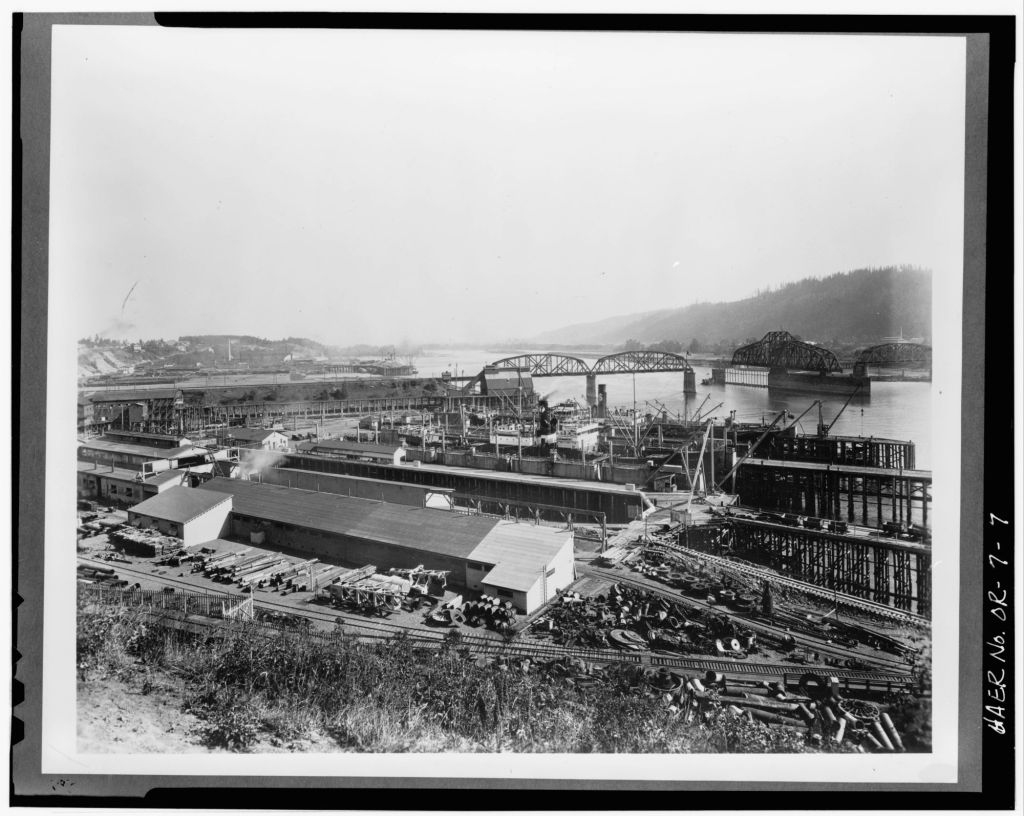
Location of the Western Cooperage Co.

Grandpa would leave every morning from his house, with his metal lunchbox in hand, He would walk to the bluffs above the Willamertte River on the well worn paths, leading to the Western Cooperage Co. It wasn’t many blocks from the house.

Work at the cooperage, as I was told, was hard, relentless work—the kind of labor that demanded everything a man had to give. The cooperage was a place of heavy timber, iron hoops, and deafening machinery, a site of true sacrifice where workers like my grandfather traded their physical strength, and sometimes even their fingers, to provide for their families. Grandpa had very few full fingers. As a young child his hands were fascinating to me.

When the workday was over and the heavy labor was done, Grandpa came home, and I’m sure, eagerly anticipating what good food Grandma had made for dinner. He must have been exhausted and famished after a day at the cooperage.

Evenings at their house were simple and comforting. The fortunate days that I found myself at Grandma and Grandpa’s house, when Grandpa came in, he was carrying his metal lunchbox, and I would look inside and invariably, he had left a treat for us kids.


I can still picture the living room, Grandpa sitting in his favorite chair, almost always with his bible draped across his knees. I know that grandpa was a believer, but it wasn’t that he lived a quiet life. He raised black labradors for hunting fowl, and he was an extraordinary hunter of other animals and he was a quintessential fisherman. I’ve heard tell of his drinking days, and I think my father took after him in every way except the bible.

I can’t even imagine the days that Grandpa had lost a partial finger or a complete finger at work. What kind of pain must he have suffered. What kind of healing had to take place for those hands to still work. What kind of courage did it take for him to get up every day after losing part of his hand and to go back to that dangerous place to work.These are things I never thought of as a child.

The machinery at the cooperage was dangerous and noisy and had no safety mechanisms. The men fed these boards into the saws to create the staves for barrels. There was the formation of the heavy metal hoops and the formation of the barrels themselves. I cannot even imagine. See the postscript for some historical notes.

Though Grandpa was very loving, I don’t really remember having conversations with him. But climbing up into his lap in his comfortable chair was a favorite place of mine. I would hold his broken hands in mine, but never ask a question about them. And he never offered an explanation. I didn’t really know what had happened to his handa until I was almost grown.

Grandpa and Grandma’s house was ffilled with familiar sounds and sights.
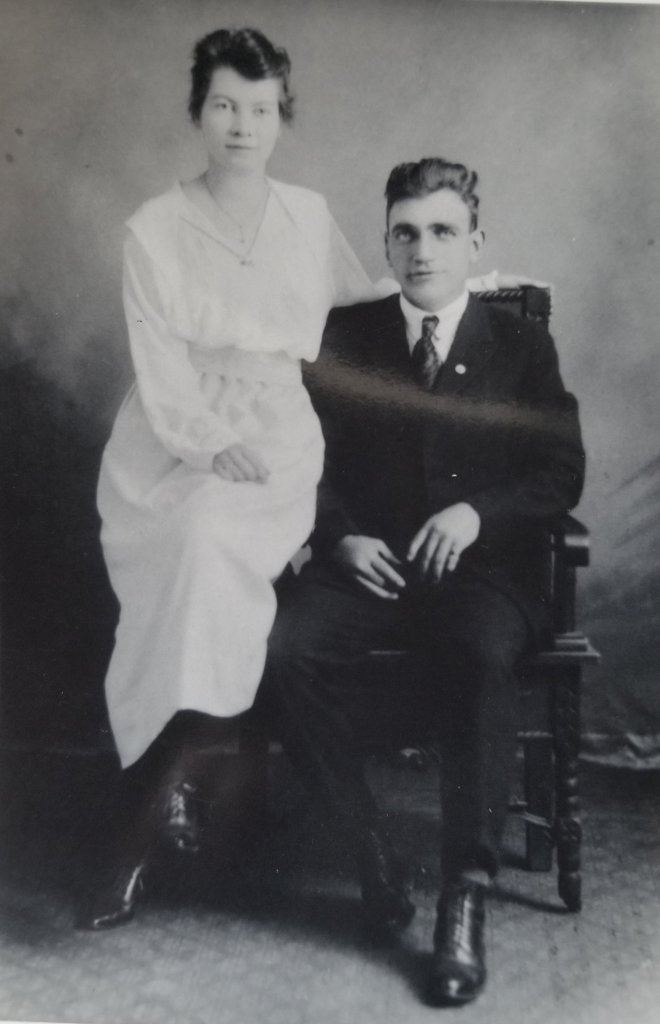
Jessie Foster Womack and
Edward Corliss Anderson

Sunday nights, without fail, Lawrence Welk and Oral Roberts, the televangelist, came on the television. After I contracted polio, it was a heavy weight on our family, yet Grandpa’s faith and love never wavered. When Oral Roberts would admonish those watching from the comfort of their homes, the television watchers, to lay their hands on those that they wanted to see healed, Grandpa would call me from my place on the couch with Grandma and he would have me sit between his slippered feet. He would place his worn, hardworking hands on my head and pray. In those moments, the hands that labored so fiercely at the cooperage became the ultimate source of tenderness, healing, and safety. Their home was a haven. Grandma and Grandpa prayed for my healing with all of their hearts with Grandpa’s hands on my head.


Postscript
The history of the Western Cooperage Company is a story of incredible industrial triumph, but it was built on the severe physical sacrifices of the men who worked the line. To achieve a massive output of 3,000 barrels a day, the factory relied on heavy, high-speed woodworking machinery that operated with completely unguarded gears, blades, and chains.
In the early 20th century, the factory floor was a landscape of immense physical risk:

* The Jointer and Stave-Bucking Machines: These used rapidly rotating, exposed steel blades to shave heavy Douglas Fir down to precise curves. A split second of fatigue while feeding the wood meant fingers could instantly catch the blades.
* Hoop-Driving Presses: These powerful mechanical winches forced the iron hoops around the wood under crushing pressure, creating notorious pinch points that could easily sever a hand.
* Exposed Belts and Pulleys: Centralized steam engines turned heavy leather belts dangling over every workstation. Without modern automatic emergency stops, a caught sleeve or stray hand would drag a worker directly into the gears.

In an era before modern safety regulations, factory owners routinely prioritized the blistering speed of the assembly line over basic physical safeguards. For the workers, losing a finger or part of a hand was a tragic, everyday risk of the trade—making the quiet endurance of men like Grandpa all the more profound.
Corrections to Grandma’s Nanny Story and Tales of Slavery in the Womack Lineage

    
In my last post, I shared a brief memory of my grandmother and the woman she always referred to as her “nanny.” I was inspired to write it after reading a troubling post on Facebook where someone recounted a family using the N-word for their household caregiver. It shook me, because in my very large family, I have absolutely no memory of anyone ever using that word. My grandmother never used it. She spoke of her nanny with fondness and respect, and that was the standard of decency she passed down to us.

However, as a professional archivist, I know that oral family histories are beautiful but imperfect things. They have a way of compressing time, blending generations together until the timelines blur.

Shortly after publishing that post, I received a note from my dad’s cousin, Carolyn. She is the oldest living relative of that generation, and she is wonderful at keeping our history straight. Carolyn gently pointed out a major flaw in my timeline: because slavery was abolished in 1865, and my grandmother was born well after that, she could not have had an enslaved nanny.

Carolyn was entirely right about the timeline. The woman my grandmother remembered so fondly from her childhood in Kentucky was undoubtedly a hired domestic servant or worker.

But Carolyn’s correction got my archivist wheels turning. While the nanny of my grandmother’s youth was free, I knew the stories I grew up hearing about our ancestorstoal tales of vast tobacco crops and prized racehorses in Greenup County, Kentucky. My historical intuition told me that an operation of that scale required a massive amount of manual labor. I decided to dig into the archival records to see exactly what kind of world my grandmother’s people came from.

What I found was a heavy, complex history.

The Womack line in Kentucky was established by my great-great-great-grandfather, James Tignal Womack, who moved his family and his wealth from Prince Edward County, Virginia, to the Little Sandy River around 1812. When he passed away in 1827, his will divided twenty-three enslaved individuals among his heirs.

His son, Archer Tignal Womack, settled in Oldtown, Greenup County. The federal slave schedules show that he held eleven enslaved people in 1850 and seven in 1860. In the hilly terrain of eastern Kentucky, owning that many people made him a substantial slaveholder. This labor force directly matched the stories of large-scale tobacco farming and horse breeding.

Because Greenup County sat right on the Ohio border, it was a hotbed for the Underground Railroad. Local newspapers from January 1859 even document a “panic among the slaveholders” after two young enslaved men successfully escaped from Archer Womack’s farm, prompting him to sell others further south for security.

My great-great-grandfather, William Archer Womack, grew up directly inside this environment. When the Civil War broke out, he held intense Southern secessionist sympathies. He was eventually arrested by Union forces, treated as a prisoner of war, and sent north to Camp Chase, a notorious military prison in Columbus, Ohio, before returning home to Oldtown as a businessman after the war.

Discovering this census and military data didn’t change the timeline Carolyn corrected, but it gave the story a much deeper meaning.

My grandmother was raised by people who had actively participated in, profited from, and fought to defend the slaveholding South. Yet, somewhere along the way, she made a choice. She broke the cycle of prejudice. She refused to carry the dehumanizing language of that era into the ears of her children and grandchildren.

“From dust we came, and to dust we will go”, she oft-repeated. and perhaps it is in recognizing our shared dust that my grandmother found her grace. The woman she loved as a child may have been a hired servant rather than an enslaved nanny, but the true miracle of the story is that my grandmother chose to look backward at her family’s history, and then chose to walk forward with love.

I will be bringing a great deal more history in subsequent posts. Stay tuned if you dare.

In bringing this historical documentation to light, I have gratefully utilized AI as a digital tool and editorial assistant to help research, structure, and refine the narrative. However, the intellectual framework, the emotional weight, and the driving motivation behind this work are entirely my own. This remains, above all, a direct reflection of my own voice and my deeply personal desire to ensure this history is remembered.

Memories of The Little House

I remember the smell of The Little House. It smelled a little like dirt and mildew and of the oil stove sitting in the far corner of the tiny front room. The house smelled of cooking, it smelled of the bathroom, it smelled of every kind of flower growing in the yard… and it smelled of welcoming.

I wish Grandma and Grandpa were still alive so that I could ask them about the origin of the little house. All I know is that it was a converted single-car garage that sat just back from the house, creating the border on the east side of Grandma’s beautiful yard.

Just behind the little house was the large burning barrel hidden by vines, accessible through a small opening, creating a small space that was always cool on the hottest summer days, a perfect place for us children to hide, as well as spiders and garter snakes.

Grandpa had closed off the garage door. It wasn’t even discernible that the tiny house had at once been a garage. Instead, he opened two doors, one at the front side of the garage, and one at the back end of the garage, both opening into the garden. Wooden panel doors had been installed as well as wooden screen doors so that as we went in and came out, the screen doors would slam shut with a familiar bang. All the time the adults would yell at us kids… ” don’t slam the door”, they would shout.

He built a wall separating the living/bedroom space from the kitchen and divided off a small square room beyond the kitchen for the toilet.

The first room one entered was just large enough for a full-size bed, an overstuffed chair, a dresser, and a small wardrobe with an oil stove in the far corner. Built into the wall was a door opening into the kitchen. If memory serves me, the living/bedroom space and the kitchen were approximately the same size.

The kitchen served well. There was a white metal cabinet with storage and a sink. Just across from that, was a yellow Formica table with two matching chairs that served for food preparation, for eating, for writing letters, or for having friends and family over for coffee and maybe a good gossip fest. Beside the sink, Grandpa built a small pantry. On the back wall stood the stove and beside that a small refrigerator. In the wall closest to the back door, Grandpa built what I will call a toilet room because that was all that was in there. It was all there was room for.

In each room, Grandpa had built a window overlooking the garden, except in the bathroom, where one looked out into the shady, cool space where the burning barrel sat.

The entire little house was covered in wooden shingles painted a warm green. Eventually, a beautiful vine grew over the house whose leaves turned a brilliant red in the fall.

I don’t know if Grandpa foresaw or knew or already had a reason for converting the garage into the little house. I’ll never know. But what I do know is that every member of our immediate family, at one time or another, lived in the little house… except for me.

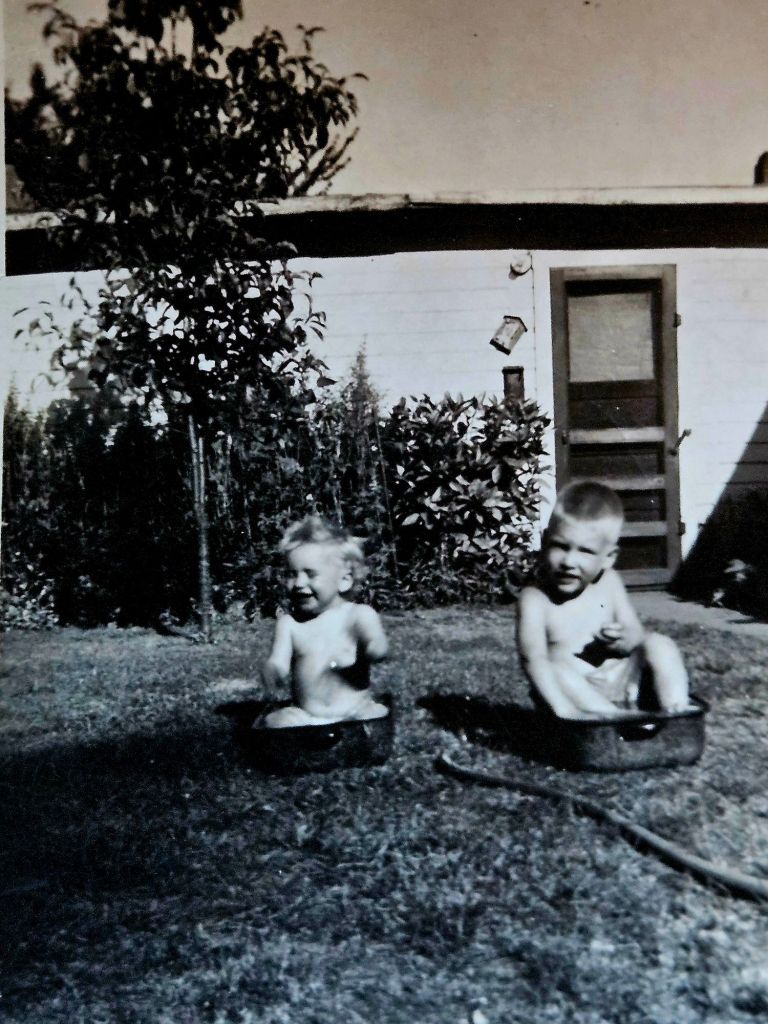
Me and my brother Steve at the front door of  The Little House

I have photographs of Mom and Dad living there. Then there was Auntie Wilma with her first husband, Bob and then with her second husband, Jim. Next, I think it was my brother and his first wife, Patty. Then there was my sister Kristi with her first husband Mark, and then I think there was my cousin Jeff and his wife Gloria or maybe he lived there alone.

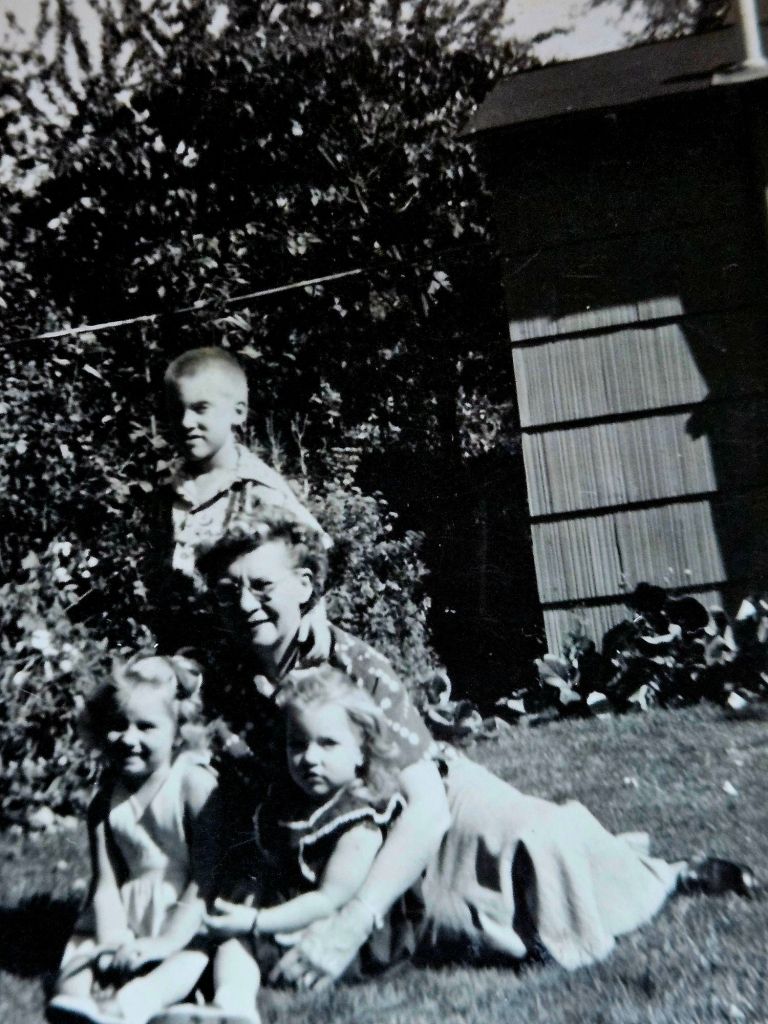
Steve, Grandma, me, and my sister Kristi, near the entrance to the cool corner where the burning barrel stood

Babies and memories were made in the little house. Steve was conceived and born there, and I believe I was, too. Steve has five children, one of them might have been conceived there and Kristi has seven, and I know that at least one must have been conceived there. If that little house could talk, I know the secrets to be told would surprise and maybe even shock us all.

I wonder if Grandpa had foreseen that he would provide a small but cozy home for so many of us as each was building their family. Whether he knew it or not, that’s exactly what he did.


P.S. My dad’s cousin, Carolyn, just wrote to me after reading this story to tell me that Grandpa converted the garage for Grandma’s mother, Ida Bell Gilbert Womack. Great-grandma died in 1947. That means Mom and Dad moved into the little house the year that my brother was born, almost immediately when the little house came vacant. For me, another gap in the family history is solved.