Growing up on Kellogg Street in St johns, my world felt small, safe, and beautifully anchored by the people I loved most. Just around the block on Jersey Street stood my grandparents’ small house, and just as the house I grew up in, Grandma and Grandpa’s house always felt safe and full of love.
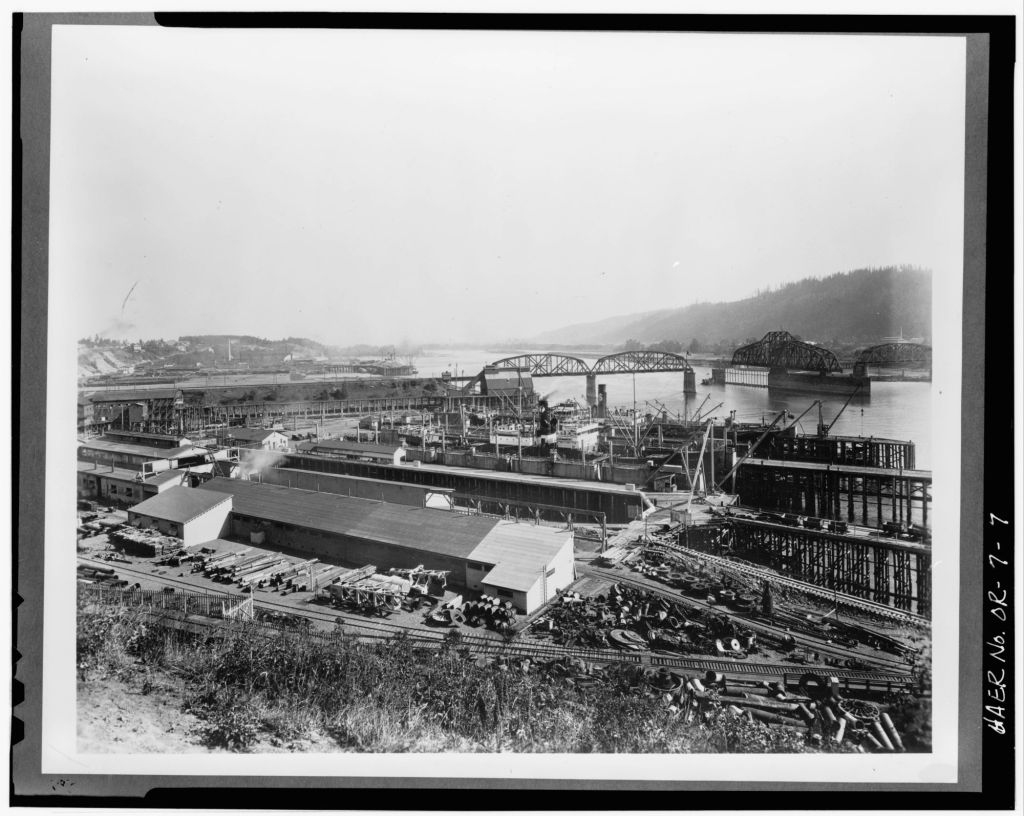
Location of the Western Cooperage Co.
Grandpa would leave every morning from his house, with his metal lunchbox in hand, He would walk to the bluffs above the Willamertte River on the well worn paths, leading to the Western Cooperage Co. It wasn’t many blocks from the house.
Work at the cooperage, as I was told, was hard, relentless work—the kind of labor that demanded everything a man had to give. The cooperage was a place of heavy timber, iron hoops, and deafening machinery, a site of true sacrifice where workers like my grandfather traded their physical strength, and sometimes even their fingers, to provide for their families. Grandpa had very few full fingers. As a young child his hands were fascinating to me.
When the workday was over and the heavy labor was done, Grandpa came home, and I’m sure, eagerly anticipating what good food Grandma had made for dinner. He must have been exhausted and famished after a day at the cooperage.
Evenings at their house were simple and comforting. The fortunate days that I found myself at Grandma and Grandpa’s house, when Grandpa came in, he was carrying his metal lunchbox, and I would look inside and invariably, he had left a treat for us kids.
I can still picture the living room, Grandpa sitting in his favorite chair, almost always with his bible draped across his knees. I know that grandpa was a believer, but it wasn’t that he lived a quiet life. He raised black labradors for hunting fowl, and he was an extraordinary hunter of other animals and he was a quintessential fisherman. I’ve heard tell of his drinking days, and I think my father took after him in every way except the bible.
I can’t even imagine the days that Grandpa had lost a partial finger or a complete finger at work. What kind of pain must he have suffered. What kind of healing had to take place for those hands to still work. What kind of courage did it take for him to get up every day after losing part of his hand and to go back to that dangerous place to work.These are things I never thought of as a child.
The machinery at the cooperage was dangerous and noisy and had no safety mechanisms. The men fed these boards into the saws to create the staves for barrels. There was the formation of the heavy metal hoops and the formation of the barrels themselves. I cannot even imagine. See the postscript for some historical notes.
Though Grandpa was very loving, I don’t really remember having conversations with him. But climbing up into his lap in his comfortable chair was a favorite place of mine. I would hold his broken hands in mine, but never ask a question about them. And he never offered an explanation. I didn’t really know what had happened to his handa until I was almost grown.
Grandpa and Grandma’s house was ffilled with familiar sounds and sights.
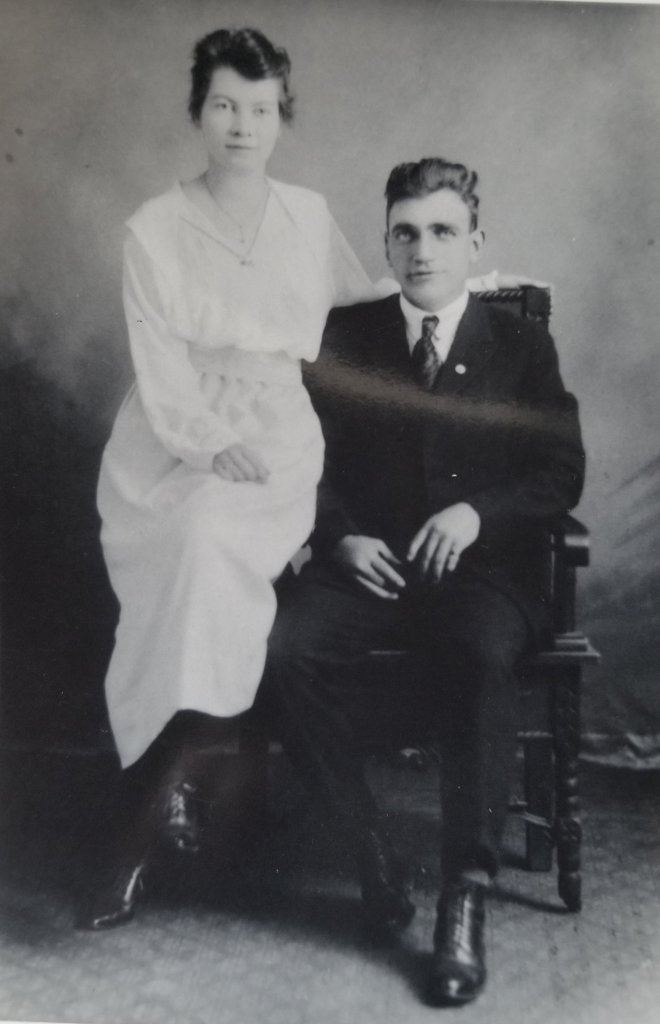
Jessie Foster Womack and Edward Corliss Anderson
Sunday nights, without fail, Lawrence Welk and Oral Roberts, the televangelist, came on the television. After I contracted polio, it was a heavy weight on our family, yet Grandpa’s faith and love never wavered. When Oral Roberts would admonish those watching from the comfort of their homes, the television watchers, to lay their hands on those that they wanted to see healed, Grandpa would call me from my place on the couch with Grandma and he would have me sit between his slippered feet. He would place his worn, hardworking hands on my head and pray. In those moments, the hands that labored so fiercely at the cooperage became the ultimate source of tenderness, healing, and safety. Their home was a haven. Grandma and Grandpa prayed for my healing with all of their hearts with Grandpa’s hands on my head.
Postscript The history of the Western Cooperage Company is a story of incredible industrial triumph, but it was built on the severe physical sacrifices of the men who worked the line. To achieve a massive output of 3,000 barrels a day, the factory relied on heavy, high-speed woodworking machinery that operated with completely unguarded gears, blades, and chains. In the early 20th century, the factory floor was a landscape of immense physical risk:
* The Jointer and Stave-Bucking Machines: These used rapidly rotating, exposed steel blades to shave heavy Douglas Fir down to precise curves. A split second of fatigue while feeding the wood meant fingers could instantly catch the blades. * Hoop-Driving Presses: These powerful mechanical winches forced the iron hoops around the wood under crushing pressure, creating notorious pinch points that could easily sever a hand. * Exposed Belts and Pulleys: Centralized steam engines turned heavy leather belts dangling over every workstation. Without modern automatic emergency stops, a caught sleeve or stray hand would drag a worker directly into the gears.
In an era before modern safety regulations, factory owners routinely prioritized the blistering speed of the assembly line over basic physical safeguards. For the workers, losing a finger or part of a hand was a tragic, everyday risk of the trade—making the quiet endurance of men like Grandpa all the more profound.
In my last post, I shared a brief memory of my grandmother and the woman she always referred to as her “nanny.” I was inspired to write it after reading a troubling post on Facebook where someone recounted a family using the N-word for their household caregiver. It shook me, because in my very large family, I have absolutely no memory of anyone ever using that word. My grandmother never used it. She spoke of her nanny with fondness and respect, and that was the standard of decency she passed down to us.
However, as a professional archivist, I know that oral family histories are beautiful but imperfect things. They have a way of compressing time, blending generations together until the timelines blur.
Shortly after publishing that post, I received a note from my dad’s cousin, Carolyn. She is the oldest living relative of that generation, and she is wonderful at keeping our history straight. Carolyn gently pointed out a major flaw in my timeline: because slavery was abolished in 1865, and my grandmother was born well after that, she could not have had an enslaved nanny.
Carolyn was entirely right about the timeline. The woman my grandmother remembered so fondly from her childhood in Kentucky was undoubtedly a hired domestic servant or worker.
But Carolyn’s correction got my archivist wheels turning. While the nanny of my grandmother’s youth was free, I knew the stories I grew up hearing about our ancestorstoal tales of vast tobacco crops and prized racehorses in Greenup County, Kentucky. My historical intuition told me that an operation of that scale required a massive amount of manual labor. I decided to dig into the archival records to see exactly what kind of world my grandmother’s people came from.
What I found was a heavy, complex history.
The Womack line in Kentucky was established by my great-great-great-grandfather, James Tignal Womack, who moved his family and his wealth from Prince Edward County, Virginia, to the Little Sandy River around 1812. When he passed away in 1827, his will divided twenty-three enslaved individuals among his heirs.
His son, Archer Tignal Womack, settled in Oldtown, Greenup County. The federal slave schedules show that he held eleven enslaved people in 1850 and seven in 1860. In the hilly terrain of eastern Kentucky, owning that many people made him a substantial slaveholder. This labor force directly matched the stories of large-scale tobacco farming and horse breeding.
Because Greenup County sat right on the Ohio border, it was a hotbed for the Underground Railroad. Local newspapers from January 1859 even document a “panic among the slaveholders” after two young enslaved men successfully escaped from Archer Womack’s farm, prompting him to sell others further south for security.
My great-great-grandfather, William Archer Womack, grew up directly inside this environment. When the Civil War broke out, he held intense Southern secessionist sympathies. He was eventually arrested by Union forces, treated as a prisoner of war, and sent north to Camp Chase, a notorious military prison in Columbus, Ohio, before returning home to Oldtown as a businessman after the war.
Discovering this census and military data didn’t change the timeline Carolyn corrected, but it gave the story a much deeper meaning.
My grandmother was raised by people who had actively participated in, profited from, and fought to defend the slaveholding South. Yet, somewhere along the way, she made a choice. She broke the cycle of prejudice. She refused to carry the dehumanizing language of that era into the ears of her children and grandchildren.
“From dust we came, and to dust we will go”, she oft-repeated. and perhaps it is in recognizing our shared dust that my grandmother found her grace. The woman she loved as a child may have been a hired servant rather than an enslaved nanny, but the true miracle of the story is that my grandmother chose to look backward at her family’s history, and then chose to walk forward with love.
I will be bringing a great deal more history in subsequent posts. Stay tuned if you dare.
In bringing this historical documentation to light, I have gratefully utilized AI as a digital tool and editorial assistant to help research, structure, and refine the narrative. However, the intellectual framework, the emotional weight, and the driving motivation behind this work are entirely my own. This remains, above all, a direct reflection of my own voice and my deeply personal desire to ensure this history is remembered.
Family Beach Trip: From left, back row: Dad, Mom (Kristi in Mom’s arms) Grandma, Grandpa; Front row: Steve, Me
When I was a young girl, my grandma was everything to me. She was Dad’s mom. I never knew Mom’s mother because she passed away before Mom even had a chance to grow up.
Even though she lived just around the block, I had to go and stay with her as often as I was allowed, and I was always allowed because my parents knew the special things that Grandma and I had together.
I think Kristi and Steve were too busy to spend much time at Grandma’s house unless it was a family affair. Grandma used to say that Kristi wanted to spend the night but once it started to get dark, she wanted to go home.
Sometimes we just sat on the front porch steps and watched the world go by or at night we looked up at the stars until I was too tired to stay awake any longer. On either side of the porch were large Mollis Azaleas, one a dusky yellow and the other a coral orange. The sloped grassy yard was green and weedless, because Grandma pulled up dandelions on her hands and knees, never having to use weed killers. Grandma never asked me to pull weeds with her, but I wanted to because I wanted to be near her and I wanted to do everything that she did.
When I was old enough, I could count on getting to go to Ralph’s grocery store by myself. It was just about a block and a half away but it always felt like an adventure. The store was small but held everything a person could want. Ralph was the owner but also a butcher. I remember well the glass-fronted coolers filled with fresh and luscious-looking meats and the smell of house cleaning products on the other side of the store. One could buy laundry detergent and that night’s dinner at Ralph’s.
Ralph knew all of the neighborhood families. As children, we could always ask for beer or cigarettes to take home. Those were the days when kids, I think, were more trustworthy. Grandma occasionally smoked a cigarette. Nobody wanted her to smoke and she never smoked in front of anyone, but she would ask me to bring a certain brand of cigarette to her sometimes. I don’t think I cared. I think I was fascinated by this sweet gentle white-haired woman in a dress or housecoat, smoking a cigarette.
Grandma didn’t can or make fresh cookies but she always had canned applesauce and pork and beans in the metal. cupboard by the sink. In the top drawer of that cupboard, she had store-bought waffle cookies or oatmeal cookies. Grandma was a really good cook as Thanksgiving dinner attested, but dinner at Grandma’s regularly for me was hot dogs and pork and beans and applesauce.
Company dinners might include potato salad, crab or shrimp louis’, fried chicken, and fresh baked dinner rolls. Sometimes chili, navy beans and hamhocks, meatloaf and mashed potatoes and gravy. and the like.
Grandma made a special dessert that, as far as I was concerned, she didn’t bake often enough. She made a cinnamon roll dough, rolled up apples and sugar and cinnamon on the inside. Then she made a sweet syrup that she poured over the top and put it in the oven to bake until it was sticky and delectable. She served it in shallow bowls and poured sweet cream on top.
Summertime meant watermelon. And I mean watermelon. Not those weak, sickly small watermelons that you find outside of the supermarkets in bins touting proudly, “seedless”. They actually should always write on the sign, “seedless and tasteless”. No, these were watermelon, the size of a small child full of plump black seeds. These were so sweet and full of water that on the hottest days they would quench your thirst. Grandma and I could almost eat a whole one of an afternoon, spitting the seeds into the freshly turned dirt in hopes of growing a watermelon.
Grandma grew up in Kentucky on a plantation. Ohh, the stories that she would tell. She said that in the summertime they’d carry a knife and any watermelon growing out from underneath a fence on the side of the road was fair game. So she knew how to pick a watermelon. I don’t remember her ever saying, “oh, this one is mealie, or this one is dry or this one is tasteless.” Every watermelon that she picked was perfect.
In the late afternoon or in the evening, Grandma would sit on one end of the couch, and I would lie on the other with my feet in her lap. Lying there on the couch, Grandma would peel oranges… as many as I wanted, even five in a row. We’d watch TV, especially the Lawrence Welk show every Saturday, or was it every Sunday? I don’t remember but we never missed it. Grandma would always say, about every man on television that he was a good Christian.
When Grandpa was still alive, they used to watch Billy Graham and Oral Roberts and pray for my arm to get better. Since I had polio, when I was only five years old, the deltoid in my right arm never recovered. When one of the two of those preachers came on the TV, Grandpa would have me sit on the floor between his feet and he would lay hands on my shoulder and pray with the preachers for me to be healed. It didn’t work, but they never gave up, always true believers.
Before Grandpa died, he was a cooper. Like a lot of men who worked with wood and saws that had no safety features, he was missing most or part of every finger. Grandma packed him a lunch every day. I don’t know how he knew that us kids would be at his house when he got home from work, but it never failed that he left us something in that metal lunch box every time. He was a loving family man, a hunter and a fisherman who had black labs. But that’s a different story.
Grandma had a high four poster bed in her small bedroom. Her sheets and pillowcases were always crisp from hanging on the line outside in the summer or on the line strung up in the basement with the large oil furnace for heat. We’d talk until I fell asleep. I never kept a secret from Grandma and as I began to drift off if I heard a siren, my first thought was that my Mom and Dad and Kristi and Steve and Gypsy were safe at home. That was ever my only worry because I felt safe with Grandma.
On top of the high boy dresser was a photograph of Dad in his army uniform when he was only 18, drafted into the army to fight in World War II. I can only imagine Grandma praying and crying while Dad was overseas in the Philippines.
On another dresser was a brush and a handheld mirror and Grandma’s favorite creme perfume, Avon’s Roses Roses. Inside the top drawer was the forbidden Pond’s Cold Cream. When I was young, I had very sensitive skin and if the cold cream even came near me, I would break out in a rash. But after a bath in the big claw foot bathtub, I would go into the bedroom and slather on Pond’s Cold Cream all over my face. I wanted to look and smell just like Grandma. When I went home or if Mom came to pick me up, and my face was red and swollen, she would scold Grandma for letting me use her lotions. But Grandma was innocent, she could deny me nothing.
As I grew up, when Grandma took a bath, I’d wash her soft white back that bent to help any person in need. She worked as a nurse’s aid in the nursery at St. Vincent’s Hospital, taking care of the little newborn babies. She loved and cared for the family. She cared for her neighbors. When Grandpa had a stroke, she took care of him. Though, I always thought of Grandma as strong yet tender, I mostly thought of her as an angel.
One of my favorite times at grandma’s houses, was when her sisters came over for coffee. They sat in the kitchen nook around the formica table, chatting, eating cookies and drinking coffee from Grandma’s special cups. She had Fiesta Ware and some other set that had a plaid motif. My favorite color in the Fiesta Ware, was indigo blue. But my coffee was more milk and sugar than coffee. As I sat and listened to them talk, i understood nothing but I felt like I was one of the grown-ups. Eventually, I’d lose interest or run out of coffee and go outside to play in the summer or onto the couch to read in the winter.
I loved sitting in the nook. Above the windows over the built in bench, hung the crab shaped plates that Grandma took down when she made her crab and shrimp louis’. And in Grandpa’s sweet and thoughtful ways, he built a long, narrow window with glass shelves, along side the back door where grandma kept knick knacks that shone in the sun.
Grandpa had transformed the back porch into that kitchen nook, and created a bedroom in the back of the house. As I grew older and bigger, I sometimes slept in the back room. Grandpa had built a niche in the wall and it was filled with paperback books, written by authors like Zane Gray, and other Western authors, there were also, National Geographics, and condensed versions of the Reader’s Digest.
In that long “Back Bedroom”, as we called it, was where Dad and Auntie Wilma had their bedrooms. At either end were matching single beds with a lamp over the head of the bed for reading. I remember only one dresser, but there must have been two and there was not a closet. This is where they grew up in this small but loving house.
Growing up, Thanksgivings were always at Grandma and Grandpa’s house. There was no dining room as such, but the large dining table was open to its full length at the end of the living room to accommodate us all. The front door had Grandpa’s unique signature. He had inserted a ship’s porthole in the heavy wooden door in contrast to the beautiful leaded windows in the rest of the room.
One accessed the basement from outside the house and down narrow cement stairs that led down to the dark unfinished basement that held the enormous oil furnace with octopus-type arms rising to meet the vents in the floor above it. When the furnace fired up, you could hear it ignite and the large fan blowing hot air up into the house. It was a comforting sound. Grandma’s favorite setting on the thermostat was 80°. That was just perfect for the two of us. I still like to have a very warm house in the winter.
I can recall the smell of the dirt floors in the basement and the oil tank and the dampness. I remember the cobwebs with spiders and the yellow boxes of “Slug Be Gone” with pictures of slugs on the front and warnings on the back. And the long tubular boxes of rose fertilizer. To Grandma, her flowers were precious, as was the large Dutch Elm tree that shadowed one side of her yard.
Years after I was grown, the tree got the dreaded Dutch Elm disease and it failed and had to be removed. To me Grandma’s backyard was never the same. The yard’s salvation was the large Mountain Ash, which fed the birds it’s brilliant red berries. When Grandpa built the bedroom and the nook on the back of the house, he and Grandma planted beautiful hydrangea bushes that grew to almost the roof line. There in the north facing shade of the house, the hydrangeas thrived in wet dirt that always had a bit of green moss growing. When those were removed to accommodate a cement, patio, it broke Grandma’s heart.
When Grandma and I would wake in the morning, we would sit at the table in the nook and watch the birds in the bird bath. I think this was Grandma’s favorite activity. And because Grandma loved it so, it became my favorite activity, as well. It still is. When we were at grandma’s house, her backyard. was our playground.
All summer long, we played in the sprinkler, running in the soft thick green grass. There were bouncy metal chairs and a wooden lounge with a thick heavy rust colored cushion and a large wooden picnic table.
There was always in abundance, applesauce and hot dogs that we could eat anytime we wanted, and cans of Pork and Beans and packaged oatmeal cookies, or the kind that were like rectangular crunchy waffles and cream frosting layered in between. If any of the family stopped by for just a minute or two, she insisted on one taking a paper bag with a package of hot dogs and cans of pork and beans and applesauce. She couldn’t stand the thought of any of us being hungry.
In my heart and mind there was never anyone better than Grandma.
I was going to save this for a different blog post, but I’ll just mention it here. Grandma and I mourned the tragic death of my dad, her son together. Dad died in a car accident at the young age of 51. For the rest of her life, grandma never quit saying that children should never die before their parents. For months I never stopped chanting “no”. I was 9 months pregnant. Our entire family was devastated. We were profoundly changed by this event. Perhaps Grandma more than anyone. But in many ways she was my solace.
One day Grandma died. Some boys accosted her, knocking her down on the street as she walked to the store. They stole her purse. She was never the same after this. It wasn’t the fall. It wasn’t about the money. But paranoia set in. It was her identification. They knew where she lived. Now, most often her blinds were closed. Her doors that were always open were locked. She stopped walking to the store alone. Eventually dementia set in.
Auntie Wilma and mom alternated staying with her, so she was able to stay in her home until she passed away. Eventually, she thought she was being kept against her will at the neighbor’s house. She worried constantly that she needed to be home to fix meals for her family.
I won’t say that this was easy for me. The last time I saw her alive, she was sitting in her chair in the living room. She wanted some assistance to get up. I walked over to her, reached out taking her arm and her hand and gently tried to help. Suddenly, she yelped like an injured animal and cried out, “I never thought you would hurt me and now you’ve broken my arm”. Of course, she was not injured in any way, but this hurt more then I could ever have imagined. To this day, I feel those words as though it happened yesterday. Of course, I know that this was the dementia talking, but between grandma and I, there had never been a crossword spoken between us.
I never saw her again after that day. I couldn’t bear to see my dear grandma crying. I have the memories. I think sometimes I can smell her Avon Roses, Roses, cream perfume and Ponds cold cream. I sometimes think I can feel her soft hands and hear her gentle voice. I wish I could sit in her garden again. I wish I could feel her strong arms around me once again. And I wish I could wash her back once more.