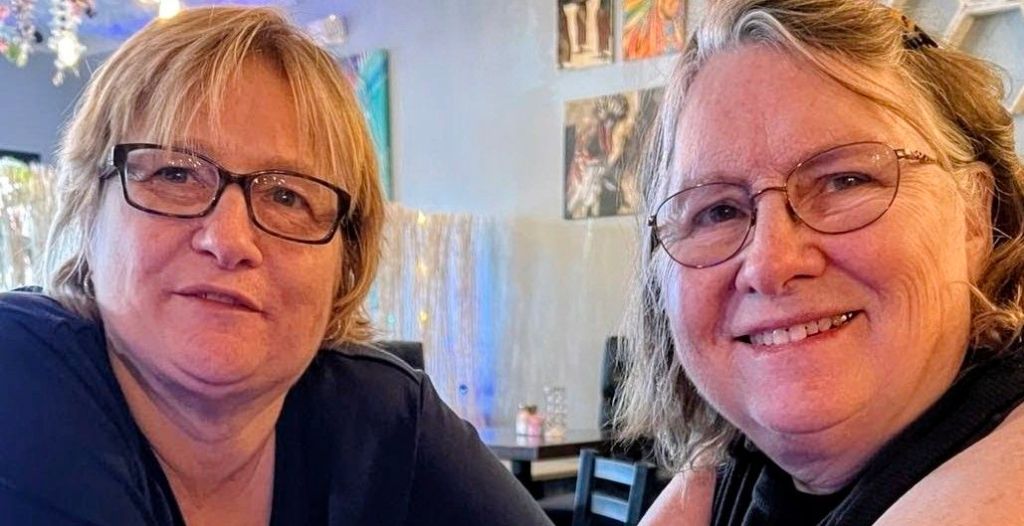
My annual visit to my daughter and her wife in Phoenix, Arizona, started out with me worried that my hip injury and my bad back wouldn’t allow me to have the kind of visit that we like to have… exploring. A week before arrival, Tracy asked me what my activity level would be like. My response was that my activity level would be at zero to nothing. As it turned out, nothing could have been more wrong.
In the early evening, Tracy met me at the airport in her giant 4×4 Ford pickup. From my first visit ten years ago, I had to use a two-step stool to get into the cab. I knew it would be no different and my expectations were high that I would be able to navigate this first obstacle with a strained hip flexor. But in reality my only expectation was pain. But to my surprise, it wasn’t that bad at all.
Then, we were off to pick up Kelly to have phò at one of their favorite places. Something I’ve learned over the years is about their love of cuisine from around the world. There’s nothing like Phoenix to supply that. I love that they will travel long distances to have the food they want or to explore new places. I was not disappointed. Phò and Thai tea filled the bill.
Saturday
In the morning was breakfast at Matt’s Big Breakfast with the usual, eggs and bacon. Then, it was off to a couple of bookstores. This is without question, a constant when I visit. Both Kelly and Tracy are avid readers. Their living room is set up like a library with wall to wall bookshelves, as is the office and any other spare space, like in the family room closet. I bought three books and Tracy bought me another.
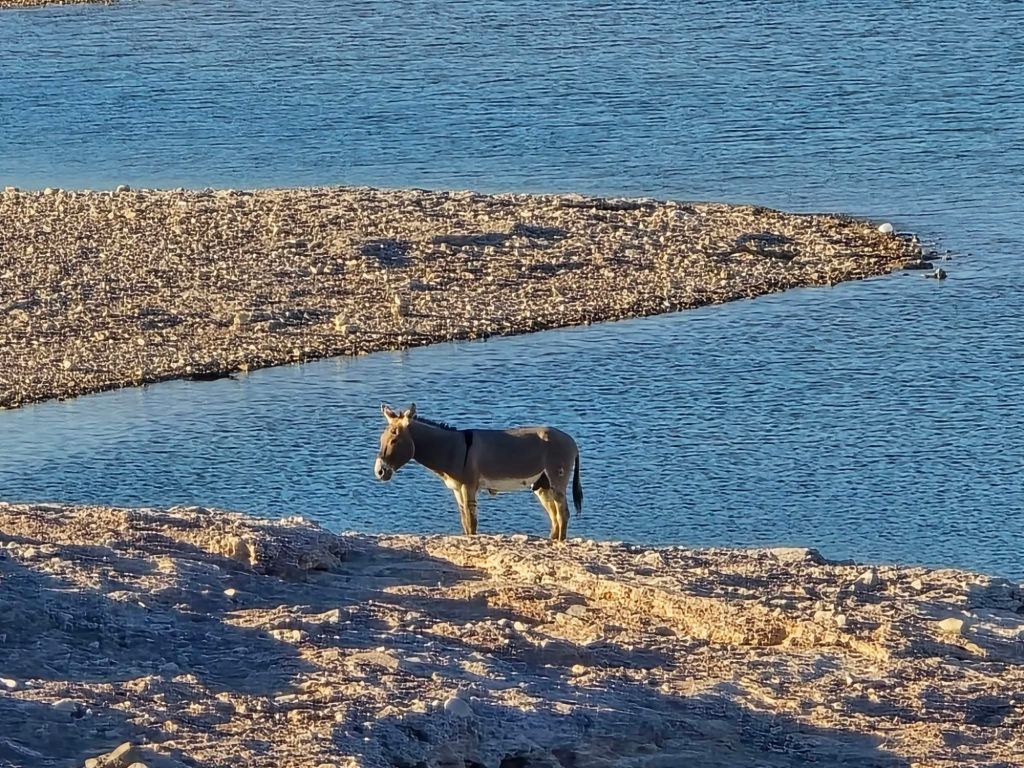
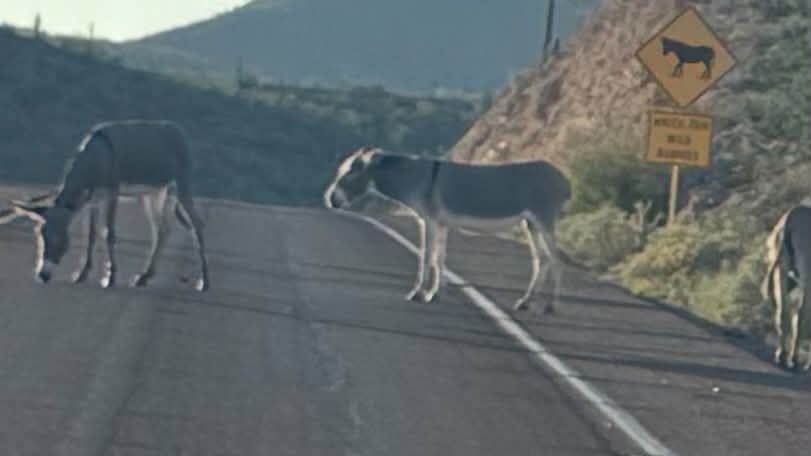
From there, we headed off to Lake Pleasant. The views are spectacular, as you can see, and it’s always fun to see the feral donkeys. The donkeys were brought over by Spanish explorers (conquistadores) and later were used in mining and other labor activities. Eventually, they were set free and began to multiply. They we’re prolific and thrived too much and had to be we rounded up and sold off by, I believe, the Bureau of Land Management. On this trip I saw 20 beautiful, healthy donkeys with some bonkeys ( baby donkeys).
That night it was dinner at home. Kelly is an exceptional cook. She had prepared gently seasoned pulled pork that we ate as sandwiches on white bread with dill pickles and raw onions. If you haven’t tried it, don’t knock it. Give it a try. I’ll guarantee you’ll love it. The night was spent talking about everything.
Sunday
We ate breakfast at home with our usual bagels, cream cheese, onions and avocado. I happened to mention that I had been taking lukewarm showers. I already knew that it was hard to turn on the water and shut off the water, because it had been so all previous visits. But now, the mixture of waters, cold and hot, were mostly cold. Fernando, Kelly’s brother, came over with his two daughters and Tracy and Fern repaired the faucet.
The girls arrived already in their swimming suits, so Kelly and the girls went swimming. I had been warned that the water was cold despite the 105°f air temperature. They both told me that they had done their last swim for the season, a week previous. So I decided not to get in, besides that, there was the difficulty of getting out of the pool once I got in, there is no railing. My damned hip injury again. I was so jealous. For dinner, there was delicious platefuls of chicken salad… Kelly’s doing.
Monday
and Tuesday were spent at home with Kelly. Kelly’s much needed vacation time was spent reading. She read four books in the time that I was there. Tracy had to work two more days so while she was working, I perused my new books but didn’t get much reading done. I’m really way too distracted to read right now. I thought I might go swimming, but I was afraid I wouldn’t be able to get out of the pool, what with my bad hip and all. Dumb decision.
Later on that first day, being that it was over 100°f, Kelly jumped in the pool. Then, I threw caution to the wind, and right there, I stripped to my undies, and got in, to hell with my swimming suit. And boy, was I glad I did. After the first initial gasp, when the water hit waist deep, the water was lovely. That night it was Kelly’s homemade spaghetti and meatballs. There was absolutely no complaints from me.
Tuesday
There was no hesitation about getting into the pool. I played with the dogs, went outside a little bit, pretended like I was reading until Tracy came home. We went to La Carumba for Mexican food, meeting up with some of Kelly and Tracy’s friends. I should have known better because I had been there a few times previously with them,, but I threw caution to the wind once again and had 2 mojitos. Time for bed.
Wednesday
was one of Tracy’s days off. This was the day we planned to go to the Cosanti Studio, not Arcosanti, which is located just 70 miles outside of Phoenix. but the actual studio where they sell and also make the bronze bells in Phoenix. Paolo Solari, was an architect, who wanted to build a self sustaining city, he wanted to prove that he could do it in the desert of Arizona. There’s so much to say about Solari, but that’s for another post.
Each year, for the last five years, when I go down to visit, Tracy and Kelly have bought me a bell. I love walking through the area, because the studio, the shop and where they make the bells, is very strangely made. It’s not like anything you’ve ever seen. I have just a few pictures. I wish I had more to try to explain to you what it’s like on their campus. The bells are not cheap and never have been.. But to our chagrin, this year, every single piece was at least double in price. I was not going to make them feel like they have to purchase something of that expense. But we found a bell that I love just as well, and it’s every bit as beautiful, though it is somewhat smaller than the other bellls they have purchased for me. As we know, size does not always matter.
I think and I hope that Tracy loves to drive as much as I think she does, because when I’m in Arizona with them, we drive all over the Phoenix area and not just Phoenix but Peoria and Glendale and Scottsdale, and so many other parts of the Valley of the Sun, as it is called. I always ask her to not take the freeways, but to take any and every other road that she knows so that I can see everything that there is to see. If you’ve never been there, you cannot imagine how beautiful and different it is from where I live. The landscape, the environment, the architecture, all of it, I love. And as anyone who knows me knows, I love the Saguaro in the Sonoran desert. If you don’t know that is where the Valley of the Sun is located right smack dab in the desert, and it’s the only place that the saguaro grow.
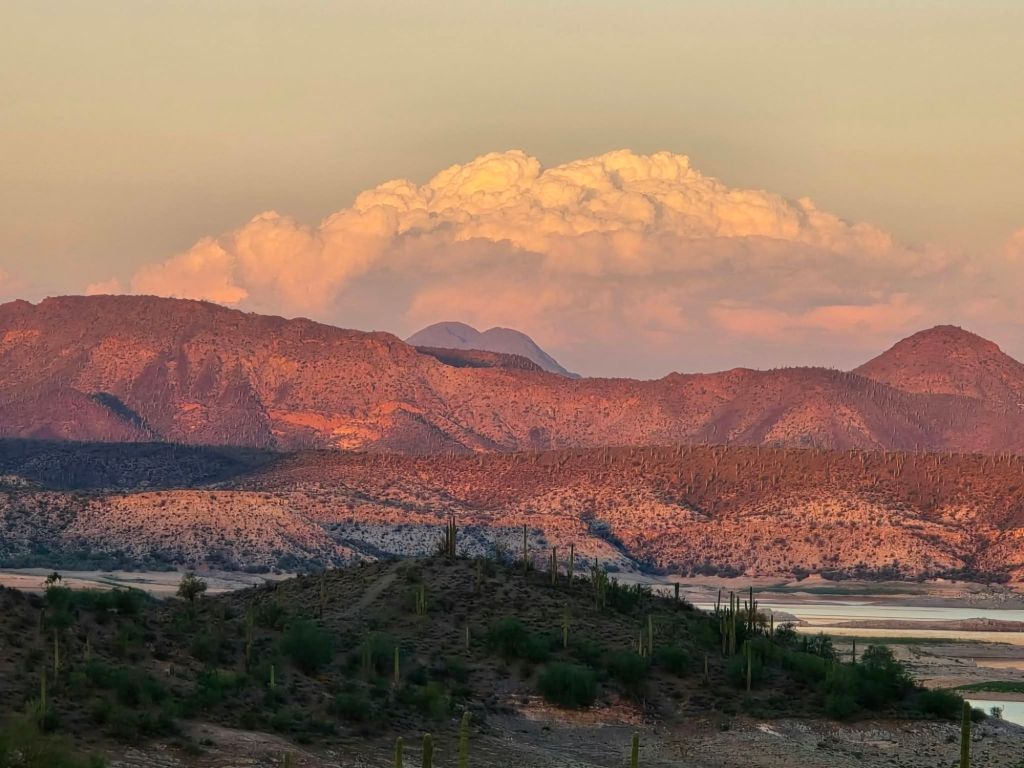
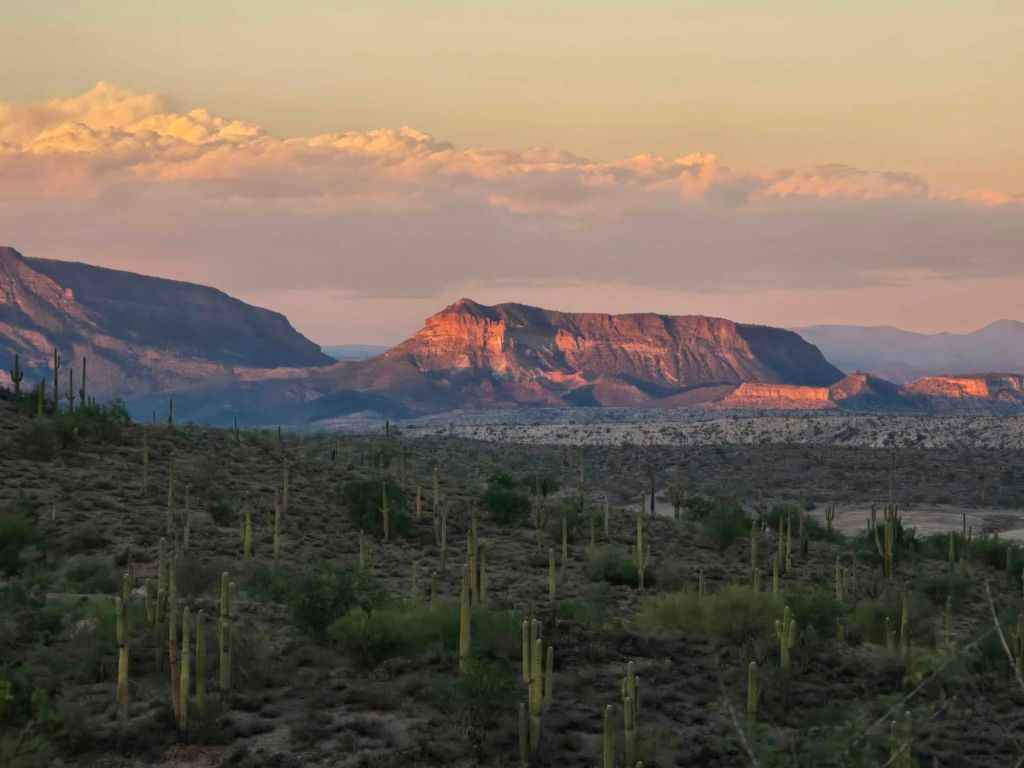
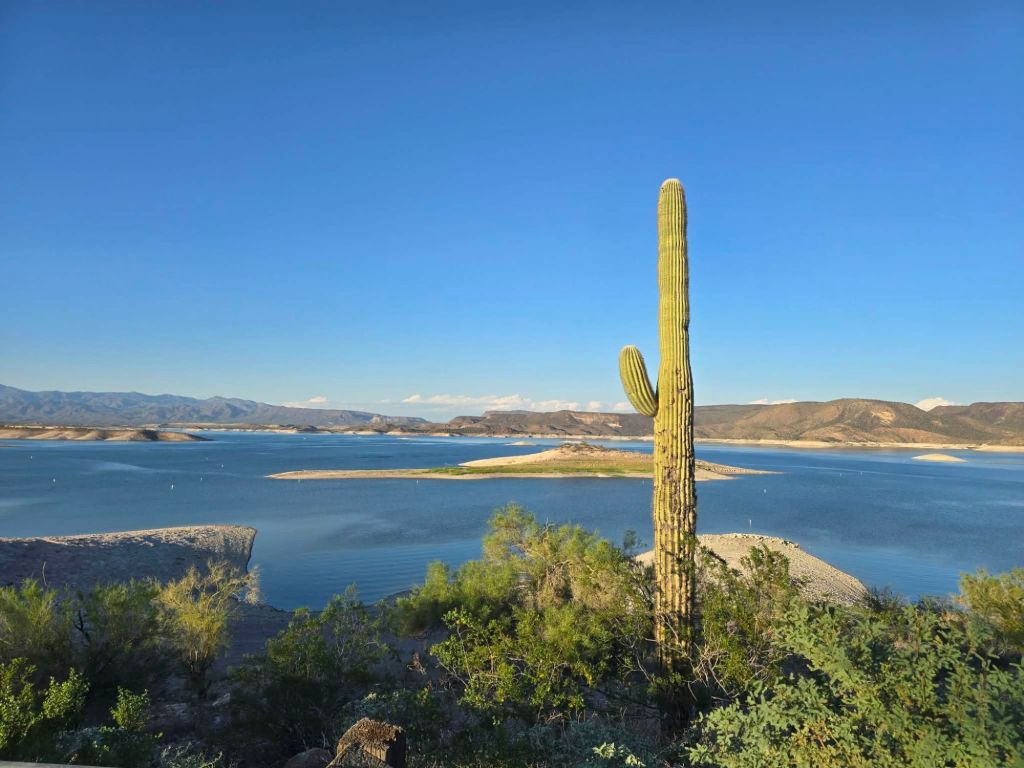
After our day in the city, when we got home, we jumped in the pool and all three of us swam around until we talked about dinner. Tracy had called home to see what we were gonna do for dinner. And Kelly mentioned potatoes. Well, there’s not much more that I like than potatoes cooked any which way. And like I said, before, Kelly’s a very good cook, so I knew it was gonna be good.
We all jumped in the pool, and were swimming around, cooling off, as it was nearly 105°. We were getting a little chilled, if you can believe it, when Tracy mentioned a barbecue place with the best potatoes in town. Next thing we knew, we were out of the pool and getting dressed to go to this restaurant, which wasn’t too far from the house.
The potatoes that they were talking about, were giant russets, baked to perfection. I said, “since you girls are experienced, I’ll have mine any way you do”. Butter, cheese, spicy sour cream, everything’s spicy in Arizona, green onions and I think some other things that I can’t remember. On top of that, we went over to the meat counter, and I had pulled pork put on top of mine. Eeeew whee! Then, there was mac and cheese and corn bread pudding! Wow! There was also chocolate cake, but none of us could eat it then, so we took it home for later. Time for bed.
Thursday
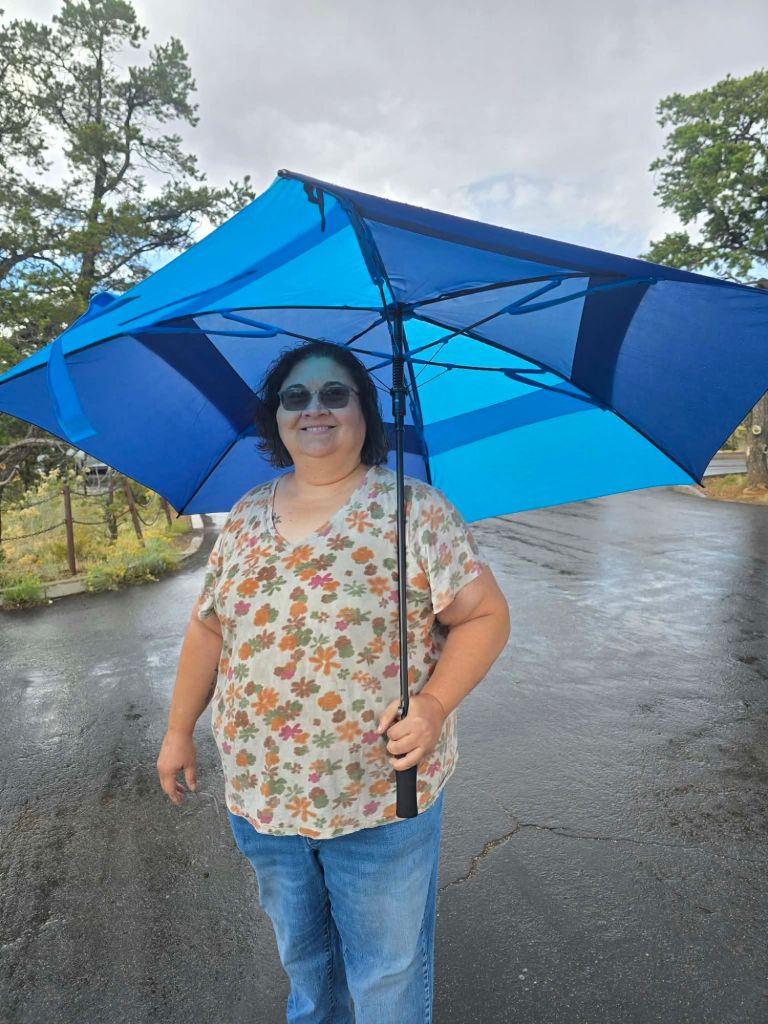
Thursday was all about getting ready for our trip to the Grand Canyon. I went with Tracy to Target for her to order new glasses. She also bought 3 umbrellas because we heard that the weather was gonna be wet and very cold, both in Page and on the Kaibab Plateau. I was going to wait in the car but she was insistent that I would walk. She was like Hannah in that I need to walk if I expect to get stronger and for my hip flexor to heal. So I did. I already knew that it was hard for me to walk. Not only because of the heat, but Portland is 50 ft above sea level and Phoenix is 1200, which is quite a difference. I was already wheezing on exhalation and exertion.
Tracy loaded the truck early with everything we needed for a safe drive through the desert from their house to Lake Powell in Page Arizona, right on the border with Utah. My phone was going crazy, trying to decide what time it was. Was it Utah time or was it Arizona time? We had plenty of water and snacks and everything to make turkey sandwiches.
That night we ate delicious crab salads, thanks again to Kelly’s good cooking. We all needed to pack because we were going to leave early for our trip to the Grand Canyon. Can you even imagine my excitement? Probably not. I have never been to the south rim nor the north rim. I never expected that I would ever get a chance to get to the Grand Canyon. And especially not this year. Tracy and Kelly both told me that they hadn’t made any plans for a trip. We were just going to have day trips, which in Arizona, in the desert and with their knowledge of Arizona, I knew was going to be exciting anyway no matter what we did.
Friday
The drive over was phenomenal. After leaving Phoenix on highway 17, we connected to highway 64 as we climbed out of the Valley of the Sun, into the cooler mountain air of Flagstaff. I love this part of the trip, as we drive through the fragrant lodgepole pines.
From there, we connected with highway 89 heading north. We entered the dark black landscape of the San Francisco peaks, and the Volcanic Fields and Painted Desert and out towards the edge of the Navajo Nation.
Today’s destination was to head over to Lake Powell on the Glen Canyon, where we had reservations to stay at the Lake Powell Resort. One continues to drive on highway 89. You have then left the Sonoran desert, and it’s Saguaro into an “other planet” landscape. It’s flat and dry. As far as the eye can see it’s flat, but with humongous mountain ranges seemingly erupting from the flat earth.
The earth is red. We drove the 60 miles along side the massive layerd red rock Echo Cliffs… ending that corridor on the Vermilion Cliffs National Monument. I am always over the top with the landscapes in Arizona. So unlike Oregon. I’m pretty annoying, probably, as my exclamations and constant narration of the incredible scenic views. I can’t help it. I have to exclaim, “Look at that. Can you believe it”?
I’m also fascinated with the demographics. Perhaps you will see a small village, or a gathering of a few houses. But more likely, you will see isolated houses, some with nothing around them. Some with a corral or a barn, and a couple of horses. I can’t help but to wonder who these people are. And what they’re doing out there. There doesn’t seem to be services like electricity or water. I know that they are the Navajo or the Dinè, as they like to be called. But I know nothing of their lives. You will definitely see, occasionally, a res dog wandering on the highway.
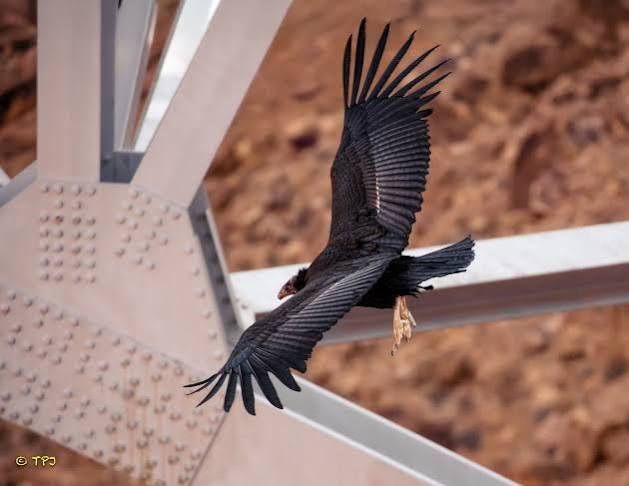
From there, we took a slight detour onto highway 89A towards Marble Canyon and the Navajo Bridge that crosses the Colorado River. Marble canyon marks the exact beginning of the Grand Canyon. We wanted to see if we could catch a glimpse of the California Condors who frequent the area. And we did. Tracy and Kelly walked out over the bridge. I’m not much for heights, so I stayed up on the viewing area. We were about to leave when we heard a man saying that there was a condor right under the bridge. Tracy got a good look at it, and so did kelly and I as it was flying away onto the opposite side of the canyon. It’s flight was beautiful as it never flapped its wings once. It’s a giant bird.
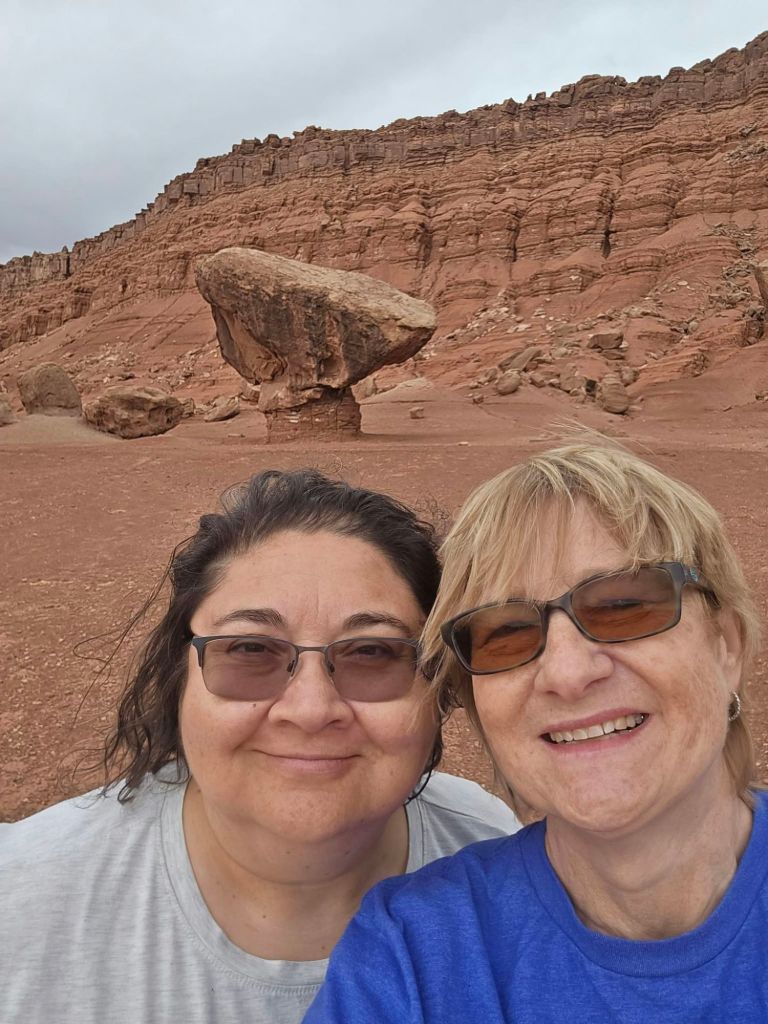
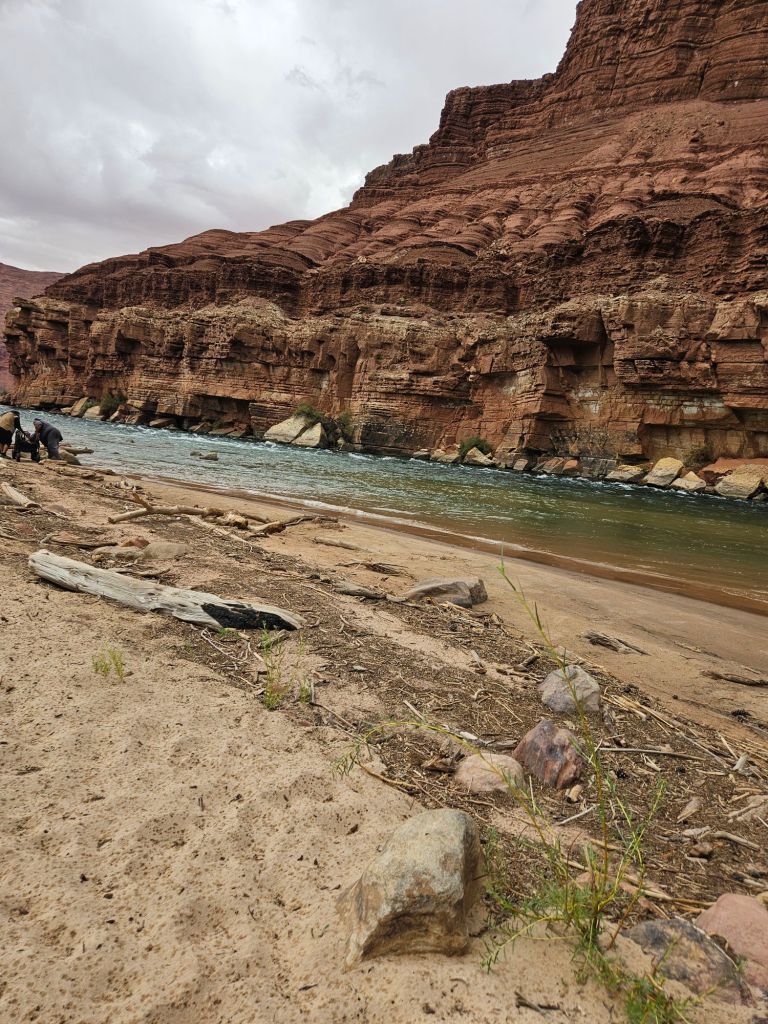
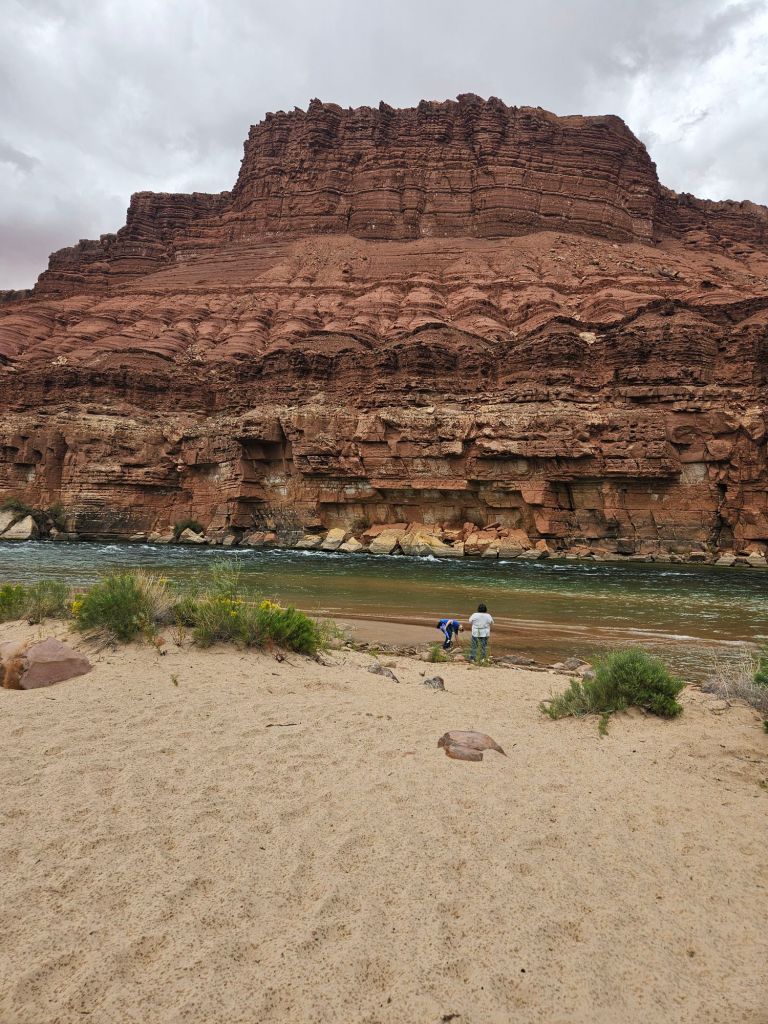
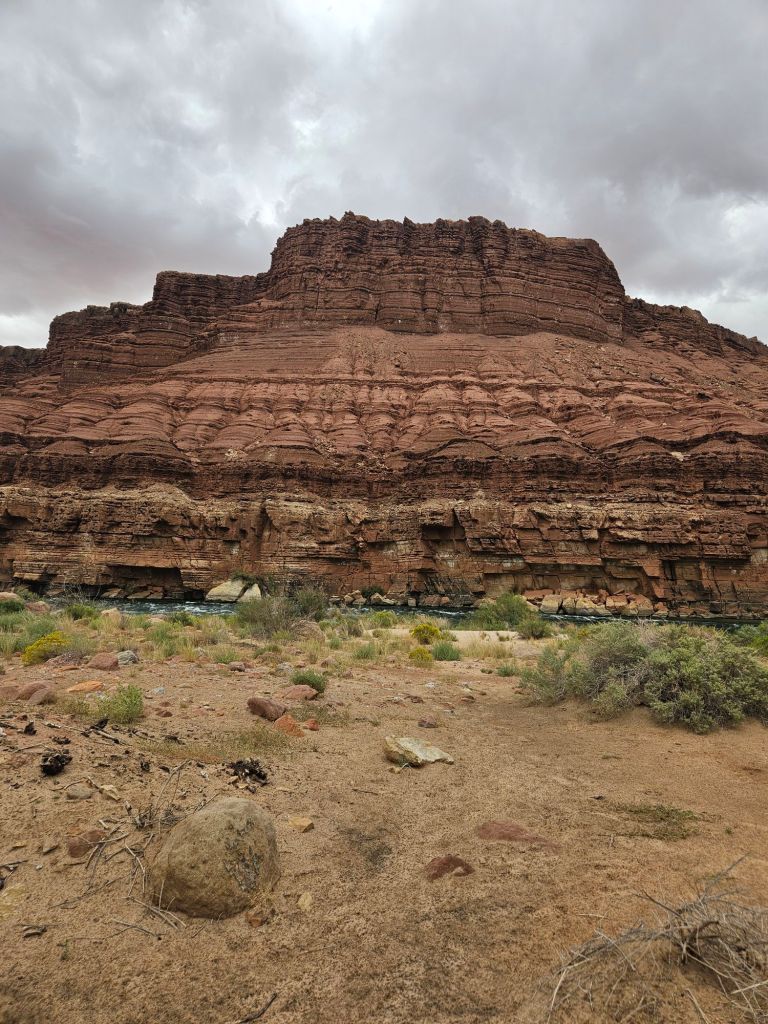
Just past the bridge on the highway is Lee’s Ferry road, Driving five miles takes you down to the banks of the Colorado.River where the true canyon begins. The rock formations on the road are otherworldly. One rock, in particular, which is called Umbrella Rock, fell from the mountainside thousands of years ago. Rain has eroded the land away. Except for under the rock, the compression and protection from the rain has created a sculptural phenomena. To me, it looked more like a mushroom, but I’ll try not to change its name.
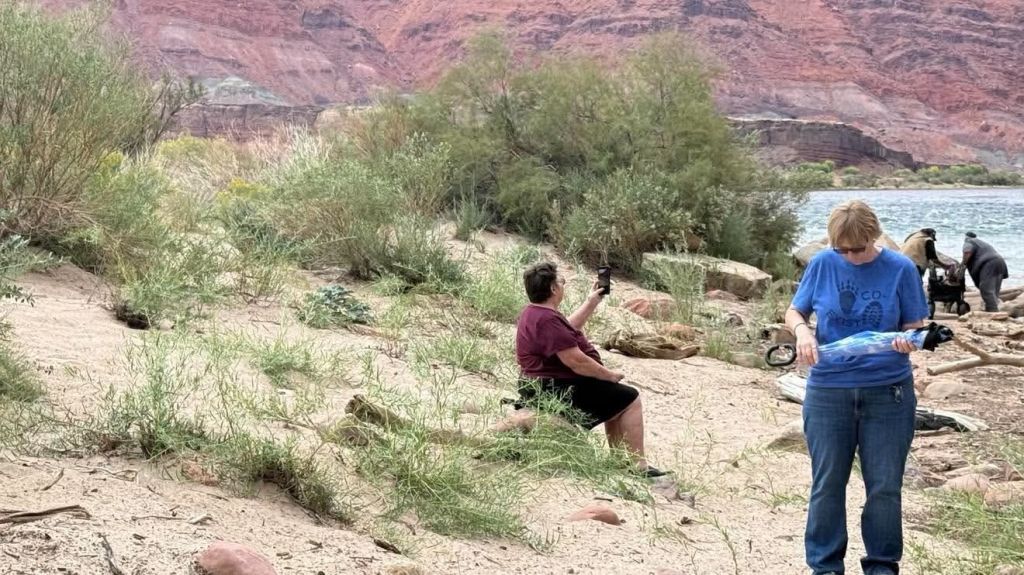
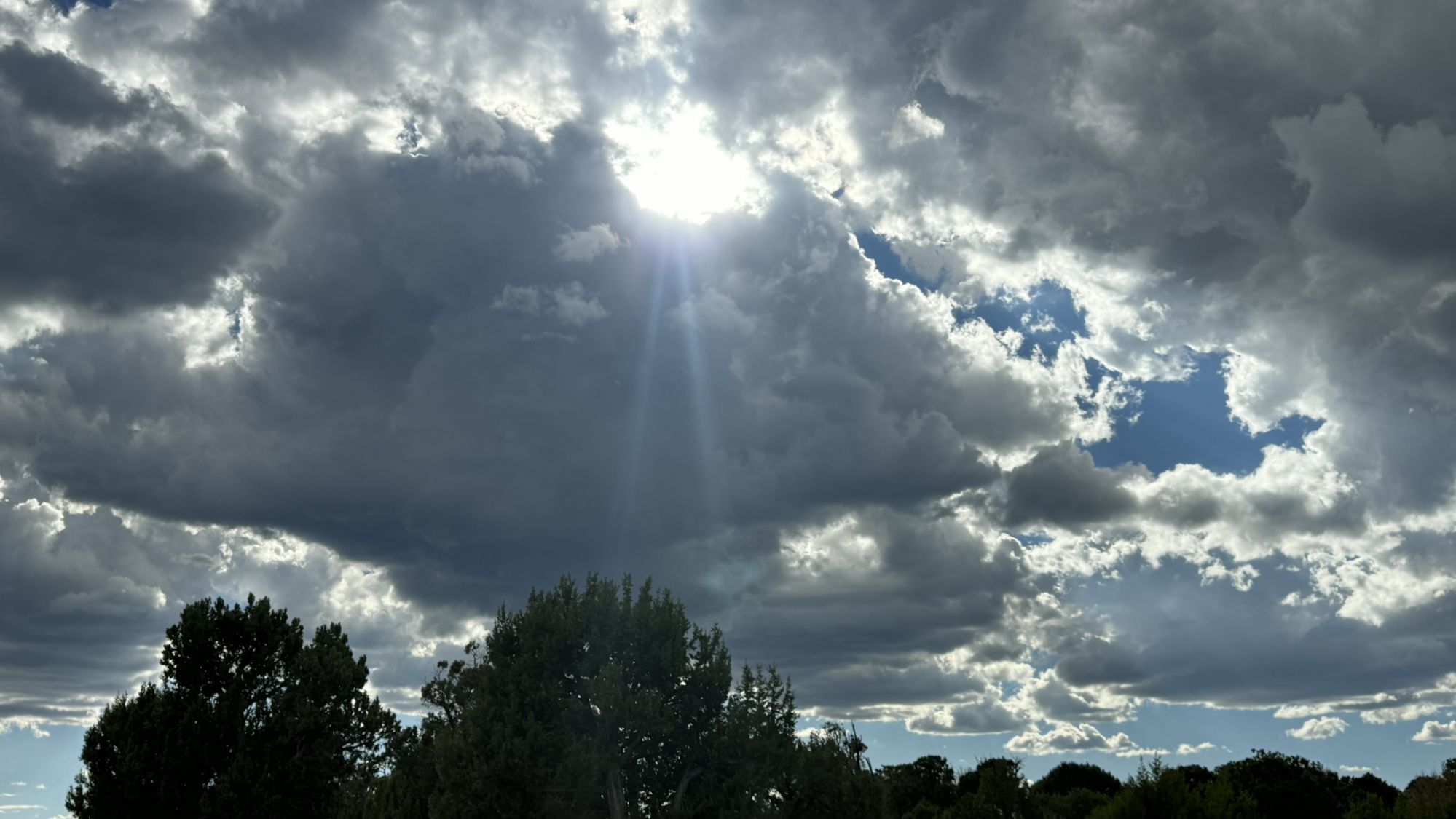
We drove down to the water where I took my shoes off and walked in the sand and Tracy went down to the water and put her hands in. Two Dinè women were fishing from the bank. After maybe 20 minutes or so, the wind kicked up. And looking into the sky, we saw huge black clouds coming. The wind was so strong it was blowing big clouds of rust colored dust onto us from the mountain tops. It was time to get out of there and get out of there fast. The wind was blowing so hard, it almost blew my shoes down the beach. Tracy helped me and took my hand and we walked as fast as we could back to the truck climbing into its safety. Our ears, our eyes, our noses and every crevice was filled with red gritty sand. It took a couple of showers to get rid of all of it. The rain came down in torrents. The rain came down in sheets so that Tracy could hardly see to drive. But we did get out of that canyon. It was amazing to be on the actual river at the bottom of the canyon.
From there it was back onto highway 89. First stop was Lake Powell. It is a reservoir that serves to store water and to distribute water throughout the southern states. But also the lake is a playground for, especially boaters. The lake cold’s a large marina. The lake itself was greatly diminished, but the Glenn Canyon dam held as much water back as it could. This is the dilemma. For these desert states, there’s just not enough water. The sad part is the history of the location once again. As it happens to all Indian land, it was taken over by the US Department of Engineering without consideration for their ancestral homeland. They were forced to move. Oh, yes, they were promised compensation, but as usual, it never came through.
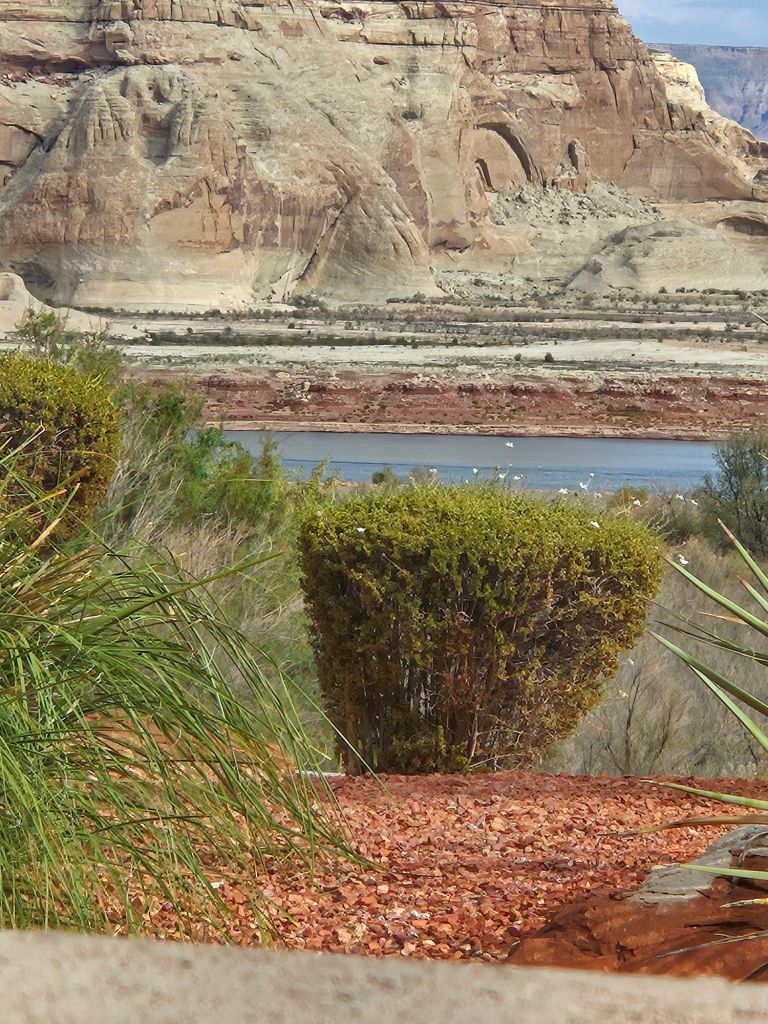
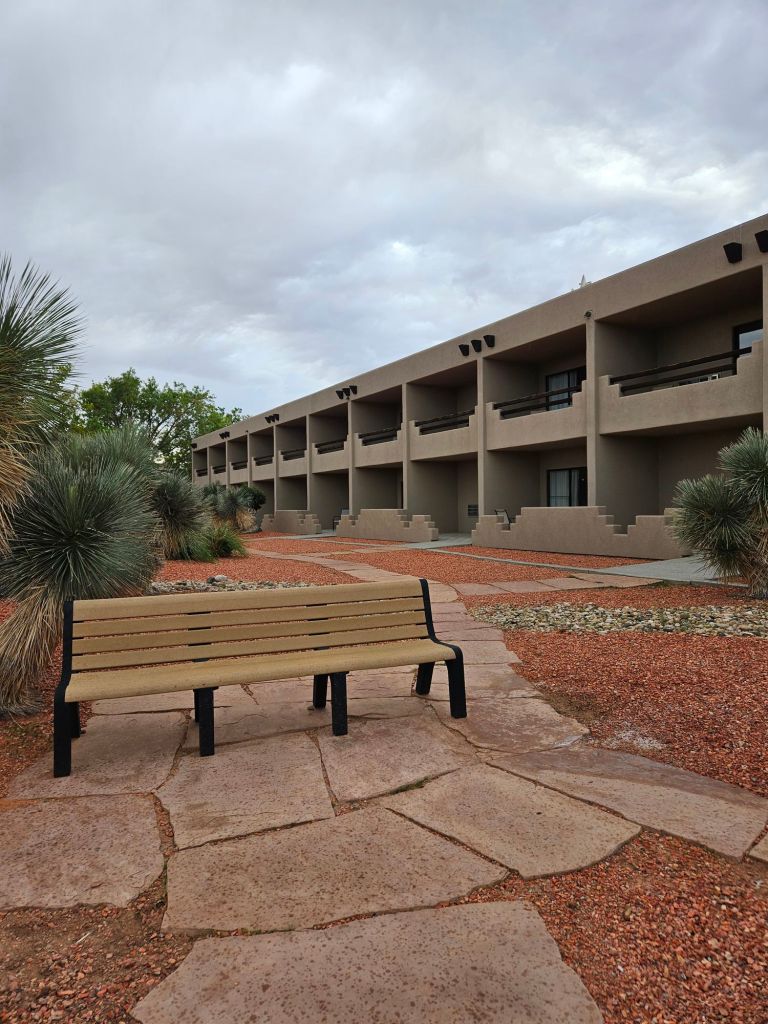
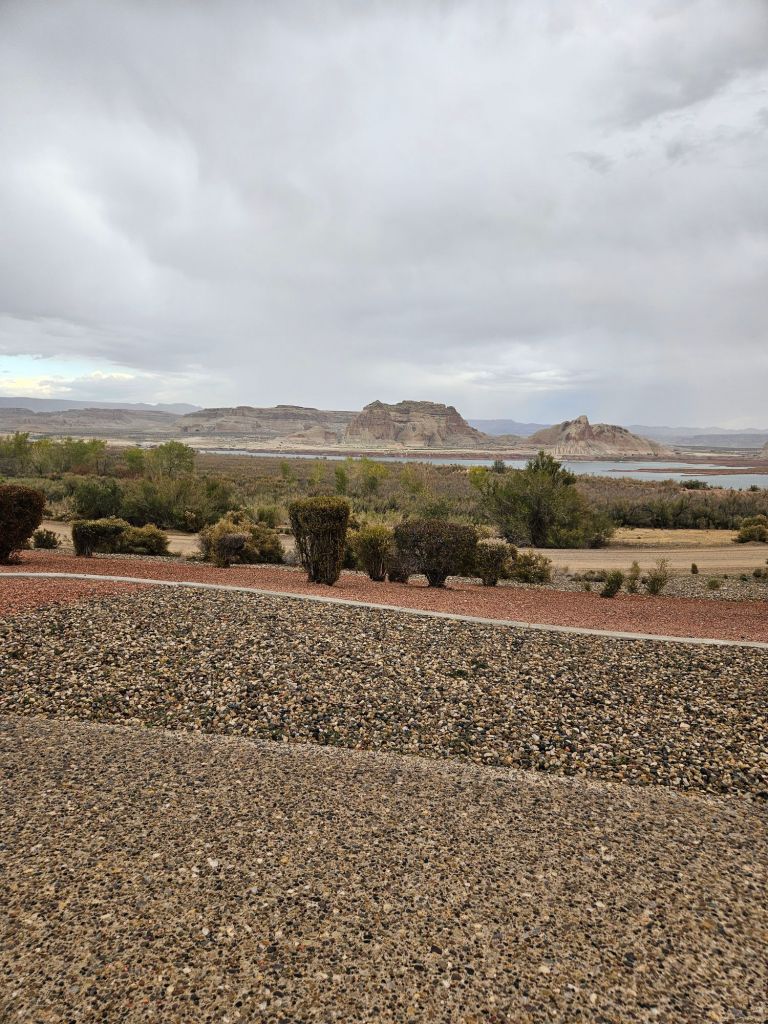
We stayed at the Lake Powell Resort. We had a great view of the lake and surrounding land. Tracy was tired from driving and cold, as were all of us, having come from weather. that was 100°+ to somewhere in the 70s. But we came prepared because we knew that once we were on the Kaibab Plateau, that it could get down to 20°.
It was dark when we arrived, so we dumped our suitcases in our room and went to the lounge for a simple dinner. Tracy had a BLT and Kelly and I ate chef salads. It didn’t take us long to shower and climb into bed. We all passed out pretty quickly.
Saturday
I woke fairly early and wandered out onto the patio in front of our room. I wandered around a bit on the trails and looked at the lake and the surrounding landscape of gray and blonde mountains and hills. The water was very, very low and it was fairly desolate looking. I think mostly people come to boat and to fish and to relax. There were a number of swimming pools and trails down to the lake. When Tracy woke up, we wandered down to the coffee bar. Tracy got one for Kelly so that we could wake her up and get going.
There really wasn’t much of interest for us to do there, so we were just going to head directly to the Grand Canyon. No one was hungry except me so Tracy stopped at the Mcdonald’s and I ordered two fish sandwiches. I remember them being quite small and very cheap. My how things have changed. They each were $7.00! I actually felt guilty. I could only eat one.
From Lake Powell, we climbed up onto highway 89 again, heading south. As we drove south the Echo Cliffs, were now on our left. We passed the Vermilion Cliffs again and came upon a very strange sight. The desert floor was made up of massive shale lumps. These are impossible to describe. They must be seen to believe.
After about 75 miles, we turned on to highway 64 west and entered the eastern gates of the Grand Canyon National Park. From there, our route began to climb and pinyon and ponderosa pines filled our view. I was fascinated by the view of Cedar Mountain, which looked like a large flat top hat. What was so fascinating was that it just stands there, alone with no other mountains or hills around it at all. One can keep it in ones’s view all the way to the entrance to the South Rim Park entrance and on to the village on the rim.
Stepping out of the truck at the South Rim Grand Canyon Visitor Center, the first thing that hits you isn’t the view—it’s the sheer scale of human logistics. The parking complex is absolutely massive, a sprawling sea of asphalt divided into huge, numbered lots designed to hold thousands of cars and tour buses. Well, maybe not thousands, but at least hundreds. It feels like arriving at a major amusement park or a bustling airport.
People are everywhere, a moving sea of humanity from every corner of the globe, speaking a dozen different languages, unloading strollers, and adjusting backpacks. Before you even see a speck of red rock, you find yourself navigating the beautifully stone-crafted plaza, modern water-filling stations, and the predictably large, industrial public restrooms built to handle the endless waves of travelers.
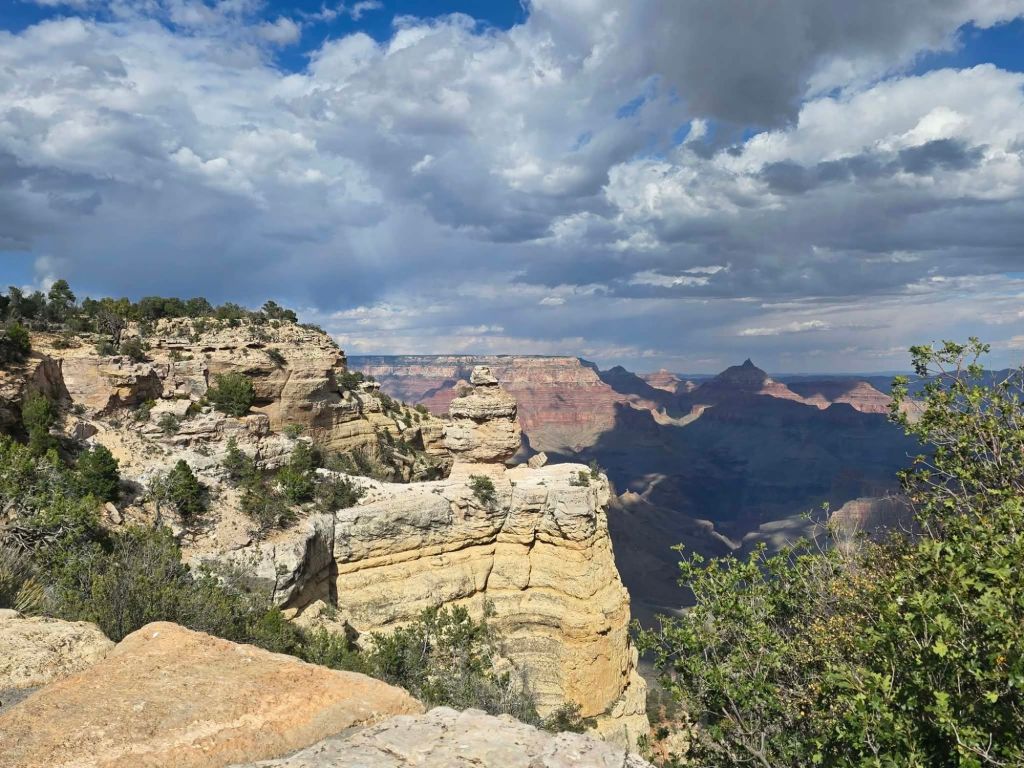
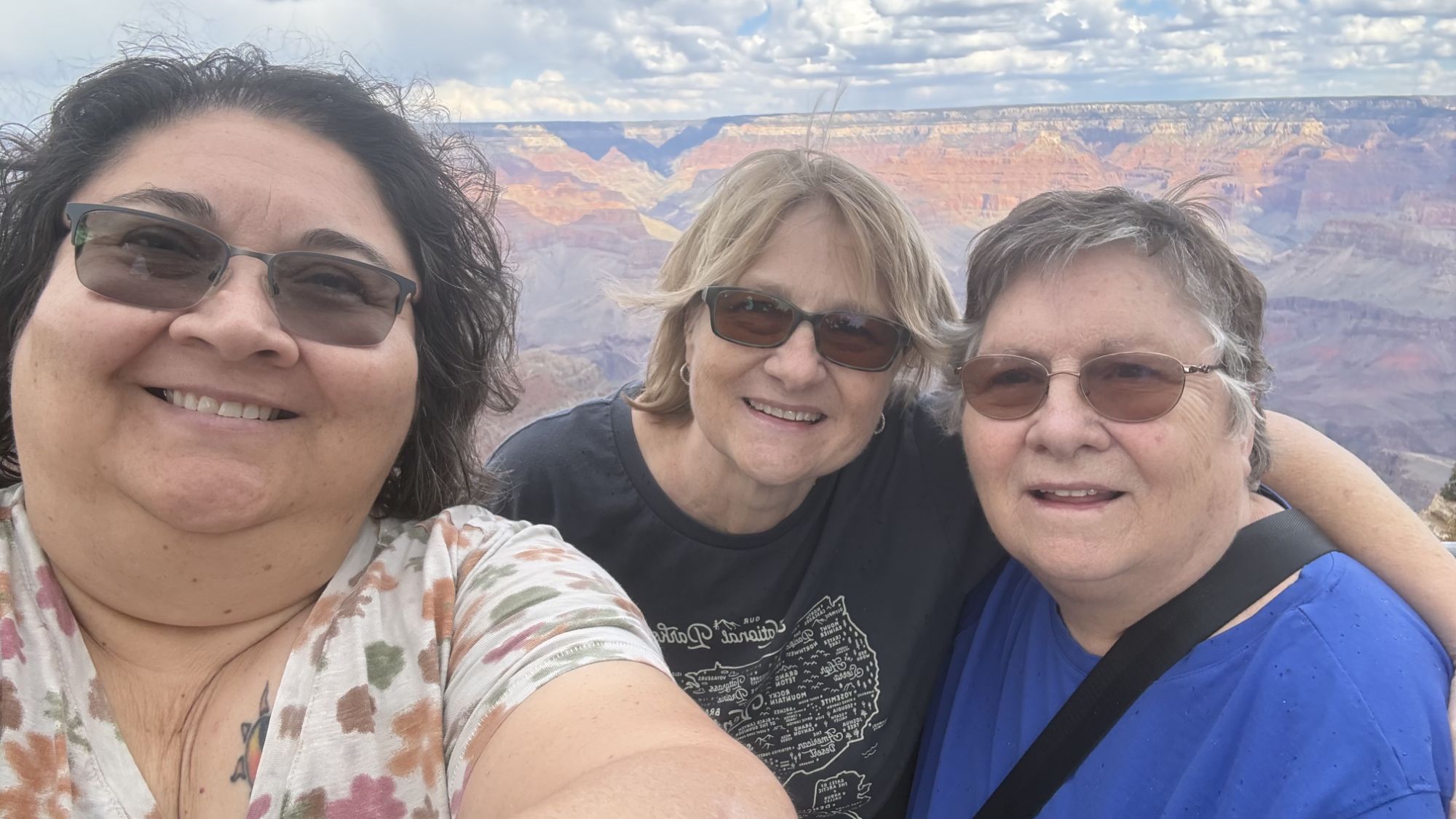
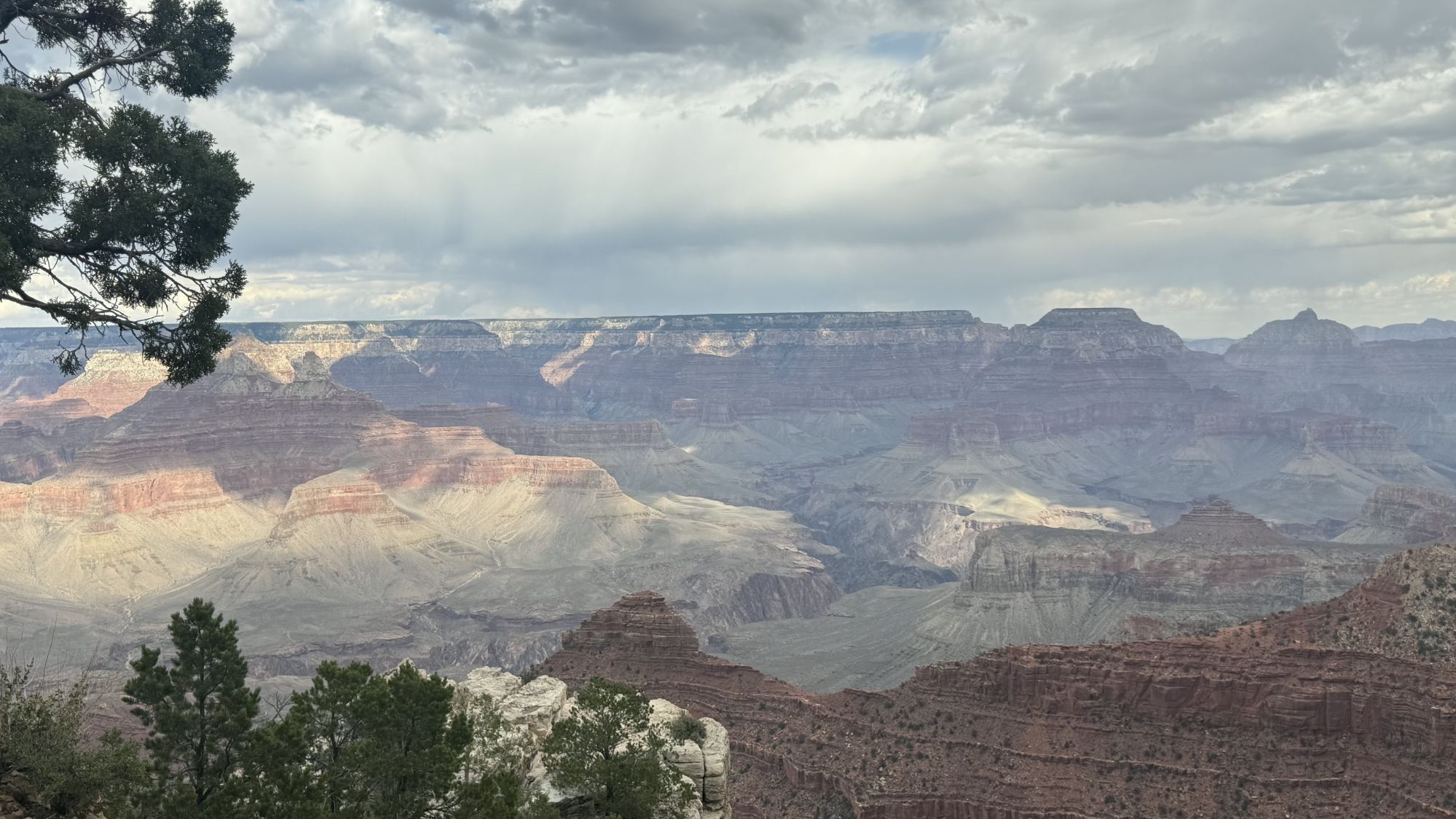
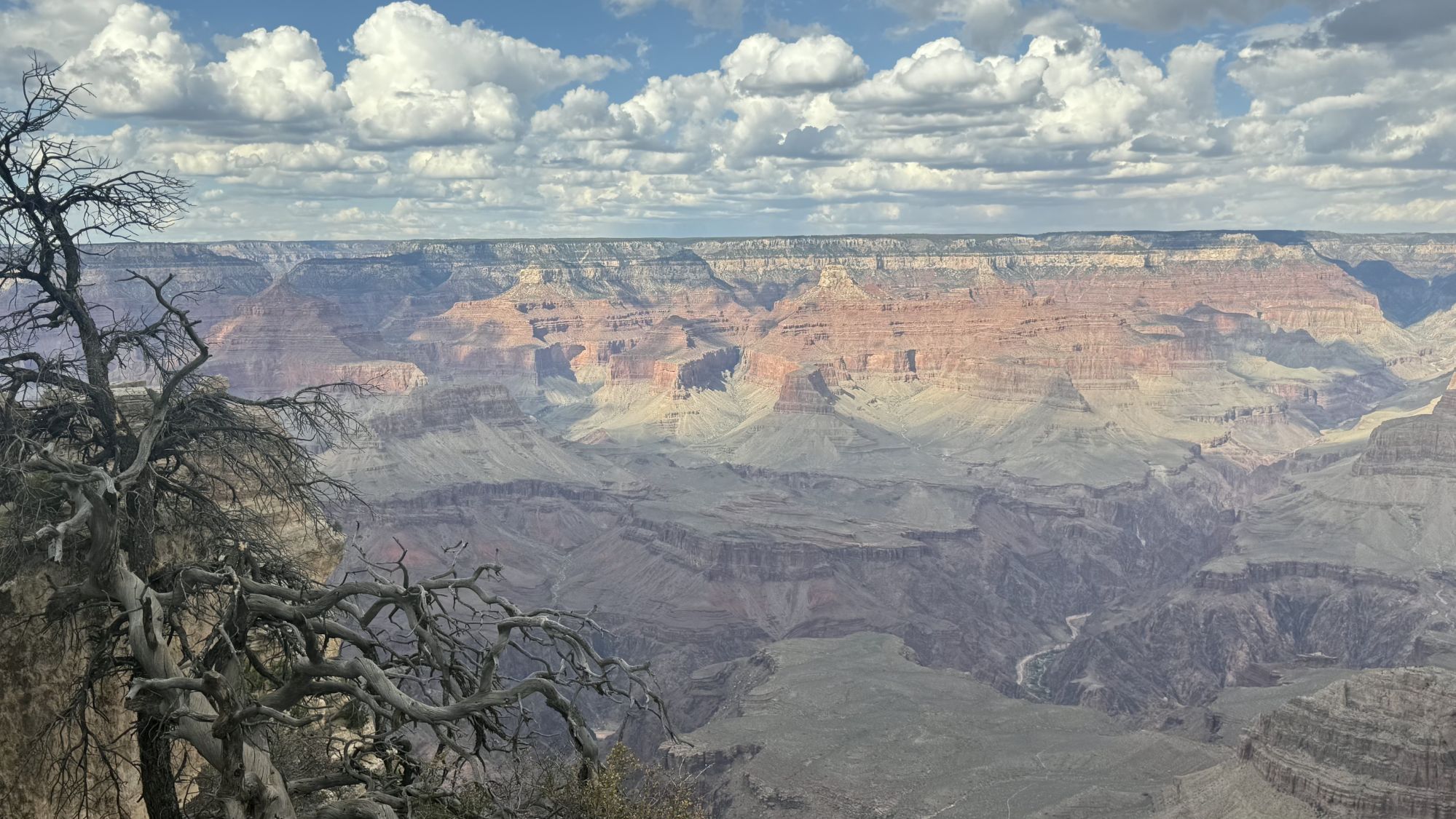
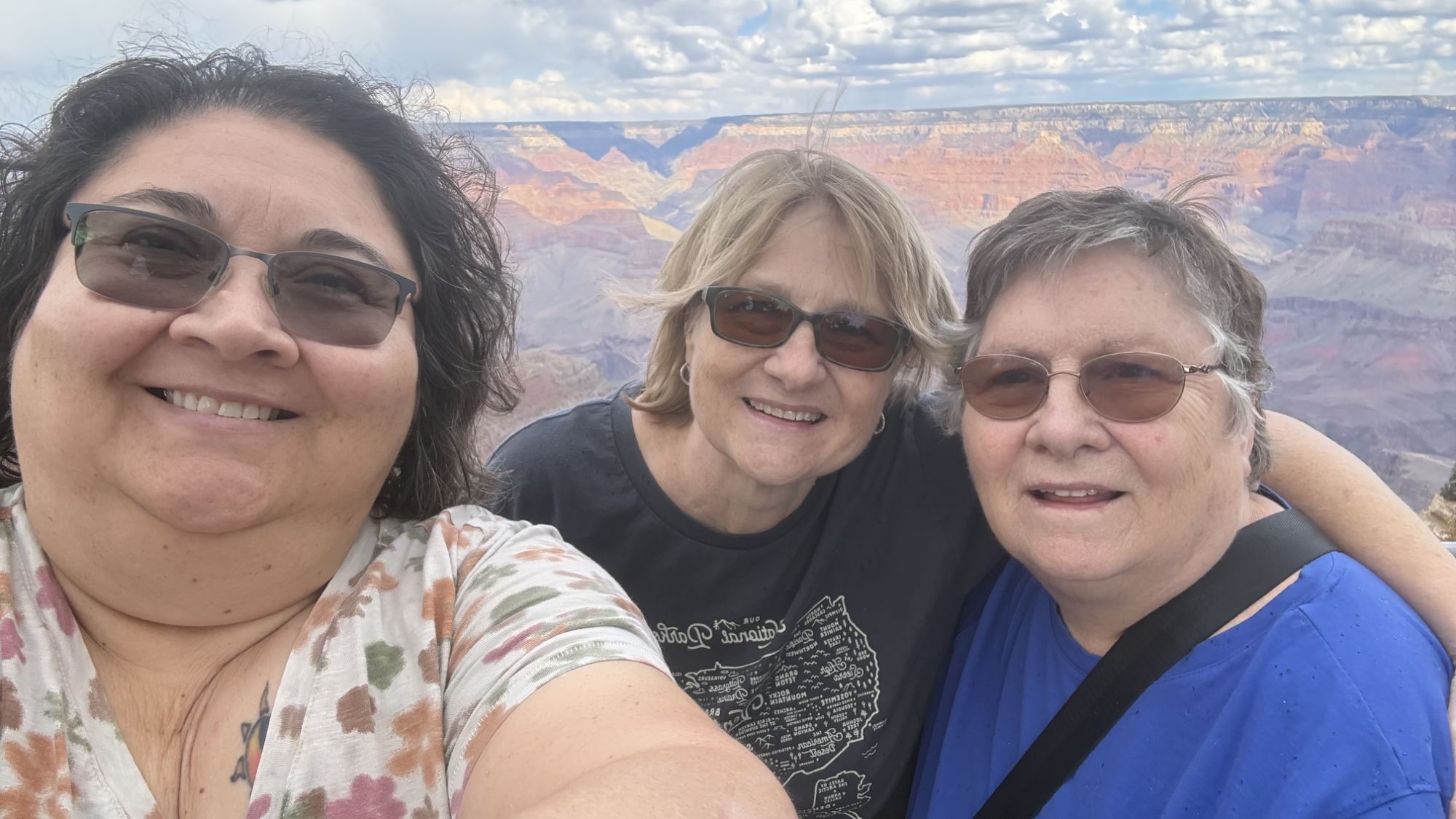
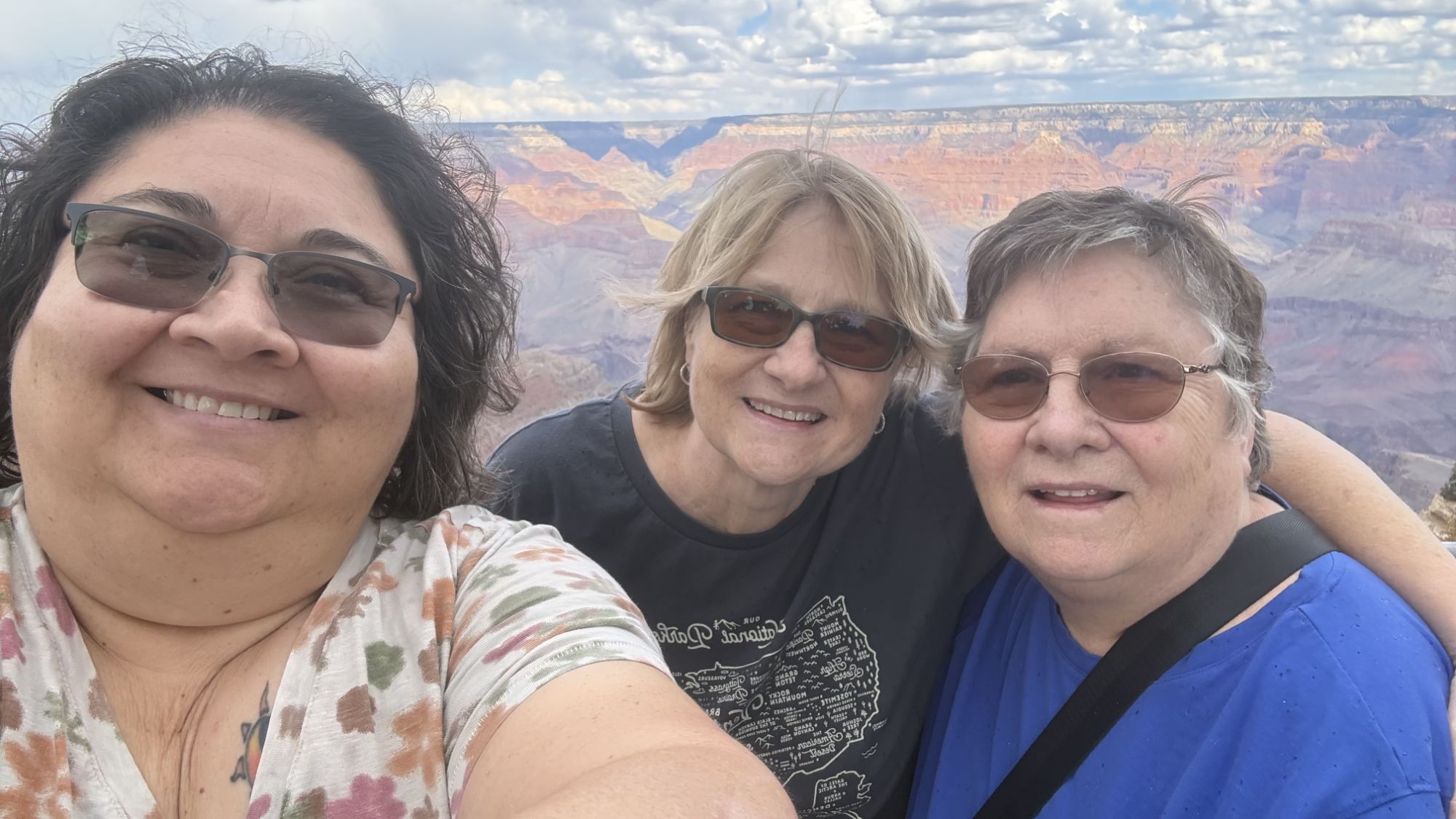
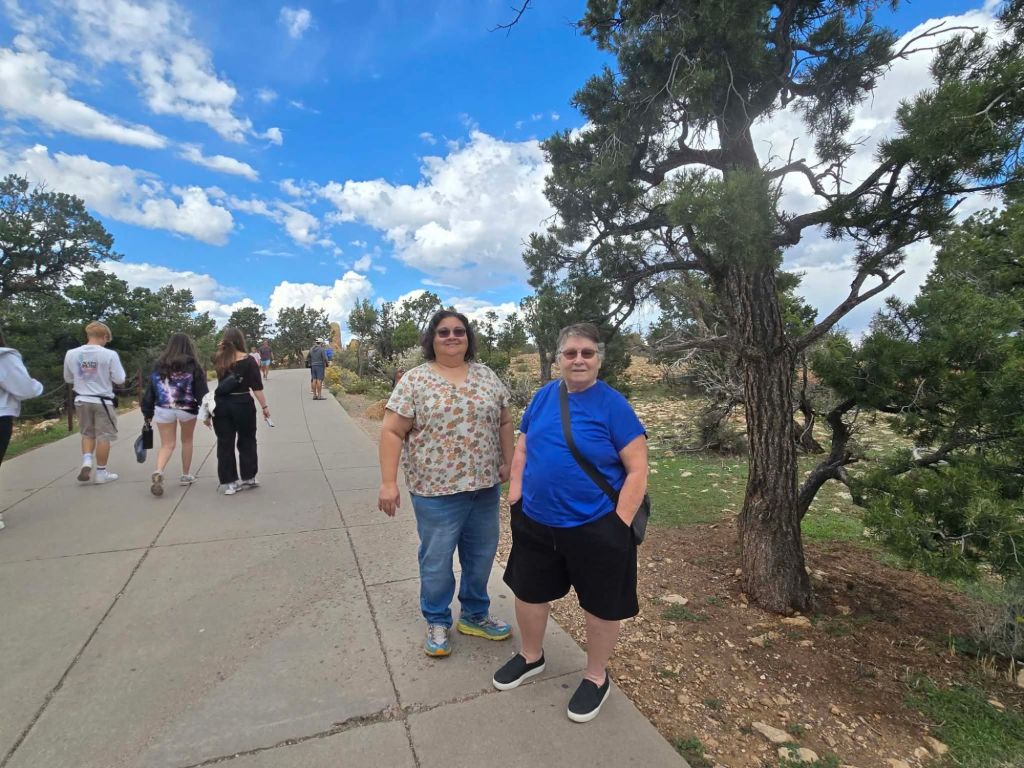
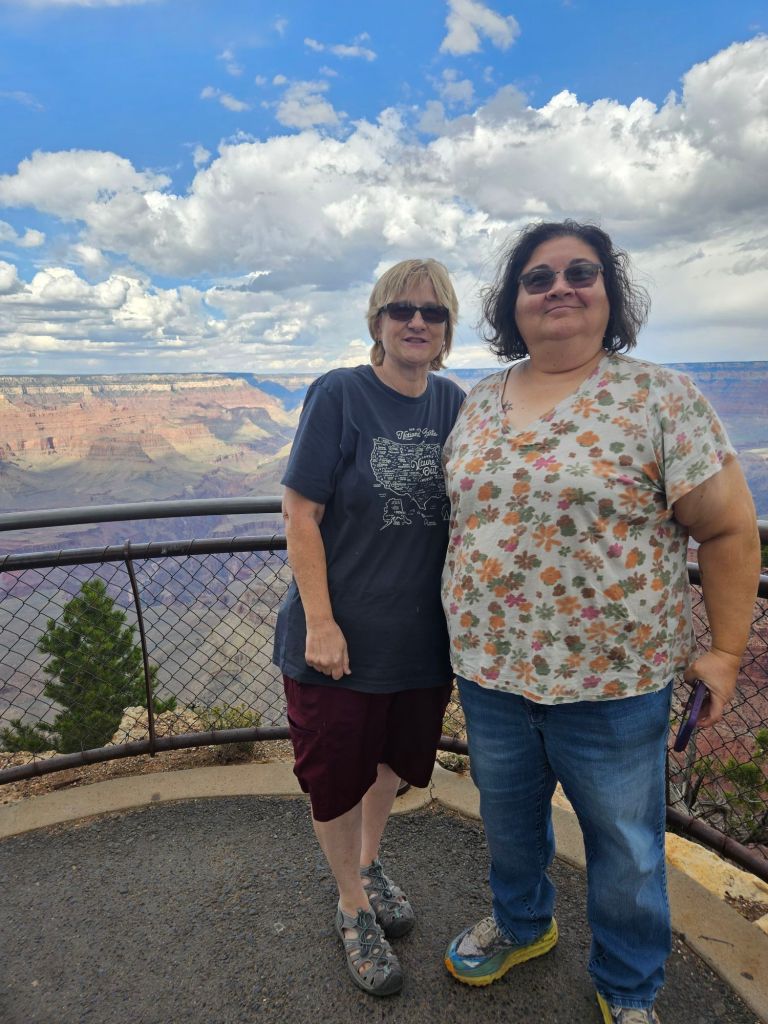
But then, you follow the paved path toward Mather Point, and the crowd begins to thin out as everyone slows down. You walk up to the edge, and suddenly the concrete world drops away. There is a sturdy, thick steel railing bolted into the limestone beneath your feet—a comforting, solid barrier that keeps the bustling crowd safe from the sheer drop. Leaning against that rail, the noise of the many tourists around you seems to instantly fade into a hush. You are standing on a paved, heavily managed viewing platform, surrounded by strangers taking selfies, yet looking out into that silent, five-thousand-foot drop, the contrast is dizzying. Man-made railings and busy walkways hold you steady on the very brink of an ancient, wild eternity.
We didn’t stay long at the South Rim as it began to rain in earnest. Before we left Phoenix, Tracy bought three large umbrellas for us since we knew that the weather would be unpredictable on the canyon. We were still walking towards the parking lots as Tracy ran to the truck, grabbed the umbrellas and brought them to us before we were soaked to the bone. We climbed into the truck and Tracy made turkey sandwiches for us all, while Kelly handed, from the back seat, soft drinks and chips.
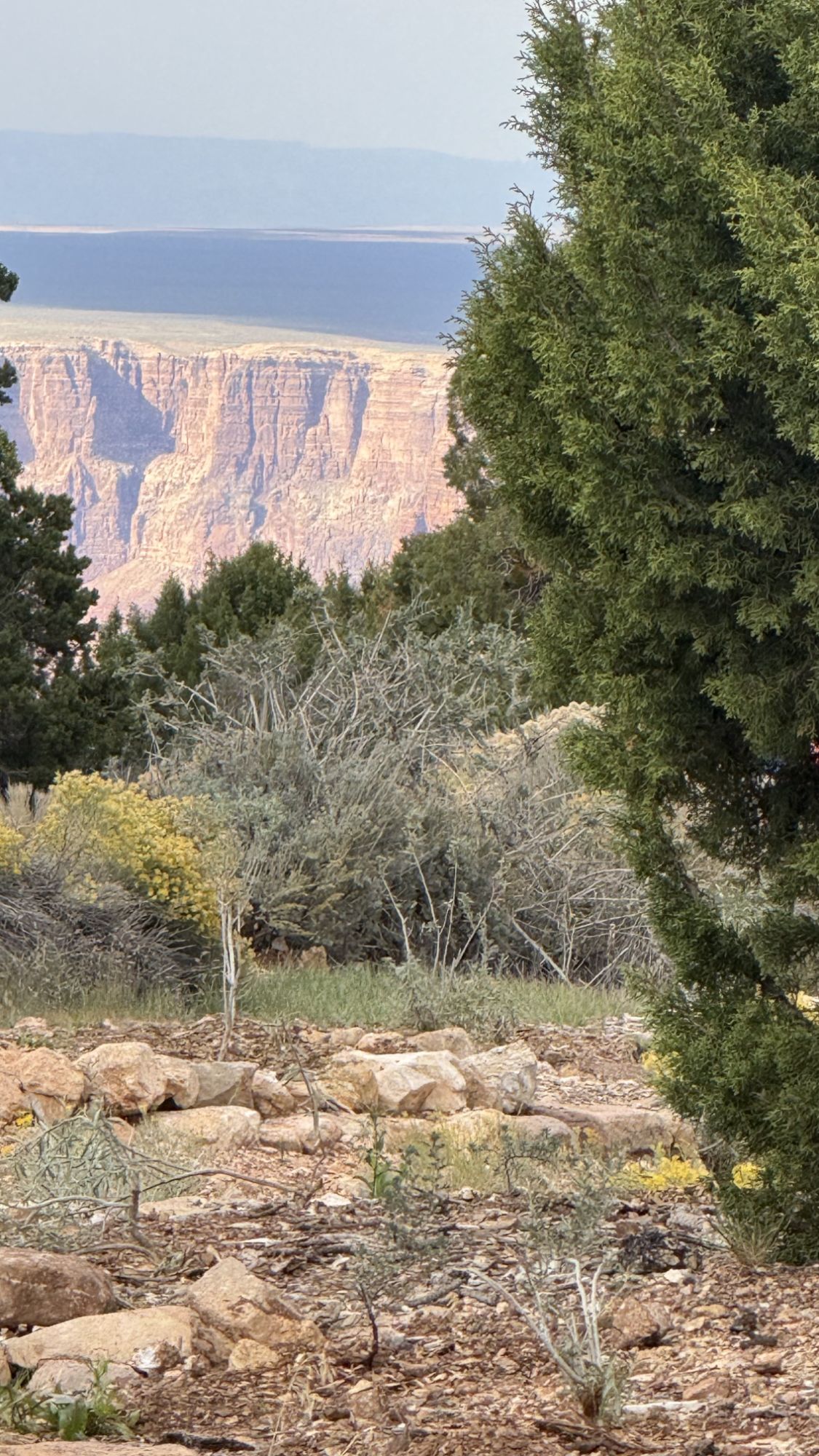
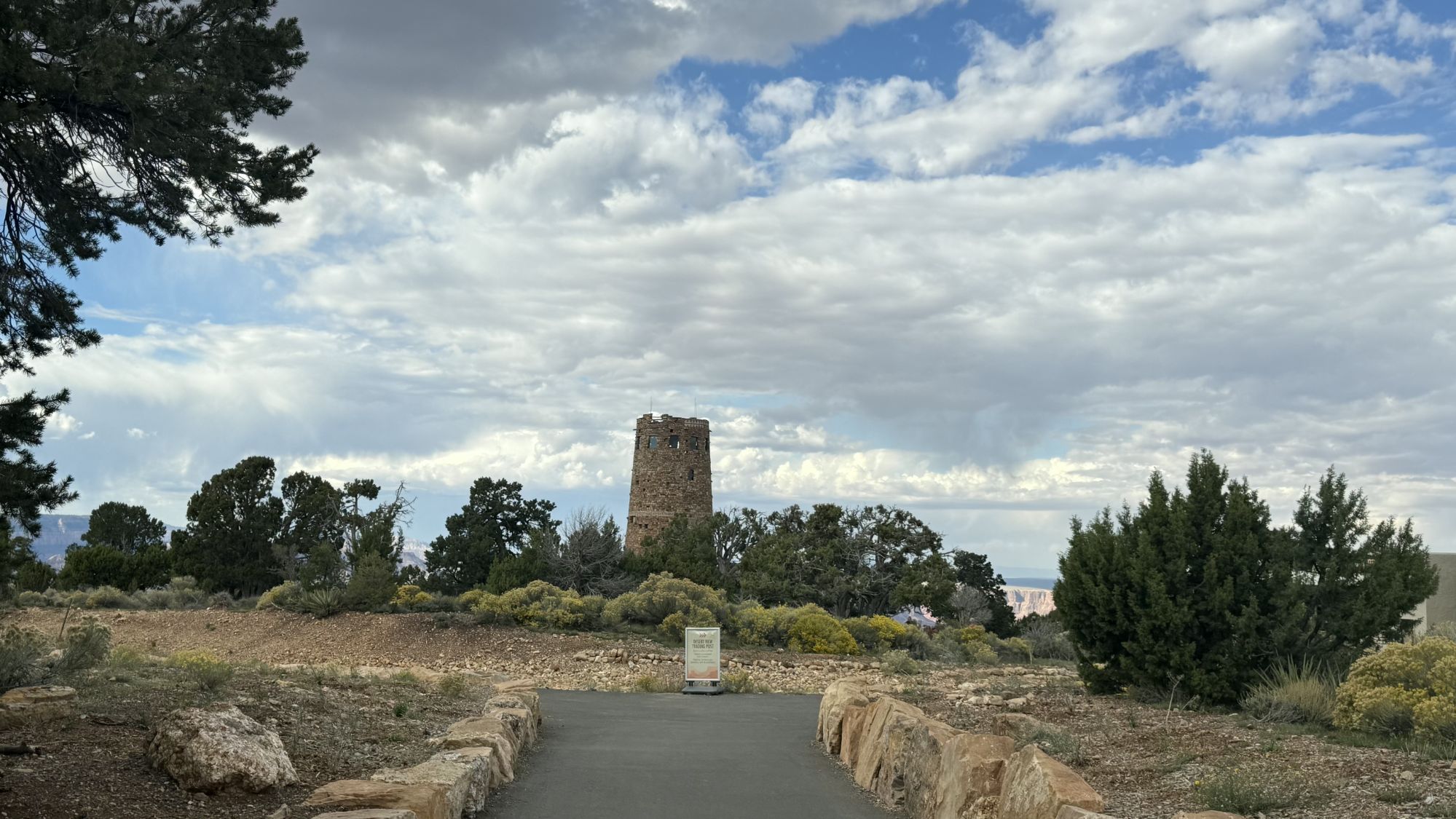
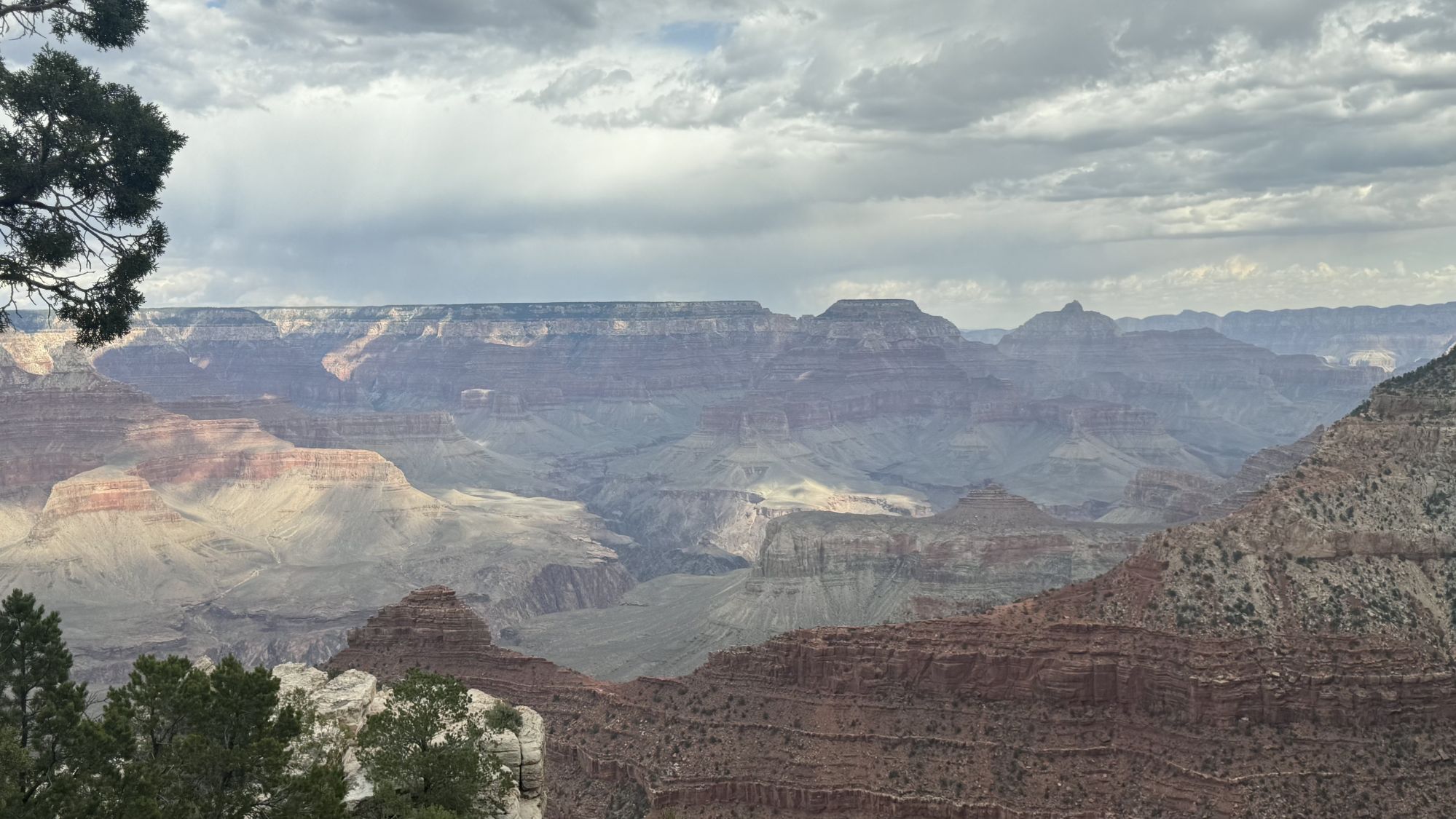
From there, we explored Desert View Drive and the many viewpoints along the South Rim on our way to the Noeth Rim. We stopped at a few places to take in the view, away from the south rim chaos. We saw a huge raven and many places to view the canyon that did not have the railings and the many people We stopped at Desert View to get a view of the historic Watch Tower. The trails and the restrooms were closed. So we went on our way.
To get to the North Rim, we once again drove on highway 67 to take the long drive south to get to the Kaibab Plateau. At times it felt like we were driving straight up, at times making horseshoe turns, our tires nearing the edges of the road that dropped who knows how many feet? Tracy is an amazing driver, and I trust her implicitly, though I kept saying, “Keep your eyes on the road. Keep your eyes on the road. Don’t look”, as I was exclaiming, “Oh my god! Look at that!” When we reached the plateau, we were at 9000 ft. elevation. We drove through miles and miles and miles of burned out forests. This was the remnants of the huge and devastating fire of 2025.
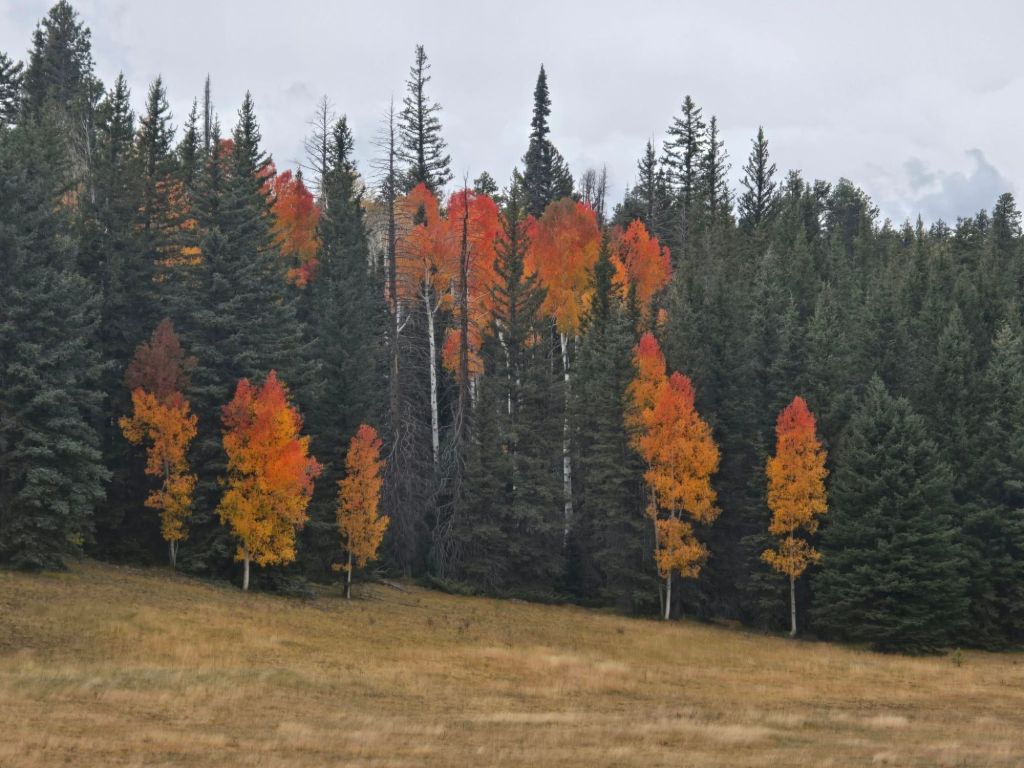
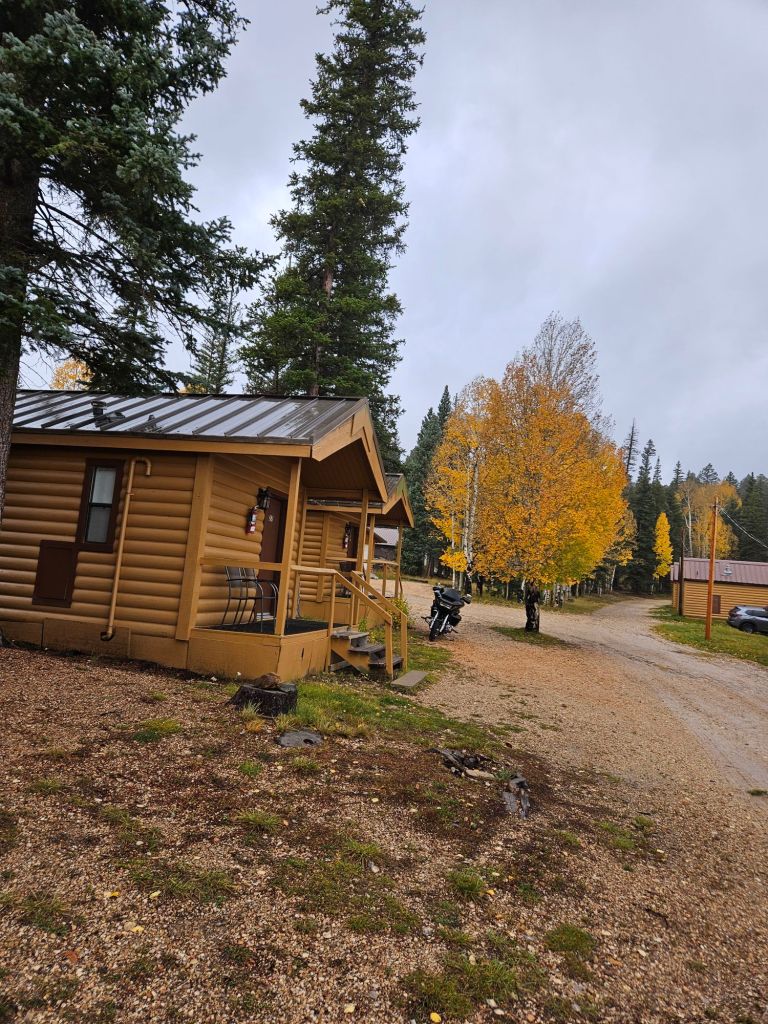
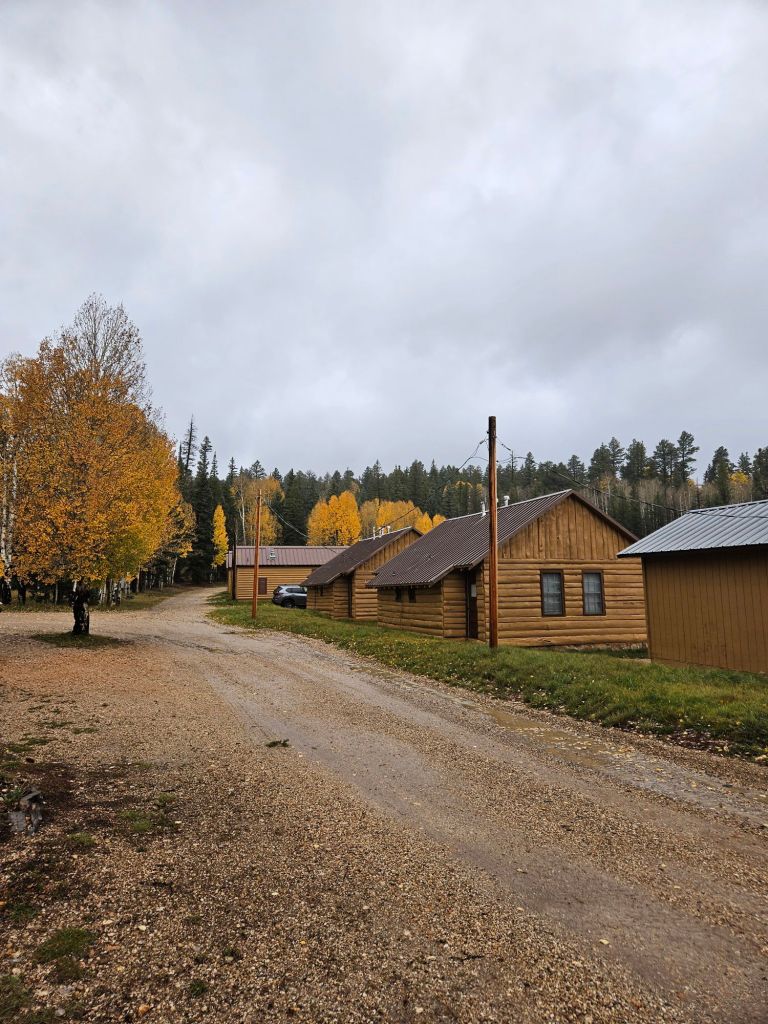
On our way to the rim, we passed the Kaibab, Lodge where we were going to spend the night. We drove through high elevation meadows with bison (we didn’t see any) but we saw cows, elk and deer. The many diverse evergreen trees were populated with groves of flaming aspen trees. October was the perfect time to go through that area.
We got a map as we passed through the entrance to the park and Tracy chose the route we were going to take to the rim. We weren’t going to go to the Grand Canyon Lodge, where the fire had taken out some 70 buildings, including the Grand Lodge. The forest is burned to a crisp, but the aspen are coming up like crazy as they are meant to do after a fire. There were controlled fires everywhere. At times it was difficult to drive through the thick smoke.
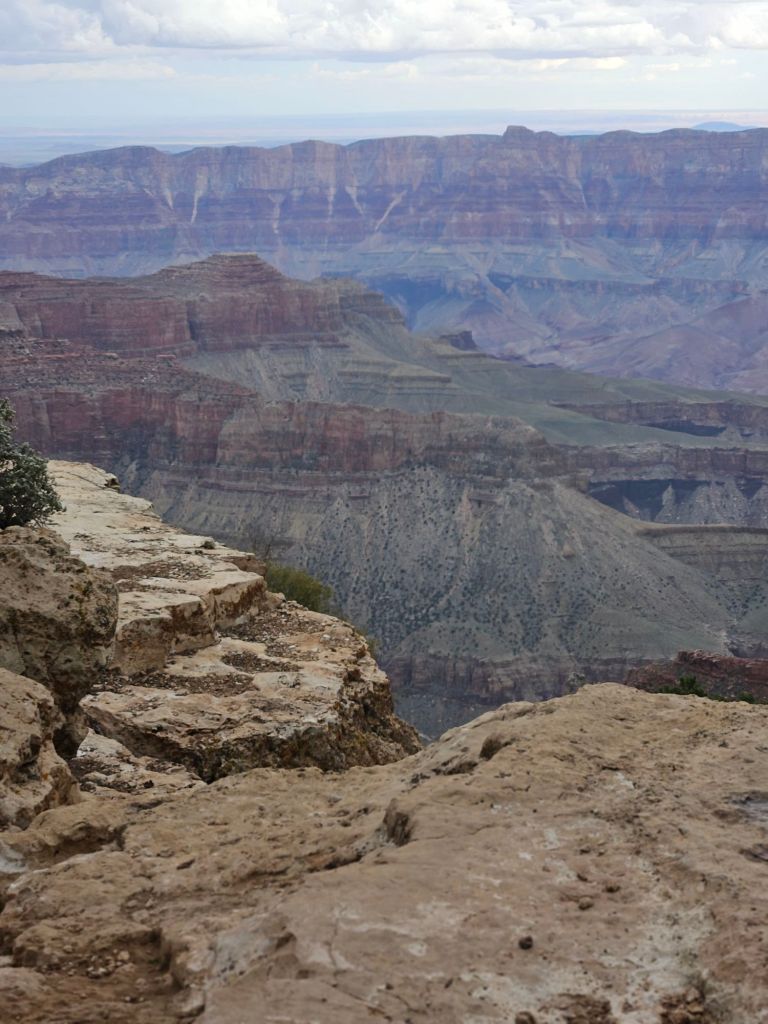
The route that Tracy chose was the Cape Royal road. A 23 mile long asphalt, almost single track road, that twisted and turned through the forest right along the rim. Sometimes our tires were just a foot from the rim. The North Rim is raw and unprotected. The road pulls you closer to the rim that just beyond is a drop off of many thousands of feet. No fences, no guardrails. Driving that road took total focus on Tracy’s part with a tight grip on the wheel. At the end of the road is a large parking lot with bathrooms and a trail going out along the rim.
We parked and took a deep sigh of relief. Any way I did. I know Tracy well enough after visiting with her in Arizona for the last ten years, that she loves these kinds of drives and has no fear. She trusts her truck and she trusts her ability to drive in the most stressful situations. But needless to say, she has a deep respect for these dangerous routes. I had a quick and greatly needed pee before heading out to the rim with Tracy and Kelly. There were just a few cars in the parking lot. This was a completely opposite experience than that of the South Rim.
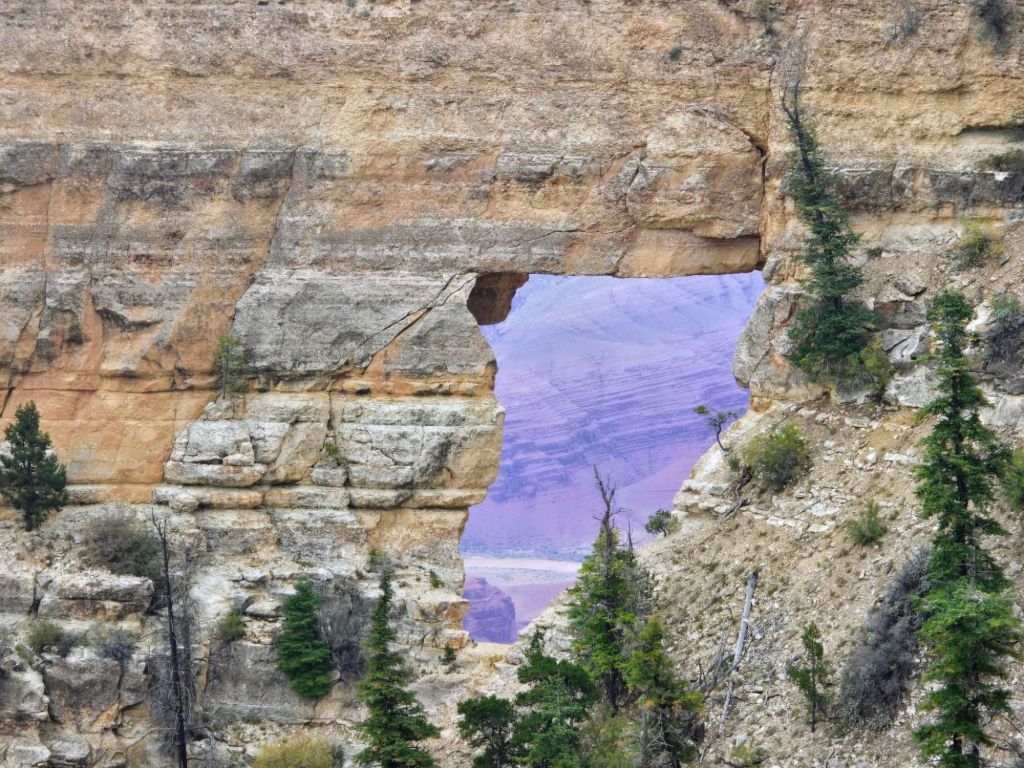
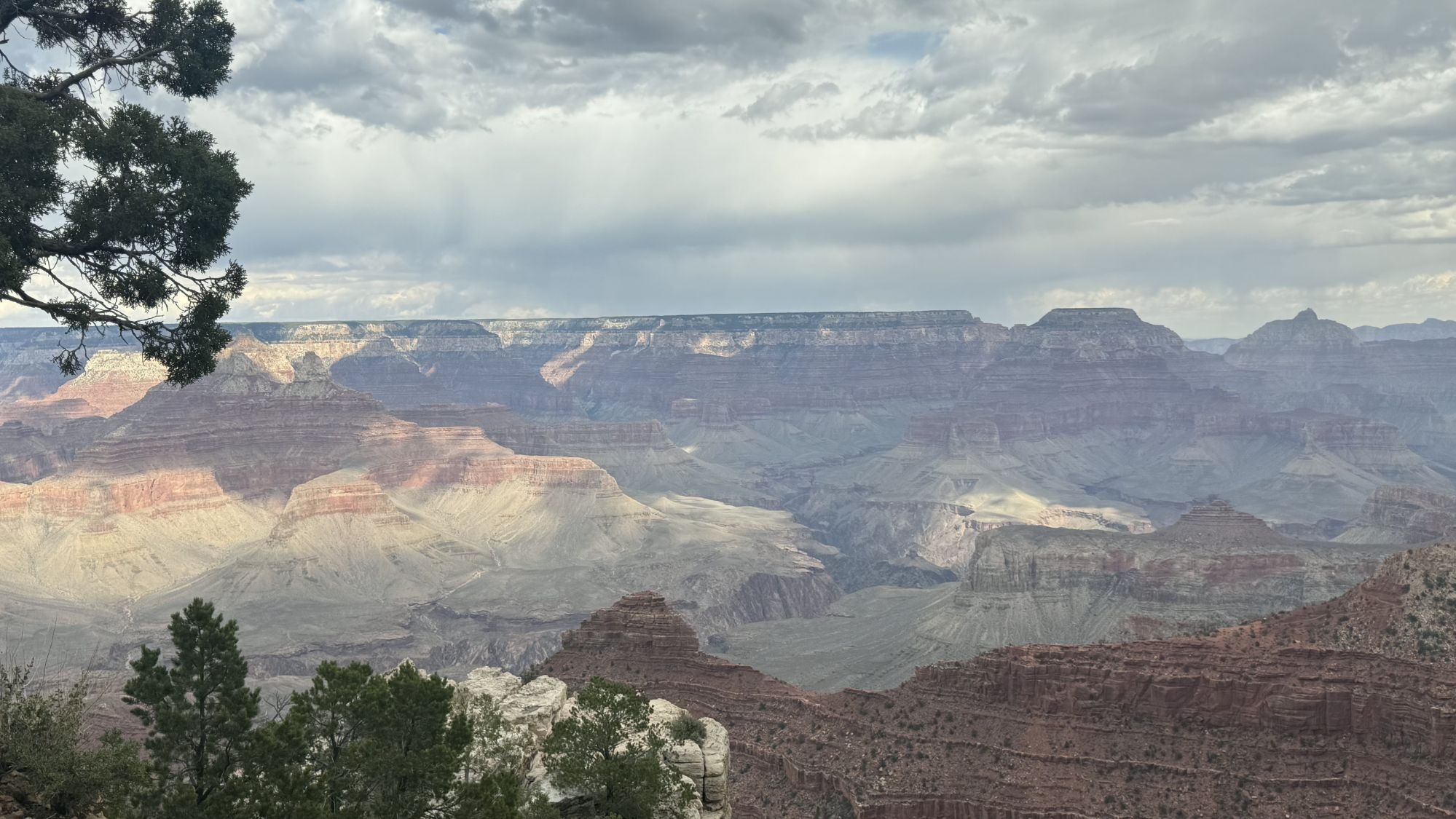
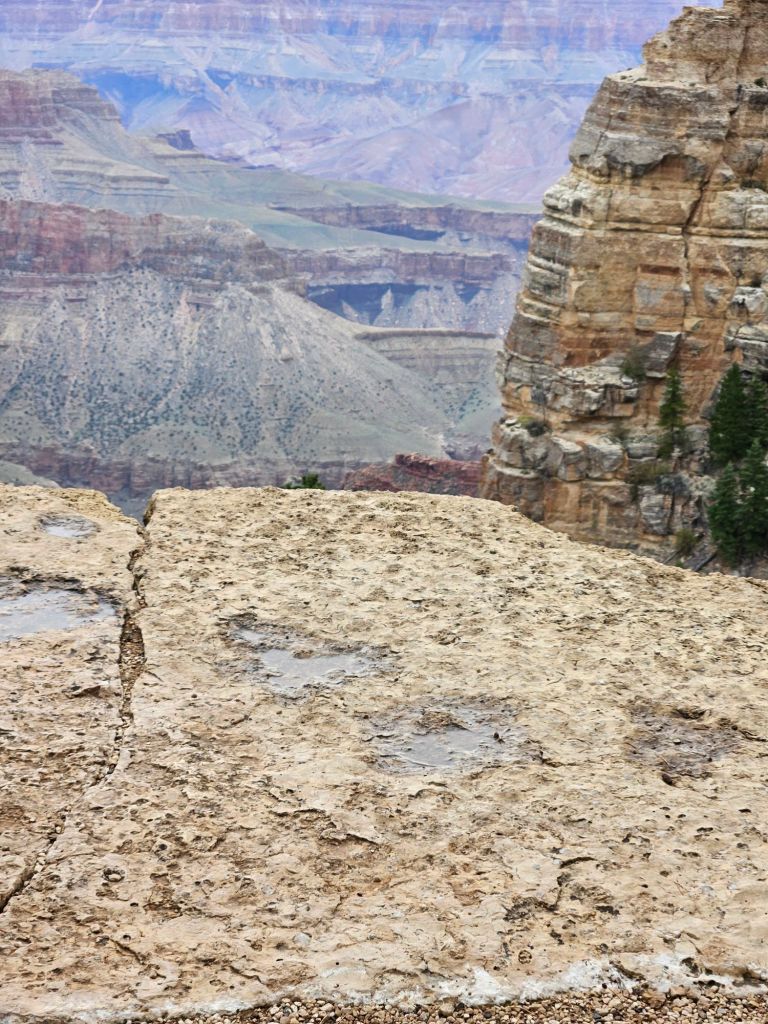
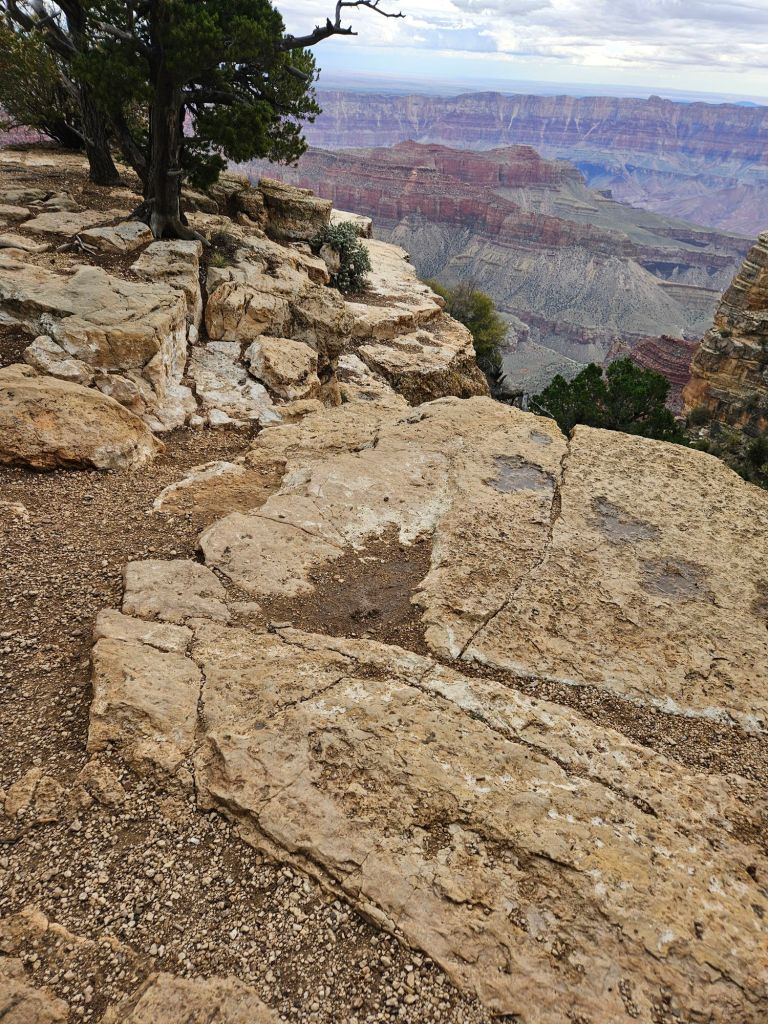
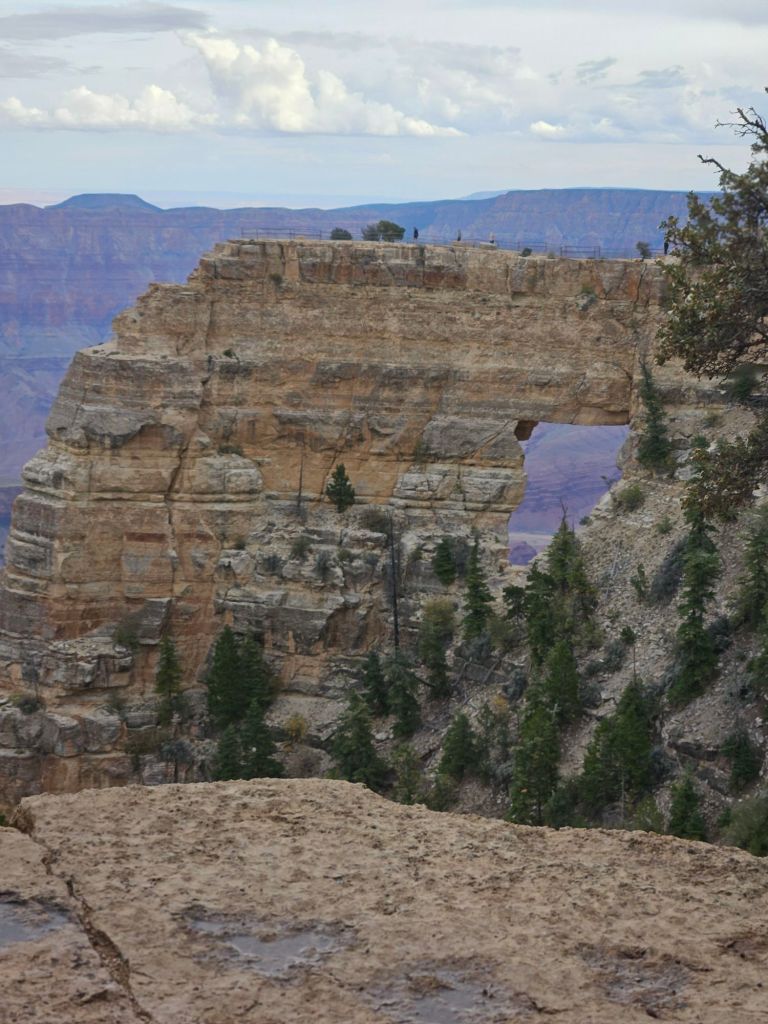
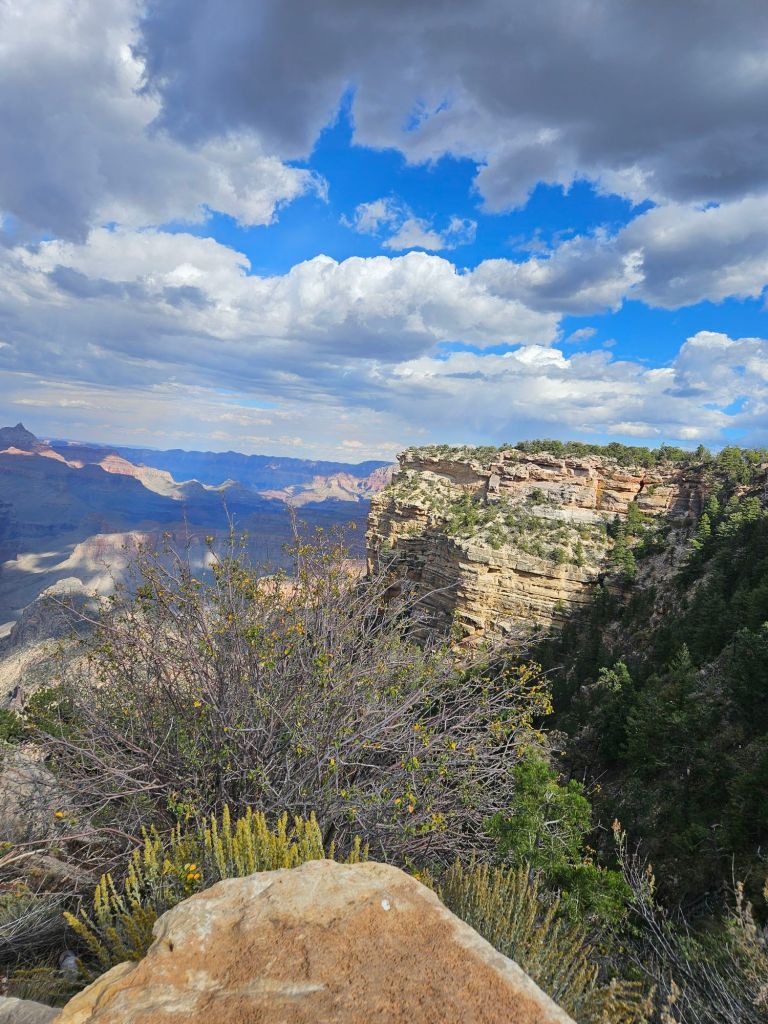
Let me say once again that there were no railings. There were no cautionary signage that says stay away from the edge. It was raw, it was wild, you are basically on your own to take care of yourself. We walked to an area where there was a rustic bench. Just two or three yards from the edge. I sat there and stared in awe, while Tracy and Kelly walked further to the Angels Window overlook. This window, an eroded archway in the limestone cliff, allows you to sit and look through the window. I didn’t realize that’s what I was doing, i thought that purple smooth looking area, which was the arch, was a large purple rock, when in actuality, I was looking through the window to the other side of the canyon.
I sat there for quite a long time, I eventually started to worry, and I was getting cold. Large black clouds were coming over and I was beginning to feel the spitting rain. I had read that Tropical Storm Rachel was going to come right over the top of us. There weren’t many people there to begin with, but by this time there was hardly anyone there, but us, maybe one or two cars. Eventually, here they came just as the rain began in earnest.
We climbed into the truck and once again, Tracy made turkey sandwiches. I still had my leftover fish sandwich, which I ate along with chips and drank sparkling water, again. Since we were only one of one or two cars left in the parking lot, we knew we had the 23 mile long, run down Cape Royal road, hugging the road away from the rim.
In the darkening sky, it began to rain in earnest. It began a deluge in earnest. The wind was blowing and Rachel’s outer bands had reached us. It wasn’t supposed to hit in earnest until 5:30 am after we were already snug in our beds in the cabin at the Lodge. At times we could ride in the middle of the road away from the edges, but at times there was nothing for it, but to ride on the rim. We finally came down to the main road taking us back to the Lodge.
There had been warnings that we should watch for flooding and falling trees. In places the road was flooded and water was coming down off the mountainside in torrents, filling up the ditches and overflowing. Once again, Tracy’s ability to drive was beyond compare. We saw an elk, come out of the woods and onto the road right before we got to the Lodge.
Our cabin was absolutely freezing. And after bringing our luggage in, we were all pretty wet. There were two small space heaters and a wall unit, which never worked. Kelly and I decided we wanted to try the buffet. So we left Tracy in the cabin to take a shower.
While we were gone, all the power went out while Tracy was in the shower. Stark naked. She hollered out, “who is there”? and then thought perhaps there was a ghost. It was nobody, so she called the front desk and a maintenance guy came and said we couldn’t run both space heaters. Since it was near freezing, we were not happy. But in the end, the one space heater did a pretty good job.
The buffet was nice, but wasn’t very good. There were meatballs in gravy, pork chops, kind of a chicken fried steak, mashed potatoes, a salad bar, creamed corn and green beans and a plethora of desserts and ice cream. I don’t know if my nerves were on edge, or what? But I hardly slept that night. I was up and down, at least a dozen times. Right on time exactly at 5:30 am, Rachel hit big time. Kelly thought she felt the cabin shake.
Tracy and I got up fairly early, probably about 7:30. I was hungry, but Kelly had advised. Tracy, that the food wasn’t very good, and that we should eat once we came down off the plateau. I agreed and we drank some protein drinks and ate granola bars. We were taking a drink back to Kelly to wake her up so that we could get on the road, not knowing what we would encounter as far as the tropical storm was concerned.
I wanted to use the bathroom before we got on the road. I sat down and was doing my business when the whole bottom of the toilet tank broke off. With my pants down around my ankles, I tried to reach the turn off valve but couldn’t, so water was spewing out full blast. I was up to my ankles in water. Tracy and Kelly heard the tank break. It sounded almost like an explosion. Tracy wanted to come in right away to help. But I had to at least get my pants up around my hips. As soon as I let her in, she got the water turned off immediately.
Tracy went to the front desk and told them about our situation and they said, “no problem, we’ll get to it.” They certainly weren’t in any hurry since hearing that we had the water turned off. We left the Kaibab Lodge a little worse for wear I’m afraid. When we were about to leave, I went into the lodge restroom and the owner seemed more concerned with whether I had been hurt or not. But just to safeguard our innocence, I took pictures of the tank before we left in case there were any insurance issues. I would have needed a sledgehammer to have broken the bottom of the tank. It couldn’t have been my fault.
Sunday
So now it’s Sunday and time to drive home.We hit some pretty rough patches of rain and wind. But mostly it was uneventful. We came off the plateau and back onto highway 89, going back the amazing way that we had come. It was no less amazing to us, on our way back, than, it had been on our way there.
Tracy heard that we should stop at the Cameron Trading Post, and so we did, and was it ever worth it! It’s kind of like a small little shopping area, but the Trading Post is huge with every kind of jewelry, rugs, and art you can imagine. If I’d had a million dollars, I could have easily spent it all.
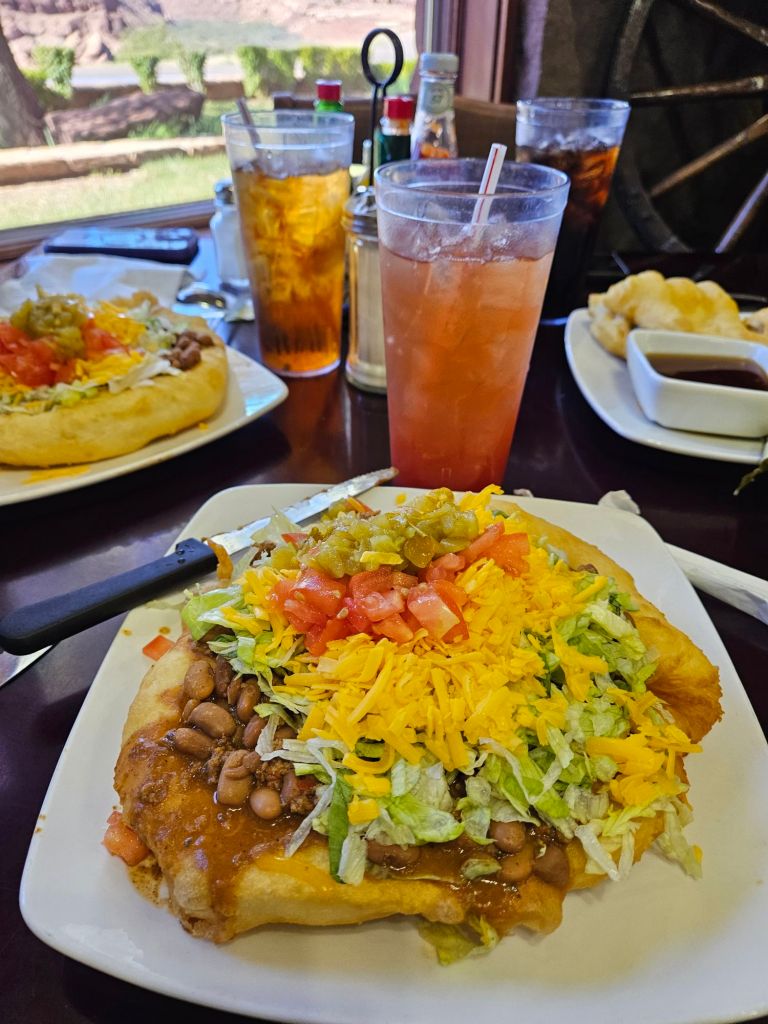
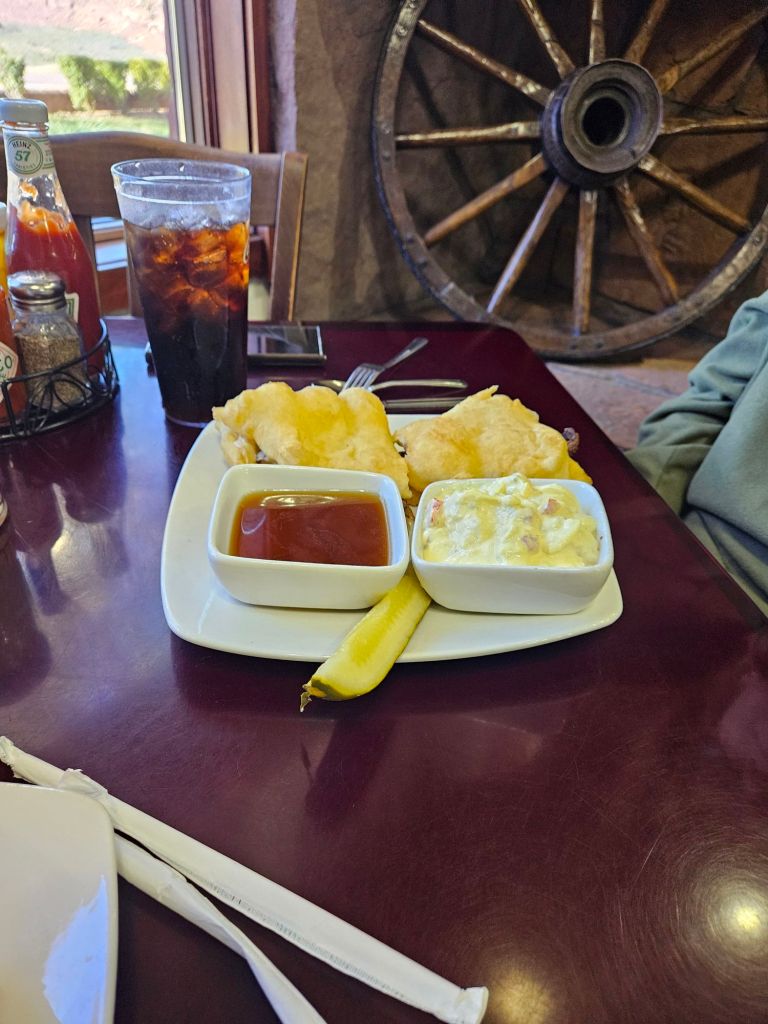
The main attraction at the Trading Post for us was the restaurant. We hadn’t eaten yet. After a wait of probably 20 minutes, we were seated. Kelly and I had fry bread tacos, and Tracy had a fry bread french dip. These things were enormous, and I brought over half of it home to eat that night. I also loved the lemonade with prickly pear.
Then, it was time to make a beeline to Phoenix. Tracy had to work early in the morning, and so did Kelly. And I needed to leave for the airport by 8:30. I needed to pack everything in the evening so that I didn’t have anything to do in the morning except get up, get dressed and get out. After eating leftovers of fry bread tacos, I headed to bed. We had traveled 900 miles in 3 days. It was time to rest.
Monday
Time to go home. I always leave reluctantly knowing that i’m going to miss these girls and Arizona and besides, their dogs, Bug and Babaduke. I was leaving with a suitcase full of Kelly’s amazing polished rocks and geodes and more books. I was carrying my Cosanti bell in my backpack. I couldn’t leave that thing out of my sight. But more than anything else, I was taking my memories of this trip with me in my mind, and in my heart and the changes it made in my soul.
There are no words to express my gratitude for the love, care and experiences that I get from Tracy and Kelly.