I talked to Jack for a long time today. What I love about still being able to be close to him is that our memories are the same and that we share those memories.
My dad, in jest, used to call himself “dirty dog Anderson,” and my brother Steve, when he was in high school, called himself, “Beatleman”. If you saw how he dressed, you would know why.
There’s no one else on earth that would know those things. We have laughed about them now for 60 years. I don’t know if you can possibly know how precious this is to me. If Jack and I were completely estranged, which for a while, I thought we would always be, we wouldn’t be able to share these memories.
My family loved our dog Gypsy so much that when we would see home movies of her, the entire family would be in tears. I found Gypsy, a small, tan, beagle type dog lost in front of our house. Jack and I share this memory. His memory is so sharp that he remembers things in such clear detail that he can fill in areas that I no longer can remember.
He remembered today, exactly the little secondhand shop where he bought me an authentic Navajo ring of carved silver set with a deeply orange/red carnelian stone. I’ve been remembering how much of myself was formed as a young girl from 16 through our entire relationship because of things that Jack said and did. I remember the things that he bought me. He encouraged me to learn and to stay curious.
He bought me art supplies and paid for art classes. He introduced me to music and artists, and literature that I may not have run into on my own so early in life.
He bought me clothes and artwork of all kinds and taught me the value of handmade everything. We shared foreign films on days when we didn’t feel like going to school. Instead, we would spend time in the art museum, in galleries, in cinema houses and the library. We lived in houses with character and historical value. I could go on and on, but I don’t know where we went off the rails.
But off the rails, we did go… some 30 years after we started. We used terrible words with each other, though we knew so many beautiful words. We hurt one another, and yet we held it together for so many years. I’m not sure that we could have salvaged our relationship. I don’t think I could stand it if I thought we could have saved it. It’s easier and less painful for me to think that our parting was necessary for our growth. Just as a plant needs pruning to continue to grow and produce flowers and fruits and vegetables. Sometimes, those plants need to move away from one another and give each more room to grow.
Regardless, I treasure the times now when we do talk, and when we remember. It’s good to know people who have known you through the journey.
And now, as far as my immediate family, there’s just Steve who knew me back when. Maybe it’s our ages, but with these two, Jack and Steve, my life has contiguous meaning.
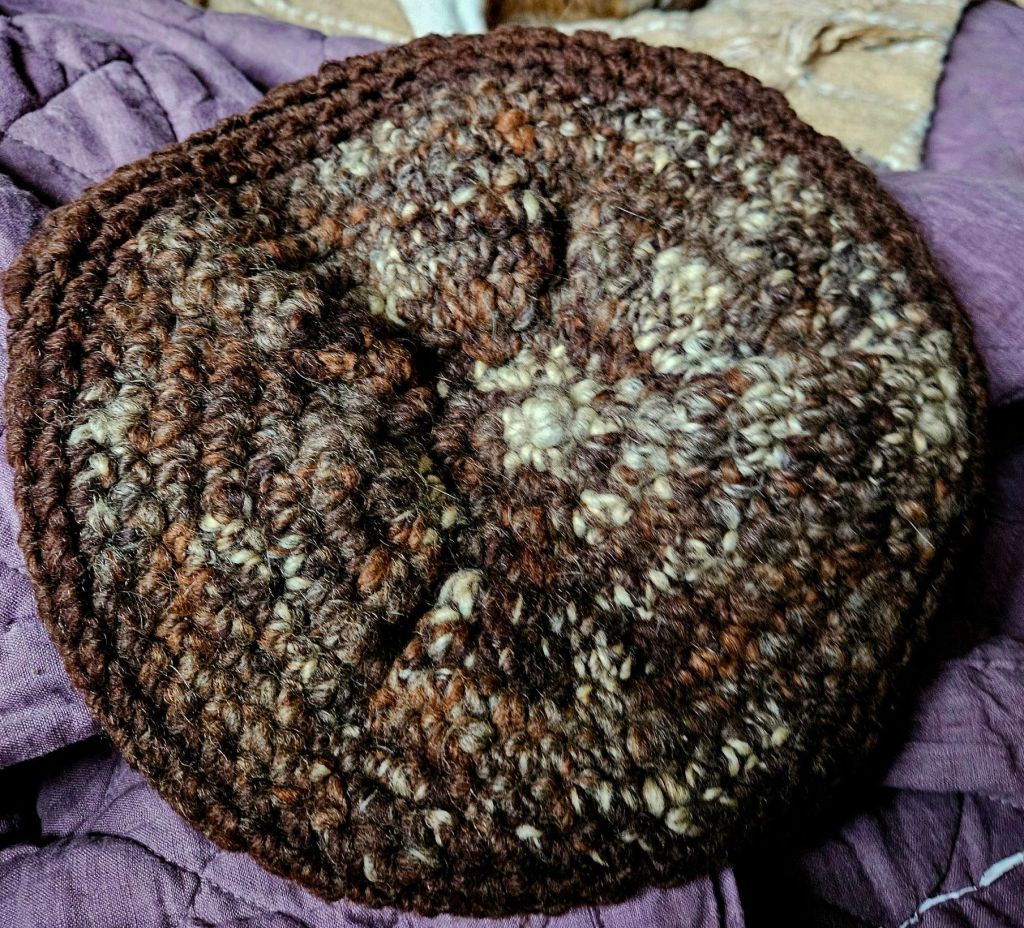
When I was rummaging around my room this morning, I came across this hat that was peeking out of a basket from under other winter wear. It has been years since I paid much attention to it… since I had begun to knit my own hats some years ago.
I, at first, mistakenly identified it as the art of the Cowichan Indians of British Columbia because of the natural colors and unplied yarn used by the tribe to create mostly sweaters and hats.
Sometimes, I’m good at remembering details, but other times, I’m not.
Actually, Jack reminded me that it was the famous Paula Simmons who knit this hat. She was one of the first PNW (Pacific Northwest) artists to raise and shear her own sheep. She processed the fleece, carding, and spinning the fibers, creating the yarn to finally knit garments and accessories like this hat.
With the help of Jack’s memory, he reminded me where we bought this hat. The time frame had to be between 1969 -1972, when we were living in a small house in St. Johns in North Portland. We were just married, and before children. We bought it on a trip to Seattle, Washington, at an art gallery/ craft store at the Space Needle. The store and its name are long forgotten.
Part of my confusion was that I did own a Cowichan Indian sweater, and the hat was created in a similar yarn. I know we bought it before 1972 because I have at least one photo of me wearing it in 1973 – 74, walking through a snowy forest with two year old Hannah, riding on my back. ( I will post the photo when I can find it). That means it would be about 52 years old. (I found it)
The hat, the sweater, the girls, and Skokie the dog
It is knit in unplied and undyed natural sheeps wool. It’s never been washed, and you can still feel the lanolin. The wool is very rustic and rough to the touch and still causes my forehead to itch, but it’s the warmest hat I own. The wool, in its natural state, is completely waterproof… not water resistant but waterproof.
It is in perfect condition without so much as a moth hole. It could pass for “unused.” This hat is one of my most treasured possessions, and it’s probably worth only a few dollars. The Cowichan Indian sweater was bought around the same time, but unfortunately, it burned in our house fire in 1974-75. I so wish I still had that sweater.
Jack bought the sweater for me when he worked for Norm Thompson. (A thorough history of Norm Thompson Outfitters is interesting and can be found on wikipedia.)
If you’re curious about the Cowichan Indian’s trade in knitwear, please see the following website for more information. Here, you’ll see lots of photos of the sweaters and the knitters, and their fascinating history: http://knitwithpurpose.com/knitters
I see that the Cowichan Trading Company store, established in 1947 in Vancouver, BC, has closed permanently. I don’t know what this might mean for the trade in sweaters, but I see that there are stores still stocking them, and there are many new and used online.
Original, authentic Cowichan Indian sweater
All of this interesting stuff because I found my hat made by Paula Simmons.
His long, curly, disorderly salt and pepper hair exposed his age, for his body did not.
Every morning, he sailed his small fishing boat out into the bay of Zihuatanejo and back again in early afternoon.
The rest of the day was spent selling fish and cleaning the boat inside of a small boat house perched over the bay. Fe Dáncio had been a fisherman from childhood and had lived in Zihuatanejo from birth.
While in Zihuatanejo, I spent my days on the beach where the pounding waves pummeled me, where I lay in the sun, where I ate in the small cafés along the beach, where at night I could be found in the small clubs along the beach, dancing.
Tired early, I returned nightly to a small hotel just steps up from the sand. At one time, it had been painted pink with white balustrades with cool orntamental Spanish tiles to walk on. I slept on the balcony in a hammock swinging under palms and flowering plants. I slept soundly. The soft breezes swished through the leaves, murmuring secrets from the past, as did the waves on the sand.
I woke early with the sun and watched the fishing boats bobbing out into the bay. All I wanted to do was the same thing that I did yesterday and the day before and the day before that. For a few dollars, a small cafe next door offered my favorite breakfast of pancakes, papaya, and other fresh fruits and all of the orange juice I could drink… And Nescafe.
Throwing on a swimsuit and a pair of shorts, i would walk into the sea, spending hours doing nothing. The waves were unpredictable. At times, they were gently rolling, and at other times, they came in violently, casting me to the hard sandy bottom. More than once, I hit my head on a rock. My brown skin was often bruised.
From my place in the sand, I could see the fishermen coming in, and as usual, Fe Dáncio drew my attention as he walked from the boathouse. I can’t explain it, but to me, he was muyatractivo. His skin was dark. He was muscular. He was weathered but smooth and shiny, if you could imagine it, and his hair was wild and wind blown. I, of course, noticed that he had an eye for the women.
One day, he approached me. We took up a conversation, and he invited me into the boathouse to see his small fishing boat. Since I am fluent in Spanish, we talked for hours, and he told me about his life. We sat in the sand later, continuing our conversation. He seemed as curious about me as I was about him. We ate some dinner, and then he invited me to his house.
(My acceptance of his invitation was not unusual for me, for I visited many houses belonging to strangers. Remind me to tell you the story of visiting a family on an island in a yellow lagoon in a village that grew coconuts only accessable by flat bottom boats.)
Not Fe Dáncio’s place
We walked to a secluded area of the beach where the locals lived in small houses, surrounded by gardens. He lived in a small board cabin outside of his mother’s house in the soft sand among mango trees and lush plants. His mother offered to feed us, but we declined having just eaten.
It grew dark. We sat in his house and talked into the wee hours of the night. I grew tired. He offered his bed for me to lie down on. As he laid down beside me, he offered me a smoke. We smoked quietly, staring into the darkness of the sky. The candle light was dim, and I began to drift away. I was high like I had never been before. I was mesmerized by his gentle touch.
Once in a while, he would send me to the outdoor shower where soft, cool, and refreshing water woke me once again to a night so pleasant, I didn’t want it to end. I only remember waking to a chicken crowing in a tree outside his front door.
Fe Dáncio had gone fishing. He left me a plate of mango and papaya and a glass of orange juice. I hadn’t heard him wake or leave. I slowly dressed. After a night of such indescribable hallucinations and pleasure, I was surprisingly refreshed. I went to my regular café for breakfast and returned to the beach to swim and to lie in the sun.
I never saw Fe Dáncio again. I did not see his boat return, nor did I see him walking along the beach. Though I spent weeks in Zihuatanejo, I was left only with this memory of him. It is so vivid, yet I wonder if it really ever happened at all.
This is the beautiful cable hat from the yarn that my friend Judith brought me from ireland. It took such a short time to make. I’m already wearing it. I think it is my favorite hat so far. And I love it especially today because our temperatures dropped below freezing for the first time this fall.
I won’t go into detail about it since i’ve already written a post with all the details.. Cozy things are important on days like this. Thanksgiving is over, and now to wait anxiously for Christmas and to enjoy all of these cold days that are ahead of us.
The fruit cake was made yesterday while we enjoyed leftovers and a fresh charcuterie board. For those of you who suffer from lactose intolerance, did you know that if you eat deeply aged cheese, that it won’t bother your stomach? Anyway, happily, it doesn’t bother mine.
What is Christmas without the wonderful fruity dense cake that i’ve been making for decades now. The fruit was soaked for over a week in rum. Now it’s wrapped in cheese cloth soaked in rum and wrapped in foil to wait for another month..
I’m hoping the christmas tree comes today. There are just a few things that I enjoy more or as well as a christmas tree. I’ll spend the rest of today knitting on the pair of socks that I started before I cast on the irish hat.
I wish and I hope, which doesn’t come easily to me, that there is joy and, most of all, peace in this holiday season for you and yours, while we remember that many suffer. And so it has always been.
When weed came in kilos across the border from Mexico, it was simple. That’s when a kilo was $35-$60. When you most likely bought a lid in a plastic sandwich baggy for $10 from a friend.
When what you bought was smattered with stems and seeds that would pop and burn holes in your clothes or in your davenport or the seat of the car.
When a part of opening the baggy, and before smoking, was performing the ritual of carefully picking through and cleaning out the debris.
When Zig Zag papers were bought at the corner store to roll a joint. When one took pride in knowing how to roll a perfect joint or a giant “doobie,” It was an acquired skill.
We rolled joints by hand that wouldn’t fall apart, clear to the finger burning end. Or maybe someone had a pipe and sometimes a hooka.
When we all had “roach clips”. Making a nice “roach clip,” was a work of art and creativity. Does anyone even know what a roach clip is or use one anymore?
The very last bit of a joint, or roach, was savored by slipping it into a clip and holding it to your lips so as not to burn your fingers. How very handy they were.
PS: Those treasured relics pictured above are more than 50 years old, probably closer to 60. They were made from the bristles of the street cleaners brushes that one could find in the gutters while walking the streets of Portland.
Once upon a time, I had a little scamp. He was lovely. He was the palist of hue yet turned brown as a berry in the summer sun. His eyes were bright and crystal blue. His hair stood on end and was near translucent, so white it was. He was round and soft and yet full of vim and vinegar but smelled of sugar cookies.
We named him Jesse, and as soon as he could move about, he had no fear. I chased him about the house and the yard until he wore himself out. He fell asleep wherever he stood or sat. He might be standing on the couch looking out the window at the sea, and just there, his little knees would bend, and there he slept, little body pressed against the back of the couch. He might fall asleep with his face in a plate of pancakes and syrup. I might find him under a table soundly sleeping. There was no need to coax him into nap time. His little body could move no more.
You might say he was a born adventurer. Once he could crawl and then walk, he was off. Since we lived on an island overlooking the Puget Sound on a 200 ft. cliff, one needed to keep a close eye on this little scamp. Did I ever lose him? Well, one time, I thought I did.
This small little scamp knew what he wanted, and though sweet as honey, he could never accept the word no. When he was still no more than two feet tall, in protest, he would cast himself backward against whatever hard surface with ear splitting and excruciating wailing. I often wondered how this beautiful boy could make such a racket and cause such chaos.
What joy and worry my little scamp caused. Once, while leaving a meeting, I walked out into the busy parking lot. People and their children were milling about. Cars were backing out to leave. I assumed that Jack had Jesse with him. I was not paying attention to my children as I was bidding others goodbye. Across the lot, I saw Jack with our daughter, but I didn’t see Jesse. He was not holding on to Jesse’s hand. Suddenly, I began to panic.
I was frantically looking for him. I called to Jack to ask where he last saw Jesse. I didn’t wait for his answer as I ran wildly around the parking lot. No one said a word as I dashed about, calling his name. I suddenly stopped, realizing that I had Jesse sitting placidly on my left hip, his big blue eyes saying, “Here I am, Mommy.” It was just like someone looking for their lost glasses that were sitting solidly on top of their head, so accustomed was I to this child in my arms.
What madness it is to have a little scamp of one’s own.
And thus began a life of tears and of stitches and broken bones.
Just recently, I found the answer to a mystery I had given up on resolving many years before. I mostly didn’t even know that I was still looking, but the search was hidden away in my heart to emerge only occasionally.
There were few things of value that I even cared about because Mom left so little behind. But there were a few of precious value to the heart only. Nothing she ever owned was embued with monetary value.
But there was one mystery to solve, known only to me as, “The Missing Heart.” I would have found the answer if I had known to ask the right people. Why did the loss of this small charm occur to me again? Oh, yes, I remember! My niece, Sharon, was going through her mother’s (my sister’s) jewelry and came upon a bracelet she didn’t recognize, and neither did I.
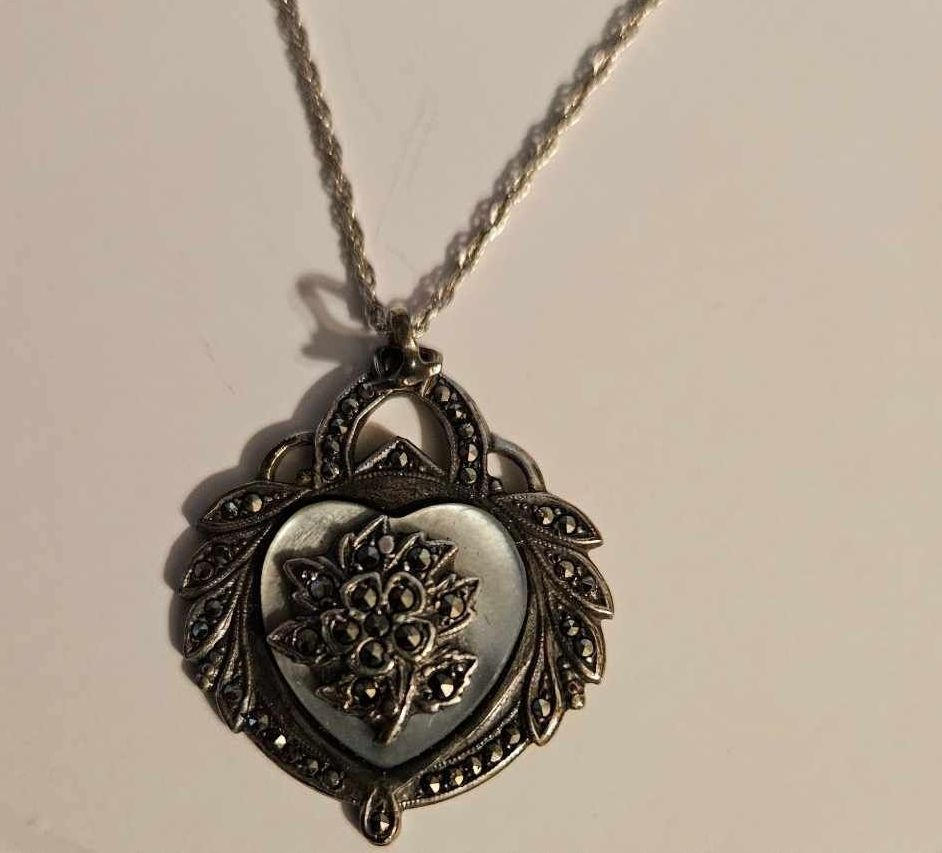
I asked if among her things, had she come upon a small silver and marcasite heart with a mother of pearl inset? At first, I couldn’t remember the stones, so it was hard to describe. Her first answer was, “No”, she said, but she would keep an eye out for it.
I looked online to see if I could at least find something similar to help her identify it. Why did I even care, you might ask. Because, as a small child, like all curious children will, I loved to look in my mother’s jewelry boxes and in her top drawer to see her linen hankies and soft gloves of silk, cotton and leather, small veils of soft netting, hat pins, hair barretts and other small pieces and mementos.
On top of her dresser, among the crystal bowls, was her hair brush, a handheld mirror, and containers of face and body powder and fancy glass bottles of perfume and fragrant lotions.
There, also sat my favorite music box. It was a small wooden piano with just enough room to hold a few small pieces of jewelry.
The music box
Mom’s dresser was always dusty with the powders she used liberally. Her favorite perfume was Tweed. The fragrance is strong, with the tiniest bit of floral notes to keep it feminine, but mostly, it is dark, moody and earthy, woody, and resinous. Perfect for Mom, but not for a small child or even a teenager. I was never tempted to use it, but it smelled spectacular on my loving yet stoic mother.
But, back to the heart.
I sent my nephews and neices online images of similar items. Sharon said she would continue to look. She said she would also ask the other girls. My sister had three girls and four boys that she left behind way too early. She also said that there was a story that went with that heart, if the one I was looking for was one that she remembered. I didn’t remember any such story.
Not long after, another of Kristi’s three daughters, Shauna, sent a message with a photo of the heart. “Is this the one you’ve been looking for, Auntie?” she wrote. I couldn’t believe my eyes.
There it was! She explained that her mother had given it to her, before she passed away, to wear at her wedding. Sarah, one of the three daughters, now had it to wear at her upcoming wedding.
She went on to explain the story behind the heart, a story I had never heard: It was a gift from Mom’s first love. If that’s true, why hadn’t I heard it?
I should have been happy just to know that it was still in the family… but. I wasn’t. I was hurt, confused, and frustrated. When did Mom give that to Kristi? Not known to lie nor even to be secretive, could Kristi and Mom have kept this gift giving a secret? When did this even take place?
I couldn’t be upset with the girls, and of what use is it now for me to be angry with Mom and Kristi, now that they passed on years ago. I decided to sit with the feeling. I couldn’t shake it anyway.
Now, after a couple of weeks, I guess I’m happy that the heart is in safe and loving hands. Somethings I’ll never know, like when or why Mom decided to give the heart to Kristi. We were and are a close and loving family. I know also that Mom and Kristi hadn’t between them, an ounce of secretive intent.
Each of the girls wore the necklace at their wedding, and if I had it, it would have been enjoyed and cherished by only me.
“I beg you to have patience with everything unresolved in your heart and to try to love the questions themselves as if they were locked rooms or books written in a very foreign language. Don’t search for the answers, which could not be given to you now, because you would not be able to live them. And the point is to live everything. Live the questions now. Perhaps then, someday far in the future, you will gradually, without even noticing it, live your way into the answer.”
–Rainer Maria Rilke, Letters to a Young Poet (1929)
There are a plethora of songs and poetry and of stories written about heartbreak. I have had my share, but there are some that still break my heart that are still etched in my memory.
These words hurt so badly because I knew at the time that they were true.
These pierced my heart, and I thought I might die. If you know, if you’ve loved like I’ve loved, you know how bad it feels to lose someone.
As we lay beside one another, he said softly…
“I don’t love you anymore. I know how much you love me. I love her like you love me.”
Why did he have to say those words? It would have been easier if he had just left. It would have been easier not to have heard them.
Some words we can never forget.
Why did these words come to me today? Like any kind of grief, it washes over you like the waves of the sea, and you have no control over your heart and how they make you feel. It was a song that brought them back.
Yesterday, I was going through old photographs and there was Auntie Wilma, her midriff top pulled off her shoulders, in shorts and looking quite glamorous. So, I’m eating cinnamon toast in her honor today. Sometimes after school she would come over and we’d make cinnamon toast and eat until we had finished the entire loaf of bread. It was the same when I went to Grandma’s house when Auntie Wilma came over.
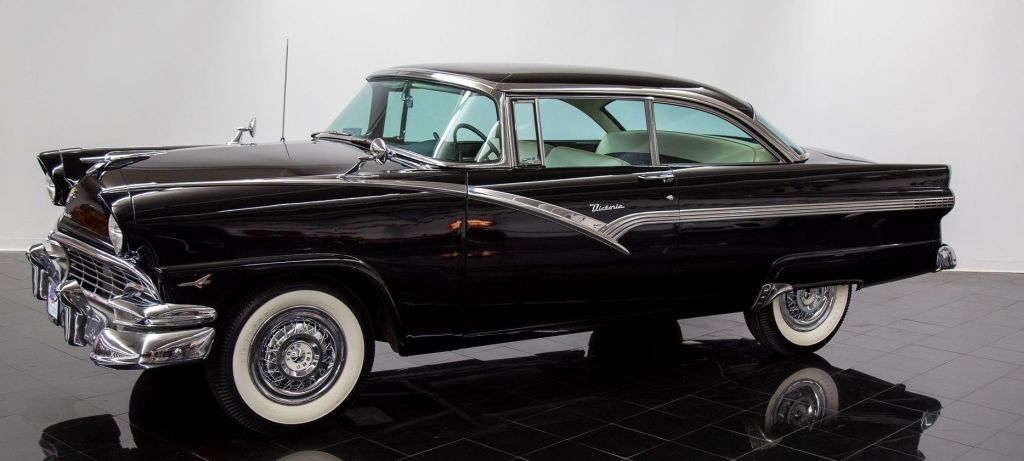
If I could wish for everyone something good, it would be that they grew up with an Auntie Wilma. She drove an all black Ford Fairlaine, totally tricked out in chrome with big fins. The back seat was littered with candy wrappers, empty bags of chips, and empty soda bottles.
Auntie Wilma’s1956 Ford Fairlane
When I was in grade school, she worked as a soda jerk in the bowling alley across the street from my school. Mom and Dad forbid us to bother her on the job, but occasionally we’d get to go in to get a chocolate milkshake… on the house. I was so proud of Auntie Willma and loved to see her coming and I loved to tell my friends that she worked in the bowling alley and she was MY aunt.
Sometimes on the weekends, if there was a bowling tournament, she would pick us kids up and take us to watch her bowl and to eat all of the chips, and sodas, and ice cream we could stuff into our mouths. Either on our way to the bowling alley or on the way back home, she would surely stop and buy us hamburgers and milkshakes that we were allowed to eat in her car. If we asked her where we were going, she would always answer with one word, “Timbuktu”. We had no idea what she was talking about but we were just so happy to be hanging out with Auntie Wilma. Later, I found out that Grandpa used to answer her that way when they would go out for drives.
Auntie Wilma had shelves with trophies for swimming, for diving, for bowling, and golfing. She had a great figure and loved showing it off. She loved going out dancing and was an award winning jitter bugger. When I was in high school, she liked coming over, not only to eat cinnamon toast but to show me that she could fit into my clothes. She loved flirting with my boyfriends. I think they liked it, too.
As a child, there was nothing better than having Auntie Wilma come over or to take us out in her big black car. When I was about eleven years old, she adopted a child. Occasionally, I would babysit for her because she was usually working as a night bartender. I thought she was quite lucky and lived an exciting life. And I was lucky because she would bring me home Chinese food or some other food from some bar or restaurant where she was working. She’d wake me up after 2 o’clock in the morning, and we’d share the food and we’d talk. Now, I can’t imagine what we had to talk about, but we were close.
It wasn’t until I was an adult that I found out that Auntie Wilma rarely made good choices in her life. She must have been the source of a lot of pain and suffering for Grandma and Grandpa. There’s some really bad things that she did in the family that I won’t mention here, because I loved her so and this is a post about me honoring Auntie Wilma today with cinnamon toast. It hurts me to think about those things because when I was younger she was magical.
No matter what, she was loved, and she loved us. Only if you had someone in your life while you were growing up, like Auntie Wilma, will you understand what I mean. I don’t even know if she was happy or not. All I know was that she was pedal to the metal. I don’t ever remember Mom and Dad saying one negative word about her, not even to warn us against turning out like her. Before I knew better, I practically worshiped her. I know better, and I’m glad she was not my only role model but only one of them because she was fun as hell.
PS: While looking at more photographs this afternoon, I ran into photos of Auntie Wilma in office wear, looking very professional. Somewhere tucked deep in my mind are memories of hearing that at some point she had office jobs, maybe even before I was born or before I was totally aware that she was my aunt.
To be fair. I also want to mention that she was a great fisher and hunter of, in particular, venison. We often went fishing with her and often went to the beach with Grandma and Grandpa and Auntie Wilma. Dad, Auntie Wilma, and Grandpa would swim out into the frigid Pacific Ocean and have been known to swim with seals.
No matter how much I write about her it doesn’t seem to be enough.





 eyeamdust