While living in Mexico, I learned what the rainy season really is. We’re talking rain so thick, so heavy, so hard that it comes through the roof.
We’re talking thunder so loud and that lasts so long that I swore that it alone could kill me.
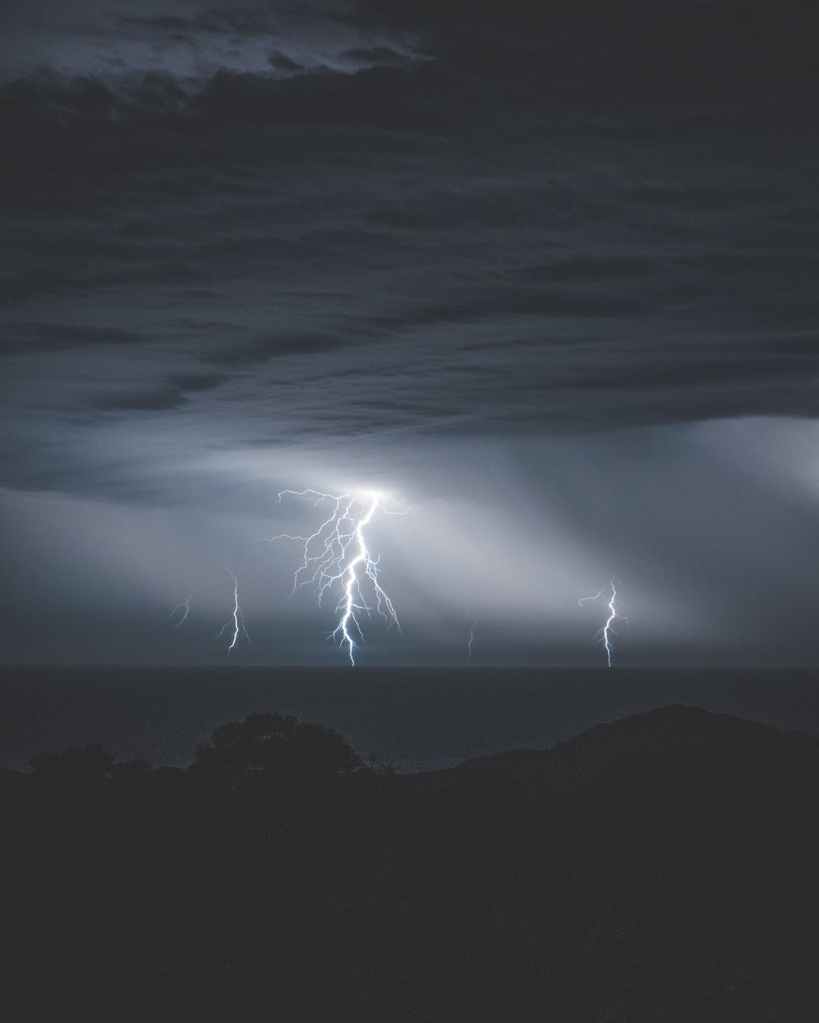
And the lightening. Lightening that lights up the world every bit as bright as daylight.
We’re talking the jungle itself being torn away and swept into the streets… torrents of water carrying trees, and plants that wash down from the hillsides, into the streets and into the ocean turning it into a swirling brown mass of debris.
The only thing to do was to climb onto the bed, open the balcony doors and watch the show. Sometimes the storms would last so long that my nerves would shatter.
Geckos and insects would come in to shelter on the walls and take cover in the corners of the ceiling.
And then it would be over as quickly as it started. The heat persisted because the rainy season happens in summer… 100° and 100% humidity. Was it refreshing? No.
Always sweating, always wet. It was too hot and wet for hair, for jewelry, for underwear. Earrings would heat up and burn my neck. I cut off my hair to the scalp. And underwear? What for?
My roof leaked. Not leak like I could catch water in buckets, but water that stood inches deep that I sloshed out and off the balcony and into the street with a broom.
I’d had enough: I called Juan Manuel to fix my roof.
Juan Manuel sent Juan Manuel and Manuel to fix my roof. Meanwhile, Juan came. I thought Juan was sent by Juan Manuel but he wasn’t. I had to send Juan away. So Juan Manuel and Manuel fixed my roof. Sorry Juan for the confusion.
Every year Mom went to see the Christmas boats parade on the Willamtte River. Lil’ Mil’, as we called Mom’s friend, Millie Sargent, owned a houseboat just north of the Sauvies Island bridge.
We went with Mom for a few years. What fun! There was spiked eggnog and clam dip and lots of other snacks and a lot of shouting and cheering and waving our arms about. We dressed in warm coats and hats, gloves and scarves and sat outside on the deck. The river there is narrow and some boats come so close it felt like we could touch them. Some would do circles and drills in front of us. We’d wave and laugh and shout just to see the revelers wave back.
Those days are gone. Lil’ Mil’ and Mom have been gone for years now but the memories are just as clear as ever. Before my sister, Kristi, passed on, Steve, Kristi and her daughter, Shauna, and I left my house to relive the joy of being at a parade with Mom one more time… the Christmas boats parade. We wanted to do this for her.
It was a dark and stormy night. The wind was howling and blowing the rain sideways but this was not going to stop us. Lil’ Mil’ had sold the houseboat so we could no longer enjoy that wonderful place and we did our eating and drinking at home.
We went to Cathedral Park in the shadow of the St.Johns bridge. There were a few other brave souls out. We walked to the river’s edge and walked the steep plank to the dock. The river was rough and the plank and dock were bucking up and down.
We shouted and waved as Mom would have and cried and held on to each other as the boats passed and circled round and round. We stayed until the last boat passed.
We were drenched and happy because we did it to remember Mom. She loved any parade, no matter how small and that wasn’t the first time that she took us out in the worst weather… remember February steelheading? The muddy, slippery, rocky riverbanks. Claming at the beach even before daylight in the pelting rain? Well, that’s a different story.
I miss you, Mom, especially this time of year. You made everything fun.
I guess each and every one of us has our own experience and perspective. My perspective is one of myth and fairytale. Drawing names for gift giving and putting heart and soul into creating handmade gifts of wood, clay, wax, paints and pencils and wool threads, paper and fabric, each item made with a particular person in mind.
We’re grateful for a warm place to bake and for creating special foods. We invite family and friends to sit at our table and around the cozy fire. We read books and share stories and warming drinks.
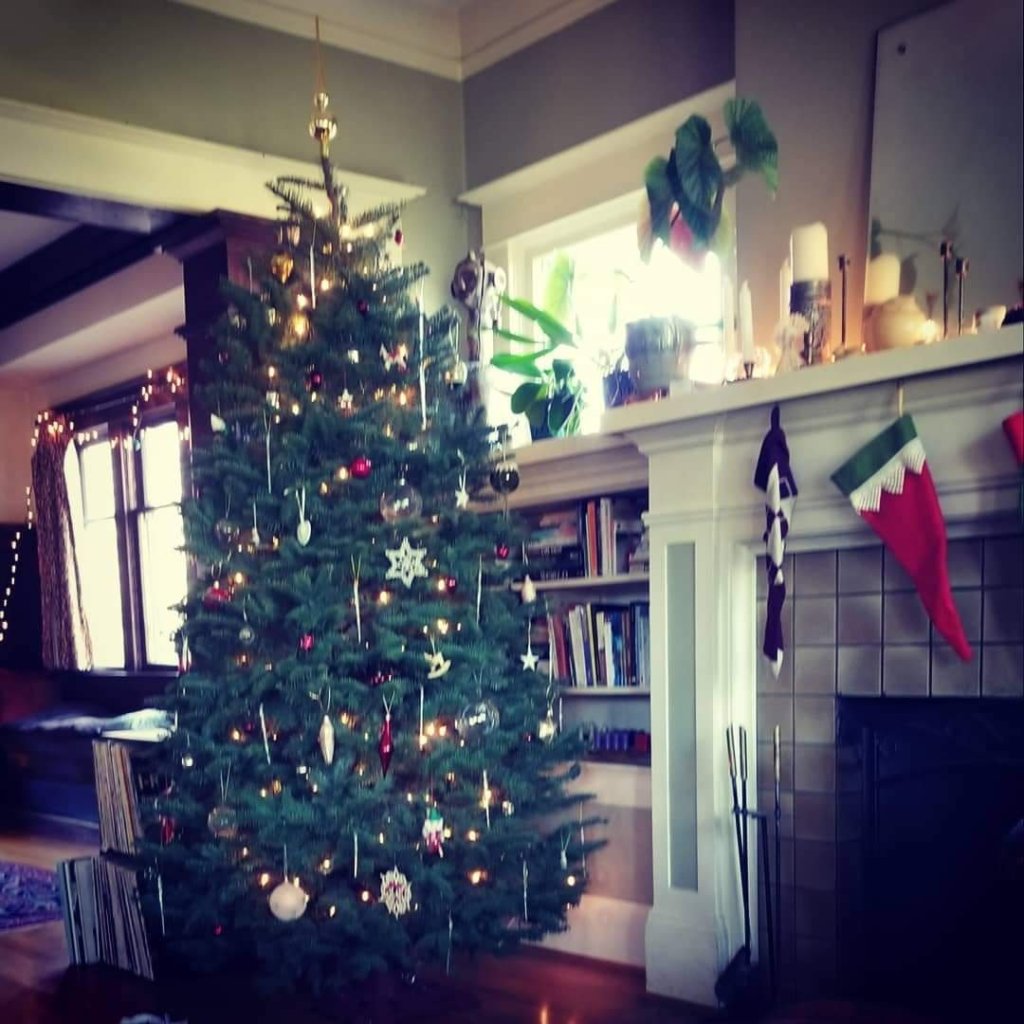
During the season we gather evergreen boughs and leaves and branches with berries from parks to make wreaths and garlands to decorate the house and to give away. We hide small gifts and candy to fill the stockings for Jul morning and pretend the elves have visited through the night.
We’ve spent hours creating our special gifts, hiding them behind our backs if someone passes by unexpectedly. We don’t even share who’s name we’ve drawn… so there’s an air of anticipation… if John drew my name, I might get a painting or something sculpted of wood. If it’s Ivan, I might get a bonsai, if it’s Laura, maybe a knitted scarf or small bottles of homemade bitters. If it’s Joannah, there’s a million possibilities, and from Jerald, handmade candles or a handbraided dog leash or something of leather. From me, someone will get something knitted or a hand-made book.
We use hand decorated brown paper for wrappings and jute ribbons or recycled papers and ribbons from last year and hand cut paper snowflakes. Cards are made from John’s lino-cut designs, or made from recycled cards I recieved last year, repurposed for this year. This year I bought some from UNICEF.
I’m an anti-theist, if a label is required. God doesn’t play into the season, for me. I love the magic of stringing lights and singing and bringing a tree in the house… a tradition that pre-dates what we now call Christmas, Xmas, etc.
I dont care what other people do. If they want to celebrate as they’re told by media advertisements and to go into debt and to get stressed during October, November and December, they can go ahead. I don’t care. We’ll be over here creating and welcoming the darker, colder days with good cheer. This is how we welcome the ending of this year and the beginning of the new with family and friends.
I understand the bah humbug spirit pervasive in society. There’s good reason, of course, but for me it’s deeper and richer and full of meaning. There is the harvest, then the darker and colder season that engulfs us all as we turn away from the sun for some months.
I would be remiss if I didn’t mention that I also know that there are the less fortunate who don’t have the ability to create such warmth and good cheer, and for that I lament. We’ll do what we can.
I can’t remember where I was, what city, but I was in Mexico, that I know. Maybe San Miguel de Allende or Guanajuato.
Sunset Art Print San Miguel de Allende
Traveling with college kids put me where I might not have otherwise been. But my decisions were my own. Nobody forced me to do anything. This is just one of many adventures that changed my life forever.
I was having unusual fun inspite of my normally sedate mother/wife self. Alot had changed, me included. A weight of some sort had fallen away. I was ready to take risks.
Not that I hadn’t been happy. I had been very happy but I was very comfortable with this new me. The minute I stepped off the plane in Mexico for a semester at the Universidad de Querětaro, I wasn’t afraid to die.
As we sped through the streets of Mexico City, I felt that if I died, I’d die happy.
Most taxis looked like they had met with many mishaps. The streets were filled with pot holes of every size. There were metal poles sticking out of the pavement with no apparent purpose except as obstacles. There were hundreds of taxis going at breakneck speed and it seemed that no one paid any attention to traffic lights or signs. Whoo, hoo!
I didn’t die but it was not through any good sense that I survived. This is just one of my mis-adventures. I will be painfully honest, so bear with me, if you will. There will be more stories recounted as I dare to share them. Please note and keep in mind, that I have no regrets.
There is a stereotype, widely held in Mexico, that women and mainly American women are there to go wild. As we know, stereotypes often bear some semblance to truth though are more likely to be erroneous or at least an exaggeration. Since I was in Mexico to attend the university, my intentions were far from going wild.
I had never traveled outside of the US. I was a new student, even back home, with one semester of Spanish under my belt. I was a wife of 27 years and I had two grown children. That made me, let’s see, 46 years old. A student of this age was nearly unheard of in Mexican universities. I was the same age as the mother of my host family.
To say the least, I felt very strange and uncomfortable at school and at home, but I was too excited to be daunted by emotions. I was there for the total experience. On arrival, I was not at all prepared for what that meant, but I was soon to find out.
Lupe, the mother and wife of the household, cooked for me and even did my laundry, while I attended the same university as her children. If that wasn’t strange enough, I left every weekend to either meet with the other American students for drinks and music and exploring town, or I hopped a bus to other cities and often to the beach. Not one of the other students were out of their 20s. So, 20 somethings do what they do and so as not to be left alone to wander about, I did what they did… went to dance clubs.
I won’t say I didn’t like it most of the time. I love to dance and no one questioned my age. I started my Mexican adventure nearly 40 lbs overweight. I walked miles to and from the university four times a day. Even universities take siestas and there’s no food on campus. I’d either walk back home or into the center of town to eat. Before long, I had lost all of my extra weight and had a substantial tan and had gained a good deal of muscle and endurance. Those 20 somethings had nothing on me. It helped that I was going to the beach, swimming and walking everywhere.
Back to the dance clubs. Most of the time those nights were uneventful. We’d go, we’d dance our asses off, then I’d go home to sleep, but twice I thought I might die. You’d think after the first time, I would have stayed home, sat with Lupe in her kitchen watching telenovelas (soap operas) while she made me “Bimbo” bread sandwiches with thin sliced ham, tomatoes and pickled jalapeno or sweet pastries and “Nescafe”. But no.
I wasn’t in Mexico to learn how a middle-aged housewife lived, though I really liked her. She treated me like a special guest. We might have become good friends if I wasn’t so determined to see and do everything presented to me, apparently, no matter how dangerous.
Don’t misunderstand me, though. I didn’t go looking for trouble. Perhaps I was naive. I met my husband to be when I was just 16. I married him at 21 and had babies at 23 and 25. From that time forward, I was a housewife and mother. Other than moving, there was little excitement in my life, and as I mentioned before, I had never traveled, we didn’t go dancing, or any of the things I was doing in Mexico.
I was not clueless, however. In the short time I had studied Spanish, I had become sufficiently fluent. Though our classes were described, in the study abroad brochure, as being taught in English, we were thrown into the deep end on site. All classes were taught in Spanish, as were assignments and tests in Spanish.
One time in the post office, I asked a clerk if he spoke English and he responded in Spanish with, “Why would I?” It was sink or swim when a grocery cashier tried to charge me $20 for a can opener. I would have been robbed blind if I didn’t understand that a $5 taxi ride shouldn’t cost $20. Immersion is, no doubt, the best way to learn a language, and as I learned, it can save your life.
Back to the dance clubs. This particular night, a group of my fellow students and I had traveled to, I believe it was, San Miguel… I don’t remember exactly where we were. This fact added to the danger I was in on this particular night. At the time, of course, I knew where I was but no one else did except my friends. No one knew where we had traveled for the weekend, either. We were dangerously footloose and fancy free. No one ever knew where I was except when I was either in the classroom or at Lupe’s.
We had explored the city all day, we had eaten and now that it was nearing midnight, everyone wanted beer (more beer), music and dancing. Who was I to go back to the hotel and go to sleep? So I went along. I ignored alot of things, like everyone was at least 20 years younger than me. And I accepted other things like, I was at least 20 years older than everyone. I felt great and I was doing things that I hadn’t imagined when I signed up to be a foreign exchange student.
The club was pulsating with flashing colored lights and loud music that you could feel in your whole body and it was quite dark. It had been at least 25 years since I’d been out dancing. We were dancing all together when a young Mexican man began to dance with me. He was a very good dancer and it was almost entirely no contact except for some exceptional twirls. This was not the first or last time I danced with some great dancers. No foul. No harm. As the night went on, he stuck pretty close to me. The music was so loud, there was no conversation. My friends and others were dancing right beside me.
In the wee hours, my friends decided to head out and find some food and more beers. I decided that I needed to go back to the hotel and collapse. I didn’t mind going alone since the hotel was close. I walked out of the club and there behind me was the boy I had been dancing with.
I can’t recall his name since it’s been so many years now, but he introduced himself and introduced another young man who he said was his brother. They then invited me to their house, their parents house, to have some food and to meet their parents.
Now before you start jumping up and down and screaming at me about how stupid I was, let me tell you that I met many people, went to their houses and even spent nights in the homes of very kind and hospitable strangers. I would not have known how people live, eat, work and play if I had not taken the risks that I knowingly and willingly took. They were not all good experiences but few led to danger.
So, needless to say, as tired as I was, I accepted their invitation. We walked along narrow cobblestone streets, up hills, into a residential neighborhood, talking and getting to know a little about each other. They were very curious to know what I was doing there. I was certainly an oddity. They were promising some amazing home-cooked food and said their parents were probably still awake.
We arrived at a large colonial style house overlooking the city. There were few lights on. We entered through gigantic carved double doors and into a cavernous and dimly lit living room. The “brother” disappeared down a hallway. I needed to use the bathroom, let’s call him Felix, took me down the same hallway to a fully tiled bathroom that was resplendent with gold framed art and gold furnishings. When I came out, Felix was standing in the doorway of a small sitting room.
He invited me in and said to remove my shoes because of the carpets. I sat on a large divan and slipped my shoes off. Felix said he was going to see his mother about food and he’d return shortly. Of course, I was fascinated with everything. They were obviously quite wealthy and lived luxuriously. Up to this point, mostly I had met villagers in remote places. This was an entirely new experience.
As Felix walked out of the room, he turned off the lights and as he quickly shut the door, I heard the lock latch. I was completely in the dark. There were no windows and there were no cell phones for me to call for help. I stumbled around reaching for the door and trying to feel for a light switch. I couldn’t feel or see a thing. I tried to find my shoes, but they were gone. I didn’t want to get too far from the divan because I didn’t want to lose my bearings and I didn’t want to hurt myself. I waited. I told myself that he didn’t mean to leave me in the dark in a locked room without my shoes. I wasn’t going to panic… yet.
The door opened quickly and closed before I could speak. I was pushed backwards onto my back. I felt long, thin hands on my bare legs, gently moving upwards. I yelled no and wiggled away.
He only persisted for a few moments and was not in the least violent. He spoke quietly and tried to persuade me to give in. I told him, in Spanish, that nothing was going to happen. He left the room. I could hear whistling in the distance… like signals.
Soon, another person came in and the scenario was repeated. Finally, a third person came in. I could tell this was Felix. He was apologizing and telling me that he had misunderstood and thought that I wanted to have fun, all the while touching and carressing my arms and legs and trying to kiss me. Finally, I screamed, what I thought was, “get a life!” I think what I said was, “are you alive?”
Suddenly, he stood up and moved away. He turned on the lights and brought me my shoes. Strangely, he wanted to walk me to my hotel because it was so late and wanted me to be safe.
He did just that. We walked slowly through the dark streets in the early morning hours talking about his life and dreams and mine, too. He dropped me at the entrance to the hotel. We embraced and we wished one another luck and fortune in our respective lives.
I know what you’re thinking… but don’t say it. This was not the only risk I took while in Mexico. I willingly stepped up to the edge many more times. Remember what I said? If I die, at least I’ll die happy.
I didn’t know it when I signed up to study in Mexico that I would encounter so much adventure, but I’m glad I did.
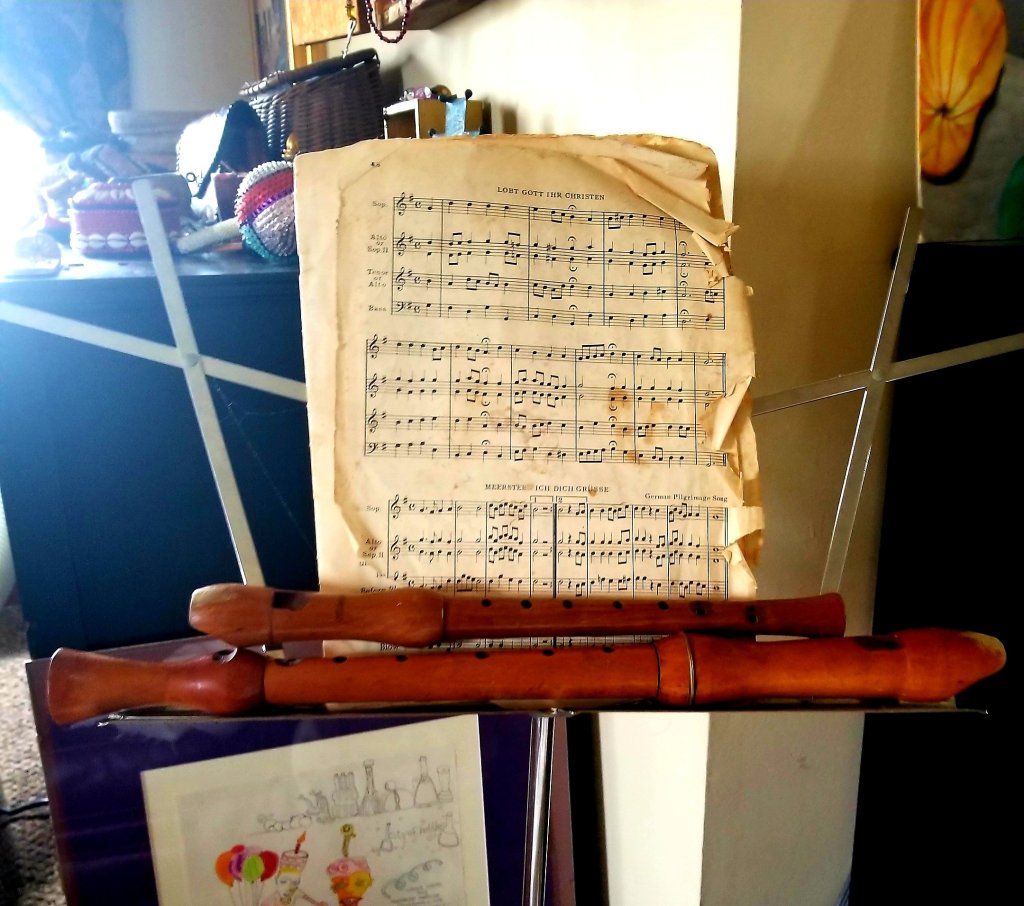
My recorders, an alto and a soprano. Constant companions for 50 years.
I finally have to let the next thing go. I reluctantly give up my recorders as I wonder what will be next. This is the last of my music making. I know without doubt that this is not the final loss.
My life was not governed by my right arm until the last decade. In fact, I never thought of it. It’s just been my right arm. I’ve made do. And no one noticed it.
As a young girl, there were games. There was volley ball, softball and soccer. Bicycle riding, scooters, pogo sticks. Swimming all summer at Pier Park. Mom enrolled me in tap dancing at two. And ballet classes thereafter until high school was over. I played the clarinet and bass clarinet in the band and the orchestra. Then there was spinning and weaving, and teaching aerobics. Riding mountain bikes and camping and hiking in the wilderness. Caring first for babies and then active children. There was laundry and cooking, cleaning, gardening…
Then what happened? When did the losses start happening? When did I notice it? What went first? I don’t remember it was so gradual.
I remember thinking in my 20s what it would be like to raise both hands over my head, but there was nothing lost. It was just a thought.
I wanted to be twirled around by my boyfriend while dancing, most of which is by the right arm. But I couldn’t, so he accommodated without me asking or explaining. We danced at home, at clubs and at house parties. But there was nothing lost.
At aerobic classes, I had to explain to my students to do with both arms, what I was doing with only one. But nothing was lost.
Kristi helped me fasten the back garters on my nylons every school day. But there was nothing lost.
I fell a lot on my bicycle when the handlebars jerked out of my hand and I couldn’t catch myself, so I was bruised and I’d bleed and now I have scars to prove it. But nothing was lost.
Sure, I dreamed of being a dancer or a musician but there was so much more that I wanted to be and do that I never bemoaned my fate. Nothing was lost.
Then what happened? When did it start? I really don’t remember. When did I realize that I was losing? What was the first thing I lost?
I think I first noticed that my arm was no longer serving me at full capacity, when as an archivist, I was struggling to place or retrieve 50 lbs. boxes overhead in storage. As this became more troublesome, I was dropping boxes, while standing on a ladder, pulling them with my left hand onto my chest. I would balance them there while descending the ladder and walking in a back bend to the nearest table where I carefully slid it to safety.
However, I knew that this just wouldn’t do. Fortunately, there was never a disaster. There easily could have been. I could have been injured and I could have destroyed or damaged materials. The collection was comprised of priceless museum artifacts, photographs that included dueguerrotypes, glass lantern slides, and every other type of photographic variants, priceless diaries, 150 years of research documents, books, etc. I’d been caring for these precious items for nearly 16 years, creating the first organized archive at my institution. My pride was hurt. I’d never had to accomodate for my arm before.
Again, fortunately, I had volunteers, students and an archival assistant to pull materials for researchers, to shift boxes, to help retrieve collections from departments, schools and individuals. My assistants began to do all of the heavy work that had always been my job. Yes, of course, I had writing to do, research, acquisitions, teaching and training, creating exhibits, committee work and all of the administration duties, management of the archives and workers, but the heavy lifting was over.
My wonderful left arm had been doing double duty all of my life. But now, my shoulder was failing to do everything I had always expected of it. My thumb, my dear poor thumb, had been pulling files, picking up large and small books and everything else throughout my life. Eventually, arthritis has developed in all but my ring finger, while my right hand is as soft and unused and unharmed as a babies.
This degradation was so gradual that I failed to see its progression for years… or did I ignore it, not wanting to admit that my right arm was responsible for the unwanted changes occurring in my life.
I still want to ride bikes, weave and spin, carry in firewood, rake the autumn leaves, carry in groceries two bags at a time, wrap both arms around someone and play my recorders. But I have to acquiesce. If I don’t accept the incapacity of my right arm, I will only do further damage to my left arm and without it, I won’t be able to make my bed, brush my teeth, or do any other kind of self care including eating. Without my precious left arm, I would not have had the adventurous life I have lived. I accept now that there is loss. There has been loss, I just didn’t see it.
I give great credit to my parents who never said, “No, you can’t do that”. I played right along side the neighbor kids. Mom, numerous times had to put my right arm back in the socket, until a bone fusion permanently held it in place. She carried me to the doctor with a broken arm. They bought me a softball mit, a tricycle and a later a bicycle. They sent me off to the pool on my bike to swim all day. I climbed trees and raced up and down sand dunes and mountain trails. When I was in a full torso and arm cast after surgery, they agreed to let me ride on the back of a motorcycle with my boyfriend to go to the races. Because of them, I never told myself that I couldn’t do something. Because of them, my life now is full of joy, contentment and unbelievable memories.
Sure, I couldn’t be a dancer or a musician, but I could dance and play music. And I could and did thousands of other things. So, though I have lost and am losing my ability to do lots of things, I can still do lots of other things.
You might say that I was lucky since there are people who have suffered greater loss than me. I’m painfully aware of that and I know just how lucky I have been. But this is my story. This is my life and I have lived every moment of it. I now take better care of my left arm and I hope it will serve me as faithfully as it always has until the end of my days. However, it deserves a rest, and I’m fine with that.
Postscript: Once while walking down the avenue in Santa Monica, a stranger came up to me and while looking into my eyes said that my right arm would lead me to the light.
A little bit of knowledge can be dangerous… as this story proves out.
I don’t know where to begin because I don’t think that I’ve told you enough about my past with Santeria, Palo and Vodou, but this memory came to mind this afternoon and I wanted to write it down. Perhaps, I’ll even publish it without giving you the proper context. To help a little you could go into some of my blog posts that are tagged with Santeria, Palo and Ramiro and the like… yet it might not help at all. But let’s get right into it, anyway.
Without going into any great detail, suffice it to say that I had been living with a Santero (a practitioner/priest of Santeria. My break with him was tragic. After being with him for several years, to better understand him and the culture of Cuba and its people, I studied Cuban spirituality and simultaneously, Haitian spirituality which, of course, both derive from African roots.
In my studies, I came across primary resources written by priests. Primary resources, of course, are documentation that record first hand experiences. These books or pamphlets or diaries recorded the rituals of their religion. I had watched many rituals performed in the years spent with the Cubans. I always felt though that I was standing at the door with the door just barely cracked open and me, I was peeking inside of a room not truly being able to enter, to participate or to even understand what I was seeing.
This new found knowledge, accompanied by my first hand experiences with Santeros and practitioners of Palo and Vodou, proved to be dangerous weapons in my hands.
After my break with Ramiro, I was left with many accoutrements, but this is another story. My heart had been broken and I had seen too many things. I wanted to relieve my broken heartedness and I also wanted to affect others with what I knew. I didn’t really want to hurt anyone, that was not my intention. But these two things alone are a dangerous combination. I wasn’t looking for revenge but this is how it was perceived.
Pepe was a friend of Ramiro’s and appeared on the scene to “soothe my pain”. I didn’t want a boyfriend, I wanted Ramiro back but I wasn’t getting him back, so Pepe became a friend. But this was not how Pepe saw it.
Pepe would not go away. He tattooed my name on his arm. He led his friends to believe we were lovers. That, we never were. My mistake was to allow him to continue to be my friend even when I realized that he was unreasonable.
My reasoning was that Pepe was nice enough. Pepe cared for me. He was willing to tolerate that I was still in love with Ramiro and that I didn’t love him. In a selfish way, Pepe was my connection to the Cuban community and vicariously to Ramiro. In some odd way this helped to ease the pain, to have somebody familiar around.
This is how the problem started and I am the only one to blame. Pepe was insistent and I suppose you could say that I allowed it, I left the door open, I was too tolerant. But as he became demanding, I became frustrated at first and then afraid. I didn’t believe he would hurt me but he had become frustrated, too. There was an element of him being out of control. Here again, I won’t go into unnecessary detail about his fits of frustration. He was refusing to just be my friend. Though I would lose my connection to him, to the Cubans and to Ramiro, it was time for him to go.
I wanted him to know that I was serious. I wanted him to know that I could make him go away. I knew in no uncertain terms that it had to be final and permanent. I thought that my most powerful ability was to use his own beliefs against him.
I knew too much and yet I knew too little. I never should have done this but I did. This wasn’t the first time, nor was it the last that I used what I had learned, that I used ways that I had no business using.
Whether you believe this or not is neither here nor there to me. I don’t care. But this is what witnesses have reported. These are the consequences of my actions. I followed the directions to the letter. There are times that I regret what I did, but they had the results I was looking for. I never heard from Pepe again.
I wrote Pepe a letter simply asking him to leave me alone. I sprinked into the envelope, powders and ashes of certain and specific animal bones, crushed plants, rocks and metals procribed in the books of priests. I carefully copied, by hand, certain ancient symbols drawn in the books. I sealed the envelope and drew certain other symbols that crossed over the seal, so that when opened, the symbols would be torn in two.
Pepe recieved the letter. According to witnesses, when he tore open the seal, a cloud of dust rose into the air covering his face and flew into his eyes. He was blinded momentarily and had trouble breathing. The dust caused sores on his face and neck that lasted for weeks.
Pepe was out of my life for good. I haven’t heard from him or about him for years. I hope he’s OK.
As a child, I easily believed that the Santas, whose laps we sat upon, were real.
I didn’t question how such a big guy could fit down our chimney or fly in a sled pulled by reindeer and land on our roof or deliver presents to all the children of the world in one night.
I was a believer.
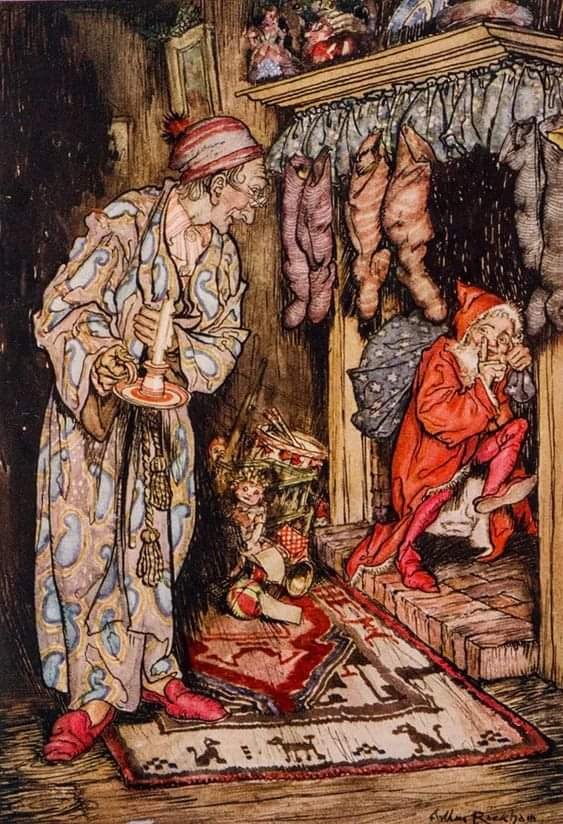
But then there came a time when I understood that a big Santa couldn’t fit down our chimney. But, I was undaunted when I learned through book learning that Santa was an elf.
Now, it all makes sense. Santa is an elf and an elf is small and magical and unlimited in its powers. Of course, he has a tiny sled and tiny reindeer and he can land on our roof and with no problem, come down our chimney. And elves are not constrained by the limitations of space and time, so children everywhere can wake up to presents under the tree.
You can’t imagine the relief I felt when I had this realization. When there is such evidence that Santa is an elf, there’s no reason to require faith or belief.
And this is why I find such joy in the season. 🤗🌲🎁
My mom loved getting and giving cards for all occasions. At Christmas time, she had a list a mile long because she had a very large family and many friends. When a card would come in from someone not on the list, they would be added.
My cards this year.
Mom would set up an aluminum TV tray (remember those?) in front of her living room chair. Beside her was a tall stack of cards with envelopes and her list with names and addresses. From right after Thanksgiving until her list was complete, this is where we would find her, when she was not at work, or cleaning, cooking, doing laundry, shopping and wrapping presents.
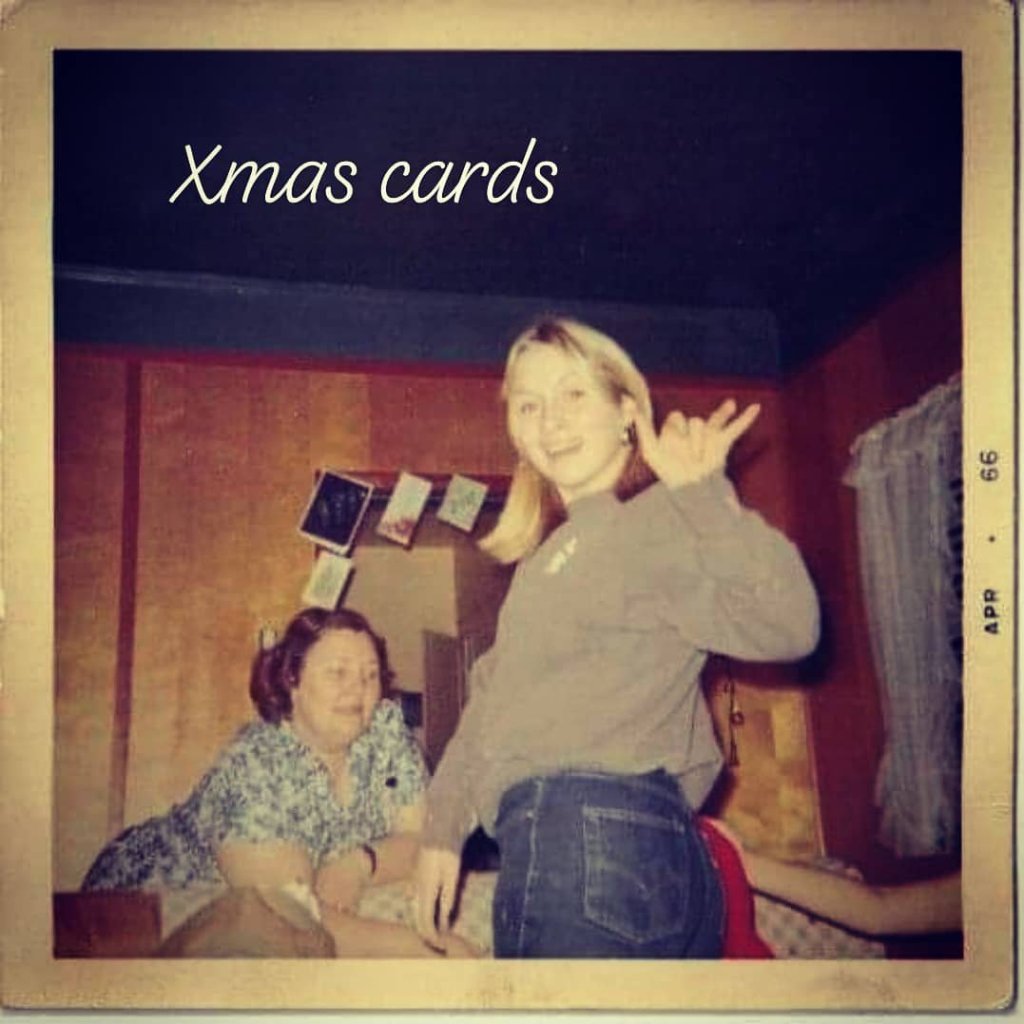
For Christmas, as the mail came in, she’d cover the fireplace mantel with cards, then when there was no more room, she’d tape them on the door jams in the living room. Every year, when the holiday season was over, she would gather the cards and stash them away in a box along with her list.
Mom and me in 1966. See the Christmas cards?
When Mom passed away, it was hard to throw away her memories that were her only treasures. She didn’t leave us money or property but she left us something more precious, her unconditional love for everyone. Cards and photos and letters were overwhelming as evidence.
I’ve never sent cards at Christmas. Kristi (my sister) had taken over this tradition from Mom. But this very special year, my cousins (on mom’s side) and I decided to send cards to each other. We needed to say, “I love you” in a very tangible way. Some of us are very alone or suffering in other ways. There are well over 40 of us. In such a large family, one never knows what heartbreak might be.
I can’t tell you how much this has meant to me. I could feel Mom stirring in my heart and see her in my mind’s eye, sitting in her chair, head down, handwriting her cards as I wrote my cards, addressed the envelopes and stuffed them into the mailbox.
And now, I rush to get the mail everyday to see who has sent me a card. I think it’s my turn to keep the tradition, Mom.
This has been heartwarming in a cold and dark night. Our world has been turned upside down and this small gesture of sending and recieving cards has brought much needed joy and comfort. Thank you, cousins.







 eyeamdust