In the Gloaming (1877)

Surprisingly, my summer project is a heavy-duty wool cardigan by Caitlin Hunter, of Boyland Knits, aptly named “Gloam”. In the gloaming means the twilight hours just after sunset. “In the gloaming” has always been my favorite time of day, whether it be a summer, winter, spring, or fall evening.

There was a time in my life, I would say, probably the decades between 20 and 60 years when I felt unquenchable yearning at this time of day, for what I do not know. I couldn’t tell if I had to go out of the house or if I needed to stay in. There was a restlessness about it… as if I was missing out on something. I sometimes would at least need to be out on the porch as darkness overcame the gloaming.

Thank goodness I don’t feel the same about the gloaming anymore. But still, this is my favorite time of day heavy with nostalgia and longing and memories of days gone by. So when I found the sweater named the “Gloam” it just seemed right that I would knit it. The style was right, as well.

The garment has an Asian appearance to it like a kimono, with an open front and wide medium-length sleeves, and a cropped body. The yarn I’m using is of DK weight of Highland woolen spun of New England, Harrisville, in a deep charcoal colorway. Across the front and back is a large textured section of 72 rows.

Some would not consider this summer knitting, and neither do I but it is what it is. I’m having a lovely time working on it but it’s not something I take outside with me. That’s okay, because as I’ve grown older, sitting outside in the heat is not one of my pleasures. As August approaches, I might have to switch to sock or hat knitting, but I’d love to have this sweater to wrap up in come Fall.

Maybe I’ll need to take it outside to work on in the gloaming as the heat of the day subsides.


My cousin Gail, after reading my blog post, brought up that the word “gloaming” reminded her of my mom. Now I might understand why I loved it so:

Mom played the piano and sang a lot as we were growing up. We had sheet music in the piano bench and Mom would sing and play all kinds of music, from pop, ballads, jazz, blues, and more. Now I know why that word stirs up such emotion in me. I now remember that Mom sang, “In the Gloamingʻ.

Thank you Gail for stirring my memory. Follow the link below to hear this beautiful but sad song.

In the Gloaming (1877)

https://share.google/GkiEYPfcG82dN6YuW

Fe Dáncio

A night of passion… or not

His long, curly, disorderly salt and pepper hair exposed his age, for his body did not.

Every morning, he sailed his small fishing boat out into the bay of Zihuatanejo and back again in early afternoon.

The rest of the day was spent selling fish and cleaning the boat inside of a small boat house perched over the bay. Fe Dáncio had been a fisherman from childhood and had lived in Zihuatanejo from birth.

While in Zihuatanejo, I spent my days on the beach where the pounding waves pummeled me, where I lay in the sun, where I ate in the small cafés along the beach, where at night I could be found in the small clubs along the beach, dancing.

Tired early, I returned nightly to a small hotel just steps up from the sand. At one time, it had been painted pink with white balustrades with cool orntamental Spanish tiles to walk on. I slept on the balcony in a hammock swinging under palms and flowering plants. I slept soundly. The soft breezes swished through the leaves, murmuring secrets from the past, as did the waves on the sand.

I woke early with the sun and watched the fishing boats bobbing out into the bay. All I wanted to do was the same thing that I did yesterday and the day before and the day before that. For a few dollars, a small cafe next door offered my favorite breakfast of pancakes, papaya, and other fresh fruits and all of the orange juice I could drink… And Nescafe.

Throwing on a swimsuit and a pair of shorts, i would walk into the sea, spending hours doing nothing. The waves were unpredictable. At times, they were gently rolling, and at other times, they came in violently, casting me to the hard sandy bottom. More than once, I hit my head on a rock. My brown skin was often bruised.

From my place in the sand, I could see the fishermen coming in, and as usual, Fe Dáncio drew my attention as he walked from the boathouse. I can’t explain it, but to me, he was muy atractivo. His skin was dark. He was muscular. He was weathered but smooth and shiny, if you could imagine it, and his hair was wild and wind blown. I, of course, noticed that he had an eye for the women.

One day, he approached me. We took up a conversation, and he invited me into the boathouse to see his small fishing boat. Since I am fluent in Spanish, we talked for hours, and he told me about his life. We sat in the sand later, continuing our conversation. He seemed as curious about me as I was about him. We ate some dinner, and then he invited me to his house.

(My acceptance of his invitation was not unusual for me, for I visited many houses belonging to strangers. Remind me to tell you the story of visiting a family on an island in a yellow lagoon in a village that grew coconuts only accessable by flat bottom boats.)

Not Fe Dáncio’s place

We walked to a secluded area of the beach where the locals lived in small houses, surrounded by gardens. He lived in a small board cabin outside of his mother’s house in the soft sand among mango trees and lush plants. His mother offered to feed us, but we declined having just eaten.

It grew dark. We sat in his house and talked into the wee hours of the night. I grew tired. He offered his bed for me to lie down on. As he laid down beside me, he offered me a smoke. We smoked quietly, staring into the darkness of the sky. The candle light was dim, and I began to drift away. I was high like I had never been before. I was mesmerized by his gentle touch.

Once in a while, he would send me to the outdoor shower where soft, cool, and refreshing water woke me once again to a night so pleasant, I didn’t want it to end. I only remember waking to a chicken crowing in a tree outside his front door.

Fe Dáncio had gone fishing. He left me a plate of mango and papaya and a glass of orange juice. I hadn’t heard him wake or leave. I slowly dressed. After a night of such indescribable hallucinations and pleasure, I was surprisingly refreshed. I went to my regular café for breakfast and returned to the beach to swim and to lie in the sun.

I never saw Fe Dáncio again. I did not see his boat return, nor did I see him walking along the beach. Though I spent weeks in Zihuatanejo, I was left only with this memory of him. It is so vivid, yet I wonder if it really ever happened at all.

When Things Were Simple

When weed came in kilos across the border from Mexico, it was simple. That’s when a kilo was $35-$60. When you most likely bought a lid in a plastic sandwich baggy for $10 from a friend.

When what you bought was smattered with stems and seeds that would pop and burn holes in your clothes or in your davenport or the seat of the car.

When a part of opening the baggy, and before smoking, was performing the ritual of carefully picking through and cleaning out the debris.

When Zig Zag papers were bought at the corner store to roll a joint. When one took pride in knowing how to roll a perfect joint or a giant “doobie,” It was an acquired skill.

We rolled joints by hand that wouldn’t fall apart, clear to the finger burning end. Or maybe someone had a pipe and sometimes a hooka.

When we all had “roach clips”. Making a nice  “roach clip,” was a work of art and creativity. Does anyone even know what a roach clip is or use one anymore?

The very last bit of a joint, or roach,  was savored by slipping it into a clip and holding it to your lips so as not to burn your fingers. How very handy they were.

PS: Those treasured relics pictured above are more than 50 years old, probably closer to 60. They were made from the bristles of the street cleaners brushes that one could find in the gutters while walking the streets of Portland.

When I was a Weaver

Maybe the worse for wear

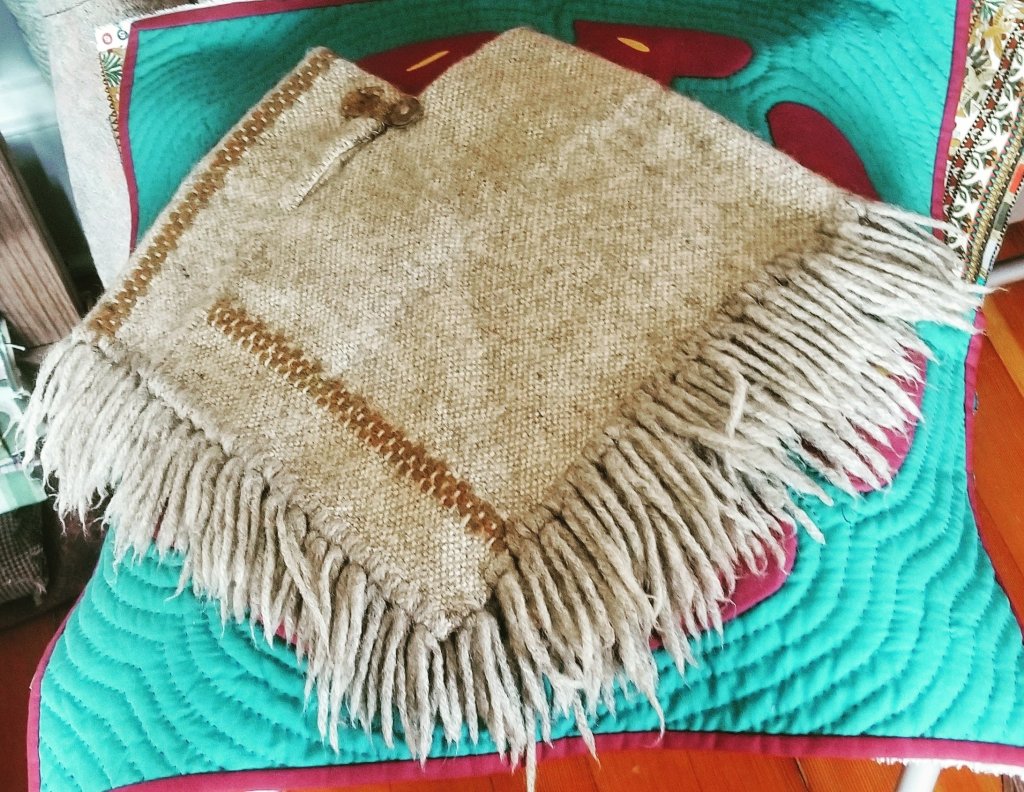
This is a hand woven pillow top completed in 1973. That’s 50 years ago! It’s made of 100% rustic wool on a large floor loom while taking classes at the Multnomah Art Center. I cannot remember what breed of wool or the pattern but it was a marvelous experience. It changed my life.

I bought several looms over the years and enjoyed weaving. I learned to spin, as well. Recently, I sold all my weaving and spinning supplies.

It took years to admit that I would not ever weave again, so I kept my equipment and supplies far too long. Thanks to my mom and dad’s persistant support, I have always been proud that I never let anything stop me from doing whatever I’ve chosen to do regardless of… well, there came a time that I had to give up on this craft and many others.

I have little to show for this time in my life with the exception of a few pieces, including this one. Though it is the worse for wear, I will sew it into a pillow cover again. It makes me nostalgic for those beautiful years.

A poncho for Hannah, 1973