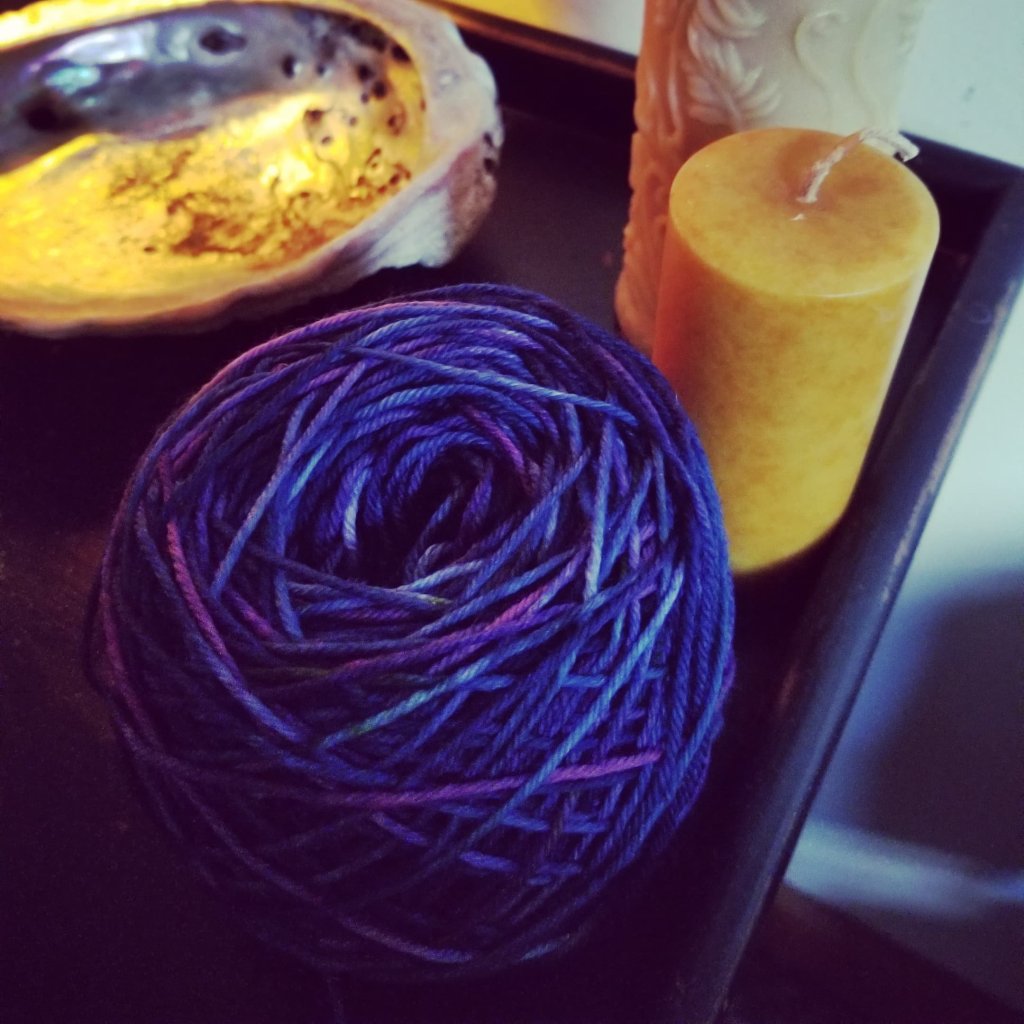
Okay, shut up. I just finished my last pair of socks of which, I haven’t even posted the final photo yet… but I couldn’t resist this yarn from Bad Sheep Yarn.
This is the most beautiful shade of blue I’ve ever seen. It’s called Wild Blueberry and with its shades of blue and pink and dark purple, it replicates perfectly the blueberries in my garden. When I laid sight on it on their website, I couldn’t resist even though I couldn’t really afford to buy another skein of yarn when my shelves are overflowing. *sigh*
But it’s hot summer and I’m much less tolerant of the heat than I used to be. I want to finish my Magnolia sweater before winter but just thinking of working with wool and kid silk mohair makes me start to sweat.
Oh, I won’t be able to resist the sweater but don’t you think that knitting more socks is a great idea in midsummer when the temperatures climb, climb, climb from mid 80°s to near 100°?
Now, I have 2 pairs of socks on my needles. When I start itching to work on the sweater, these can easily be laid aside momentarily.
Oh, Bad Sheep… You are so bad. You and your yarn are so tempting that I can’t resist. You feed my addiction, you bad bad sheep.
But Bad Sheep, keep it coming. I’ve already spotted another skein for another pair of socks.
I’m coming close to the toe on the first sock of a pair. Haven’t I showed these to you already? I can’t remember.
They’re “DK Vanilla Socks” by Kay at Crazy Sock Lady Designs.
The design is simple and unadorned but not necessarily an easy knit. I’m using Spun Right Round’s Squish DK, which is a 100% superwash merino (wool). I prefer not using super wash or anything with synthetic material added to the yarn, but when giving a gift one never knows how the recipient will wash the item. As they say, “Better safe than sorry”. Right?
The colorway is called, “Quake”. It’s really beautiful with a solid but subtle grey background with shades of browns and blacks and darker greys interspersed throughout.
The yarn is sourced from South America and is dyed in small batches so every skein is unique in it’s speckling and saturation. It’s then rinsed in a lavender wash before it’s ready for us crafters.
If I have underestimated the amount I need to complete a pair of socks, I will not be able to find the exact same yarn. But I’ve never found that to be that important. I kind of like the variations.
Now I remember why this seems familiar to me. I used this very same yarn to knit a pair of socks some years ago. But those had a variation of yarn colors for the toes and the heels. You may remember.
Sock knitting is not my favorite kind of knitting but I was pleasantly surprised when pressured by my daughter to knit her socks that it was something I actually could do. I don’t know how many I’ve knit since that 1st pair.
Since I started knitting late in life, I’ve since surprised myself now that I can knit sweaters and scarves and shawls and hats and mittens and gloves and all kinds of things. I knit lace work, stranded color work, cables and all kinds of designs and patterns.
Nothing I knit is perfect but it just goes to show that you CAN teach an old dog new tricks.
Here is my new interim project, Fingerless gloves, “Leaves” from Valknitting by Valentina Fezova – Georgieva.
Is there a point where a project is messed up enough that you just can’t gift it? Well, that’s how I’m feeling.
It’s not that it was a difficult pattern, it’s that somehow I didn’t hit the mark on stitch counts. I ripped it all the way back one time and then decided, even though it wasn’t perfect, that I would continue to complete the left one.
The Turkish yarn, “Alize”, is simply described (in translation) as wooley wool but makes up only about half of the fibre. The other half is acrylic. Not my favourite, but I was considering the ease of washing and drying them and it wasn’t unpleasant to knit.
I’ve started the second one of the pair thinking that the first could just be practice. If it turns out better, I can knit another to match the good one and then it could still be a gift, right?
I don’t know why but this small project has shaken my confidence in my abilities. Isn’t it strange how small things can have such a big impact.
I think these gloves are so pretty and worth a second chance. If I can knit sweaters and large and small shawls and mittens and hats and even do colorwork, lace and cables, shouldn’t I be able to knit some fingerless mitts?
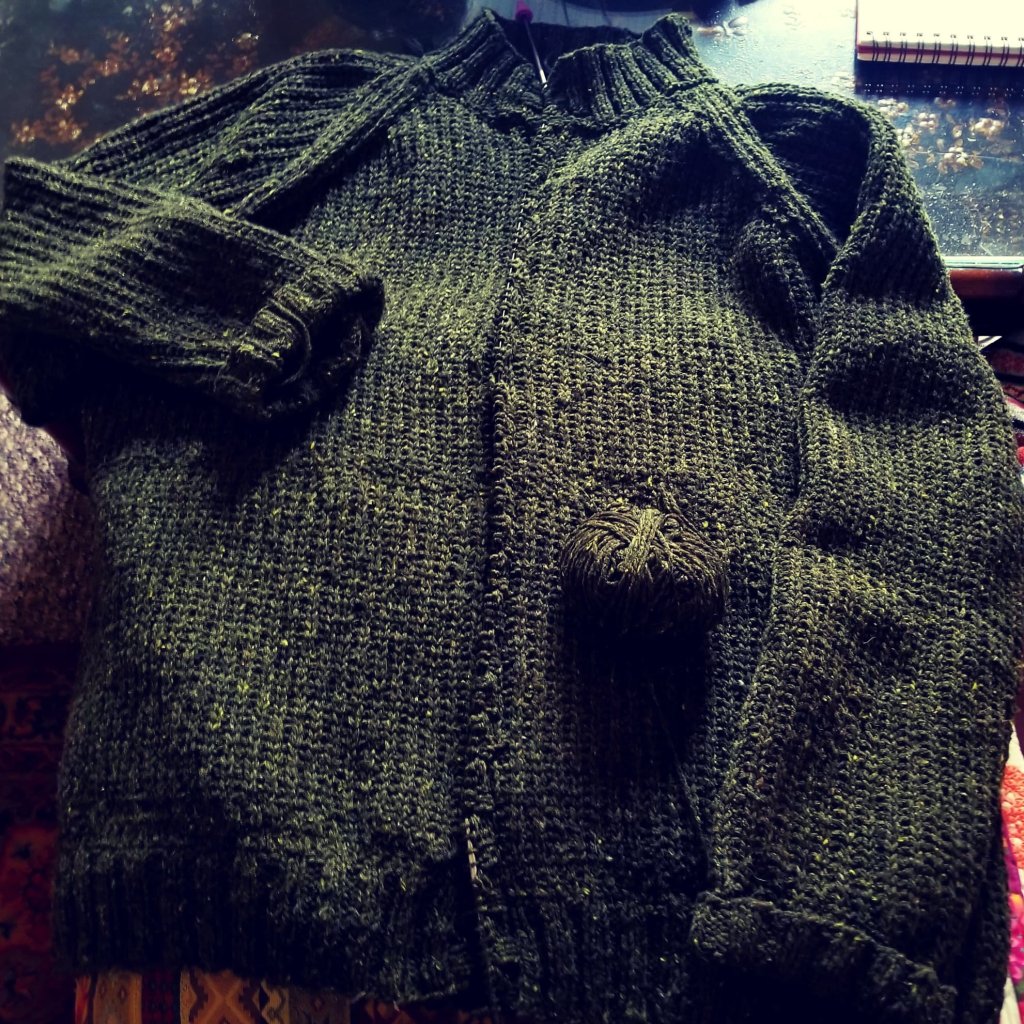
This photo makes the sweater look long but it’s actually cropped and comes just to the top of my hips.
This baby’s done! It’s the FELIX cardigan, knit in Woolen Twines rustic worsted merino in the colorway, Fossil (undyed). The yarn is the color of the sheep it came from.
As I’ve said before, Jule (owner and creator of the company and the dye pots) only harvests the best wool from local sustainable and organic farms and caring shepherds in her homeland of Germany. She has it spun in a small local mill and though she is a hand dyer, I chose this natural undyed color for this sweater. However, her natural dyes are some of the prettiest colors I’ve ever seen.
This was a joy to knit. The yarn, the pattern and the finished sweater just made/makes me happy.
I bought the buttons from Vintage Buttons on Etsy. They were made in the 80s of French river shells and hand painted. These also make me happy… like a bag full of gummy candies.
It’s too big for me but it’s large and cozy and will fit over anything. It’ll be a daily wearer.
I’ll definitely make another one of these but in my true size… determining my size is like trying to catch a wild horse in the Painted Hills of… where are the Painted Hills?
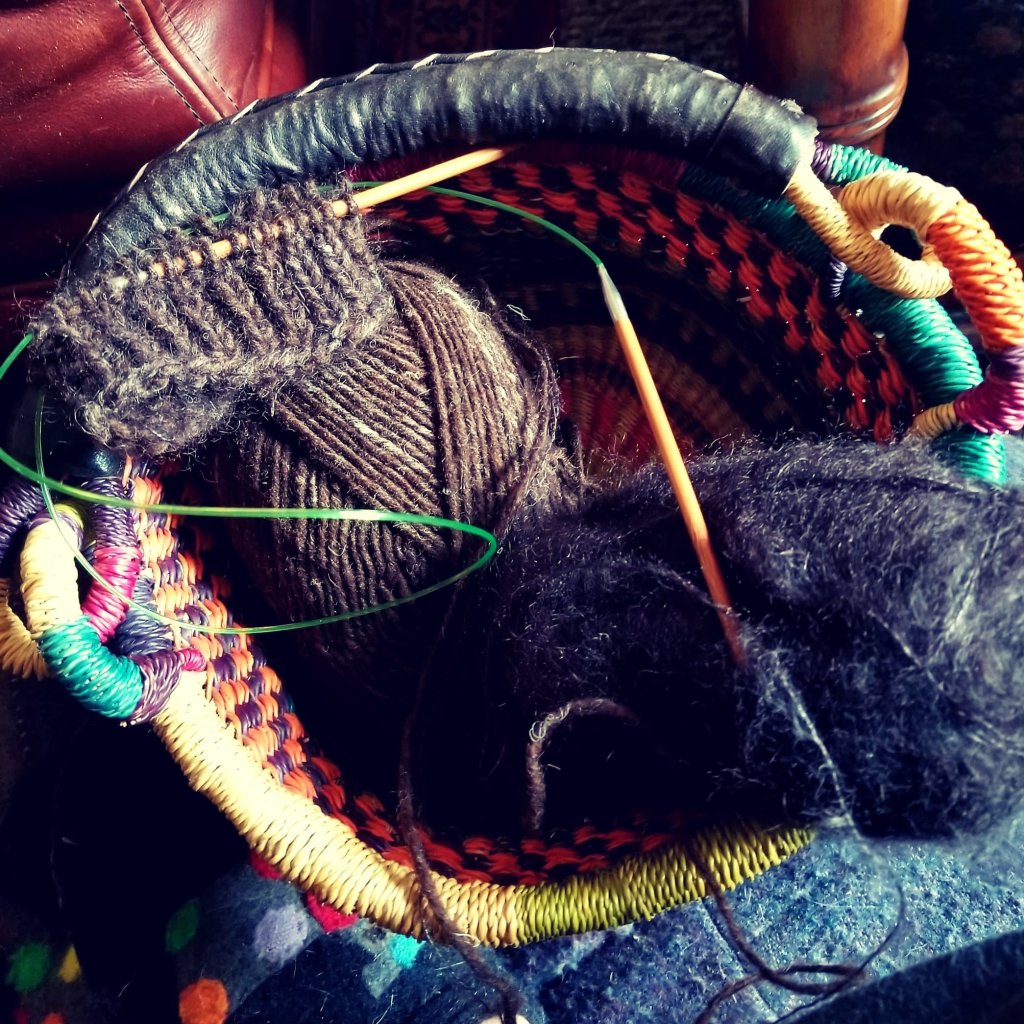
Before I start my next sweater, the “Magnolia Chunky Cardigan”, designed by Camilla Vad, I’m knitting the “Handful of Berries Mittens designed by Jocelyn J. Tunney.
For those who don’t knit and particularly don’t knit mittens, the photo shows what it looks like when you’re just starting. I’m just 7 rows into the ribbing for the wrist.
The yarn is the softest and fluffiest yarn I’ve worked with yet. It’s Beiroa Retrosaria, Rosa Pomar, 100% Portuguese wool.
The skein band says that, “Beiroa is made exclusively from the wool of Serra da Estrela sheep, a Portuguese native breed found in the Serra da Estrela region. It is entirely sourced and manufactured in Portugal. The Serra da Estrela Breeders Association (Ancose) verifies the origin and quality of the fleece used to produce this yarn.”
I’m thrilled to be using this beautiful Beiroa. Of course, I’ll be showing you the finished product when it’s done.
As my knitting journey continues, I find myself buying more and more yarn that can be traced to the source, including some yarn that can be traced to the exact sheep from which the fleece was shorn.This part of my craft gives me more pleasure and makes me more grateful than you can imagine.
And, I love that I am participating in an age old tradition.
Just waiting on the buttons to finish the button hole band.
The long awaited Ranger sweater, by Jared Flood, is done except for the button hole band… we’re waiting on the buttons.
Jesse (son and fortunate recipient) has ordered some Native American handmade silver buttons that will really enhance this cardigan.
The yarn is local to me and made of Brooklyn Tweed, Shelter, in the colorway, Artifact. The yarn is spun of Targhee-Columbia wool. It’s worsted weight and is woolen spun into a very light 2 ply that if not careful can be pulled apart almost as easily as unspun yarn like the beautiful Swedish Nutiden yarn.
Soon, I’ll be giving it a good soak in warm water and then I’ll pin it to block it to hopefully give it a perfect fit. I can’t hardly wait to see the stitches bloom and come together in the most pleasing way.
Jesse will be wearing this sweater when the weather warrants a big cozy jumper. When the warm monsoon like rains of fall turn into bone chilling shards of icy and soaking rains, he’ll be warm. Because wool, even when wet. or covered in snow, remains warming. Just ask any sheep.
This was not an easy project. I warn you that if you’re not familiar with garment making and reading a complex pattern, start with something easier. Bette Hunter, of Scotland’s Oban Seil Farm, says that some patterns read like a foreign language. These challenge even the most experienced knitters.
I did a number of techniques that I have not attempted before. First and foremost was knitting a sweater from the bottom up. I will, I swear from this day forward, reject any pattern that starts you at the bottom. How are you suppose to know if it’s going to fit if you can’t try it on along the way? I learned so much from knitting this beauty, but it put me through my paces.
I love the yarn, I love the sweater but please universe, don’t let me do this again.
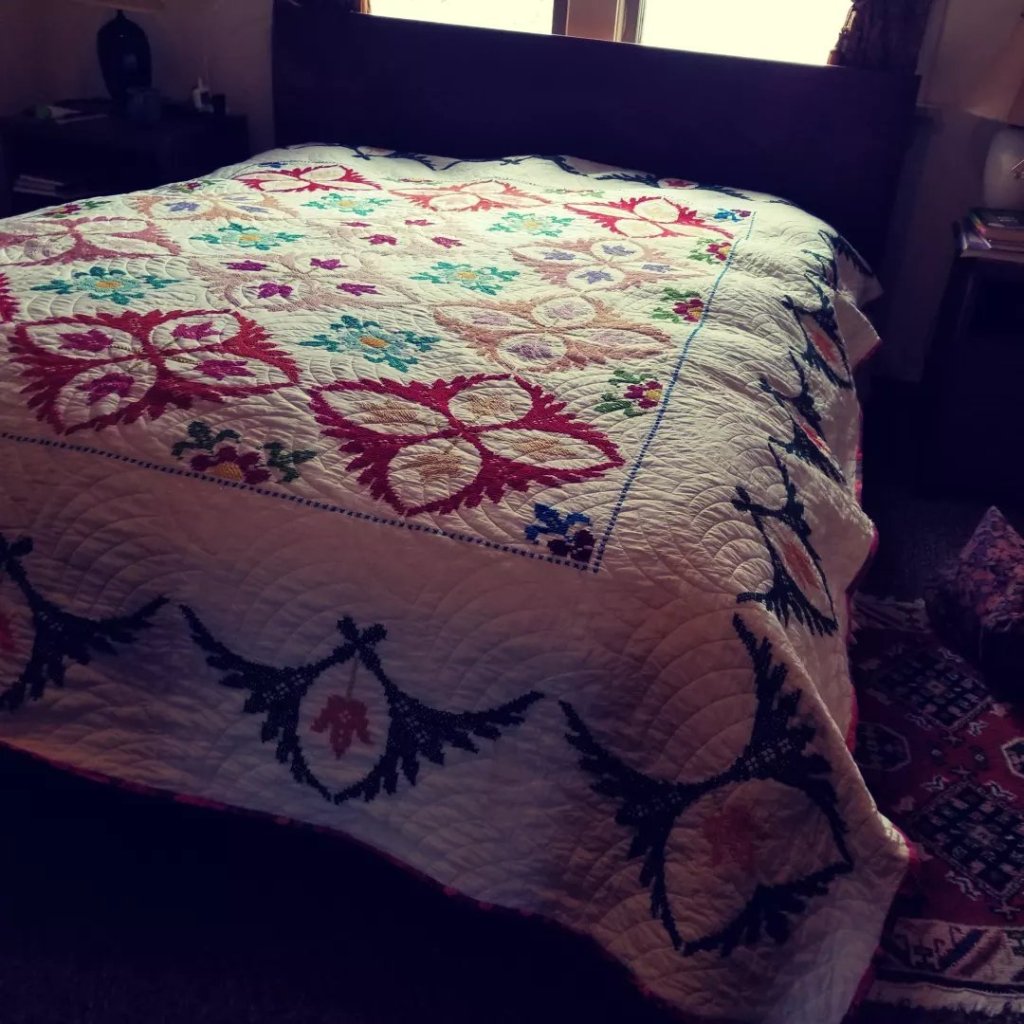
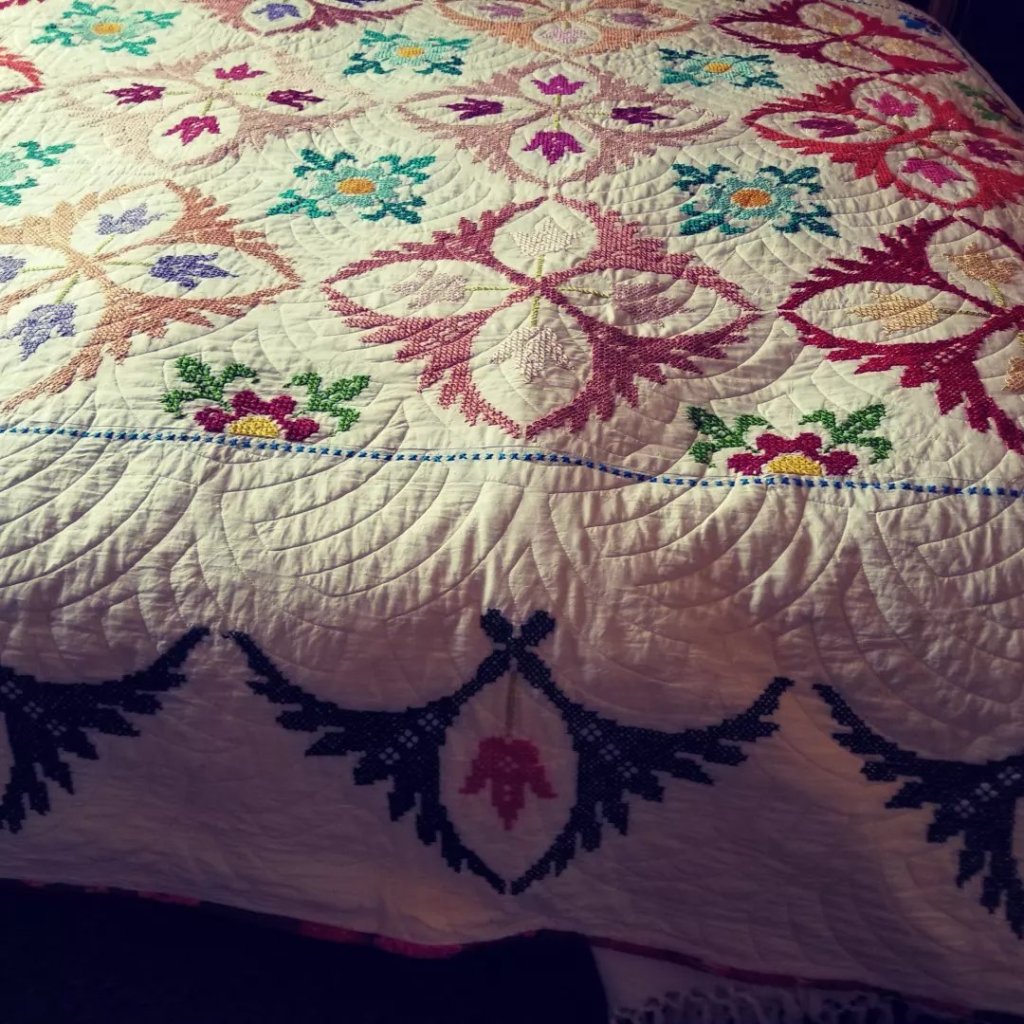
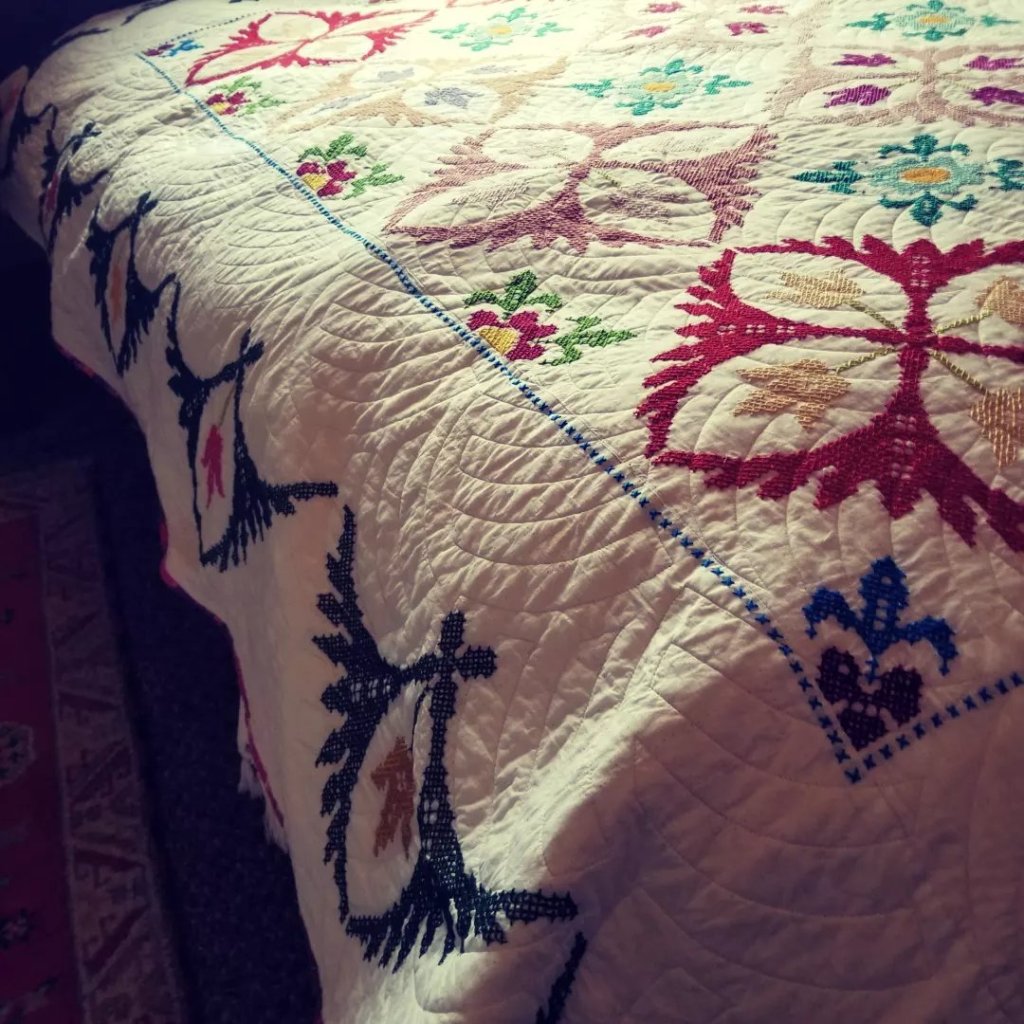
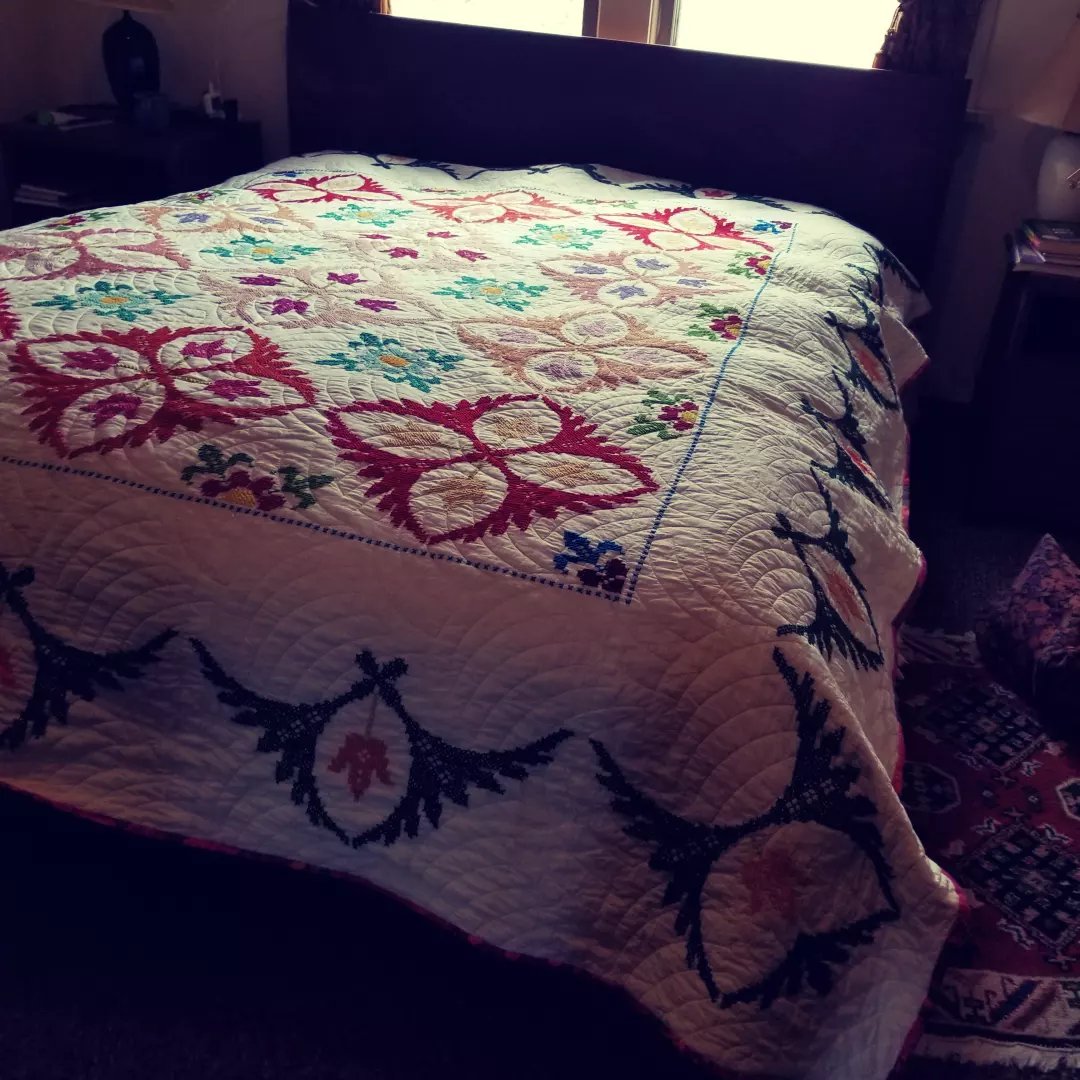
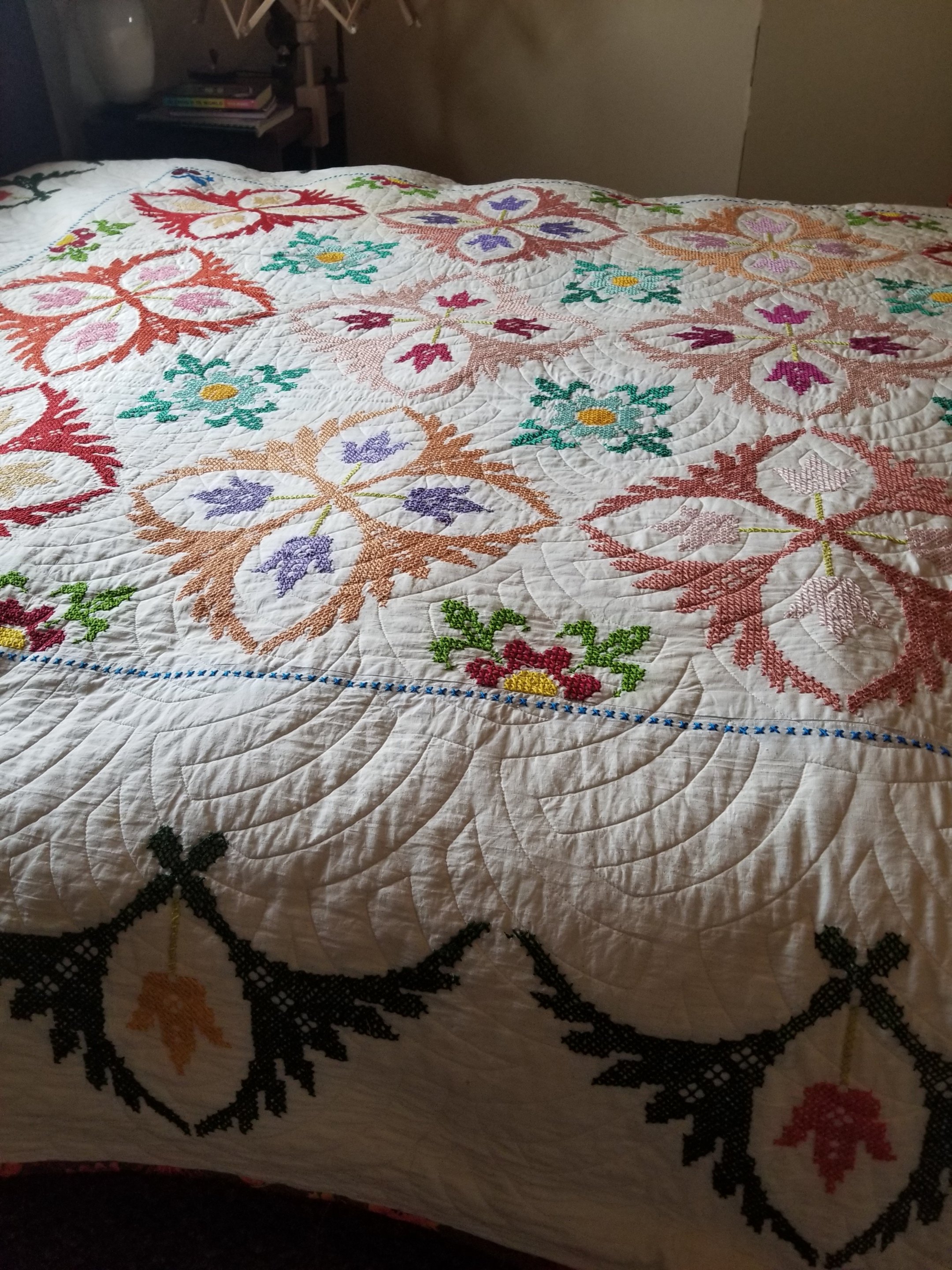
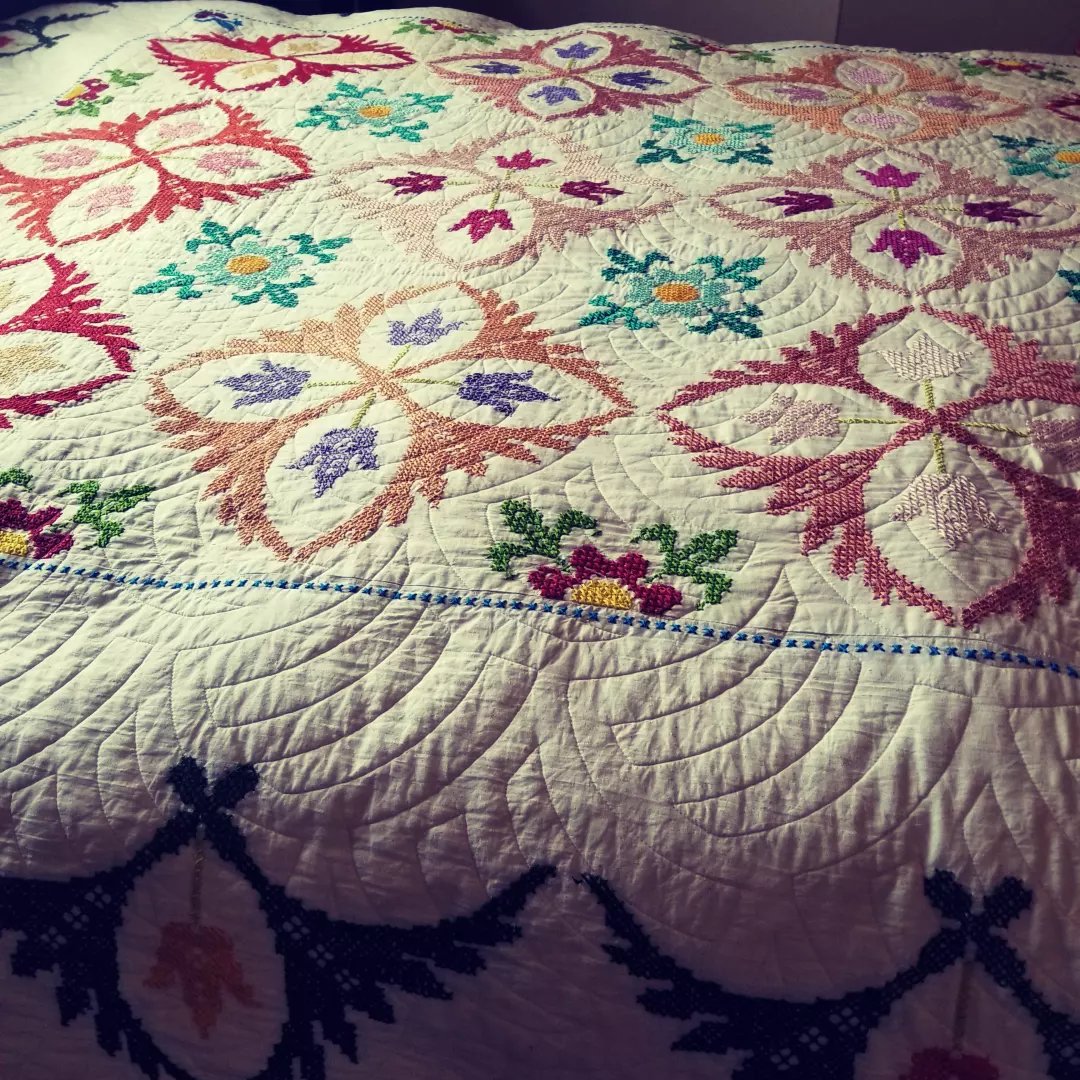
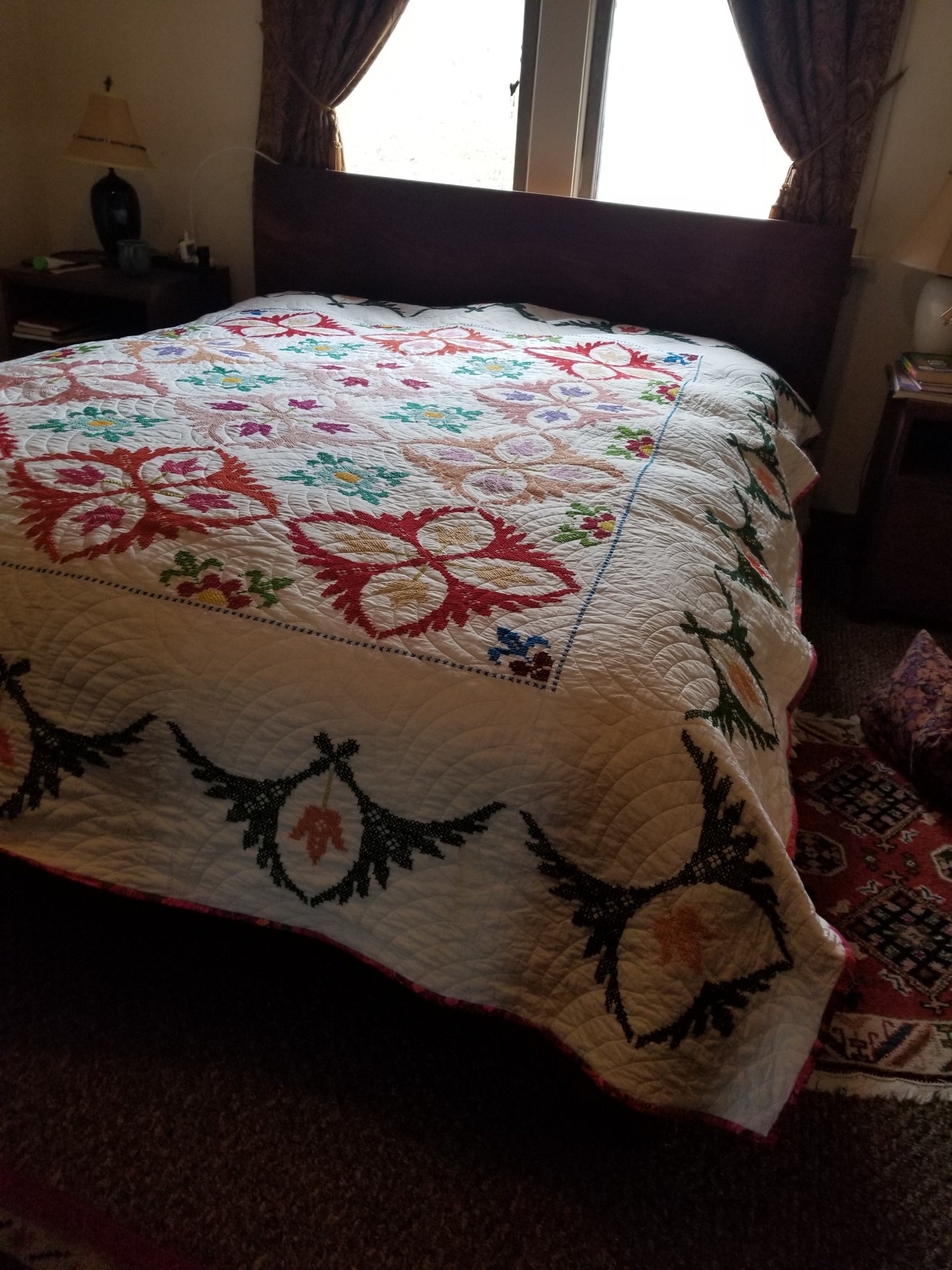
This cross stitch quilt is spectacular and it only took five decades to complete.
The quilt is made by making millions of tiny cross stitchings that I started sometime in my 20s and continued into my 30s. All the while there was home, children, work and gardening, weaving and spinning, macrame, sewing and crochet. There were births, helping with school projects and homework and driving to soccer and baseball games, picnics and family reunions. And then there was moving… from Portland, to Estacada, to Lacey, to Whibey Island, to Washogal and Home Valley, then back into Portland.
But all along, the quilt stayed with me, patiently waiting. The children grew and moved away. Finally, in my 40s and 50s, I started the hand quilting but then I started to knit, as well. Then there was the divorce and new relationships. There was years of University and moving to Florida and California. And the beginning of my career. Once again, the quilt was all but forgotten. But I kept it, and it lay dormant, waiting.
Once, I accidentally tipped a cup of tea off the table into the basket sitting beside my chair, soaking into parts of the quilt. That’s when I almost gave up on it. I thought it was forever ruined. I couldn’t wash it because the pattern was not indelible. The ink would wash out leaving me without a guide. But I couldn’t destroy it or even give it away. So, I put it away while getting my BA and my MA and even started and finished my career.
Finally, in my late 60s, I picked up some quilting hoops and worked on the quilting some more. I set up the hoop stand in the living room where I looked at it every day. The quilting thread and needles beside it and I spent some brief hours working on it. But I somehow knew that sewing tiny running stitches to cover the entire queen sized quilt would never be done. It was discouraging. It was so beautiful, I just couldn’t give up on it.
I was now in my my 70s. I had worked on it and carried it everywhere with me for five decades and I was in danger of never finishing it. It didn’t help that I was developing arthritis in my hands. In the end, would it remain unfinished? The thought saddened me.
Luck was with me, however. Crafting podcasts and vlogs became a thing. I watched them constantly while I knitted. I had my favorites but once, by the recommendation of other crafters, I came across a woman who lived on the English border with Scotland. Her blog, Kate of the Last Homely House, a reference to Tolkien’s, “The Hobbit”, became a favorite of mine. Anyone who loves Tolkien is a friend of mine.
After her mom passed away, Kate was left with boxes of unfinished patchwork quilts that only needed the quilting to be done. It was then that she mentioned Kat, a long arm quilter, who lives in Scotland, who she would employ to quilt her mother’s quilts. What is this, she says? Could I find someone near me to finish mine? I had no idea. I had no clue as to what a long arm quilter was.
It took only a simple Google search to find a few long arm quilters in my area. I called one of them and made an appointment for the very next day. I packed up my tea stained quilt (the stain had faded over the years) and entered the world of long arm quilting. The machine is huge and nearly filled the entire workshop. It’s connected to a computer whose software programs a multitude of designs to choose from. I showed my soon to be savior my “art piece”, chose a design and I said, “f***k it”, when I accepted the $300 quote with ease. In two weeks, voila!, I had my beautiful finished quilt in hand.
But wait! It still wasn’t finished. A quilt consists of three layers. The top, the batting, or the fill, and the backing. The four raw edges of these layers need to be bound. Would the quilt now languish once again? No. Not this time. I was inspired by already having paid for the quilting and its beauty.
Some months ago, I bought the fabric for the binding, I made the binding, machine stitched the binding to the front, then, I finished it by handsewing the binding to the back.
I washed it in the clawfoot bathtub, hung it to dry and here it is in all it’s glory. The stain is still visible if you really look for it but that doesn’t bother me at all. As an archivist, I see every part of this quilt as evidence of its journey to the present. I wouldn’t change a thing.
The only problem is, now that it’s finished, what shall I do with it? I can’t leave it on the bed because the dog sleeps with me and she’s got dagger claws. It wouldn’t take long for it to be ruined.
Shall I just fold it up and display it on the end of the bed or should I figure out which wall I could hang it on?
Besides that dilemma, I am really over the moon, and all the stars, that it’s finished. For now, it hangs out on my foot stool where I can enjoy it all day long, every day. It’s already almost an heirloom.
I finally retired in October 2014. Kristi had retired about a year before me. One day we met for coffee at an intimate, neighborhood cafe in Woodstock to celebrate.
We bought these cups as a symbol of our promise to be companions as we aged, to take trips together and maybe even one day to live together. Little did we know that within just two weeks, she would die in a terrible car accident.
Kristi’sMine
Two days ago I was drinking coffee out of my cup and I thought about these promises we made to one another. I wondered if Kristi’s kids had found her cup amongst her things.
I sent them a message and in a short time, I got a message back from Sharon, her oldest daughter, with a photo of the cup saying that she drinks out of it often.
I cried for loss but also for gladness. A girl could not have had a better sister. My memories of her span 64 years, so they are many.
When she was only 3 years old, I contracted polio, and for the rest of our time together, she did for me what I could not do for myself. She was my confidant. She was my buddy. She was my heart.
I miss her so. When I drink from her promise cup, my heart fills to overflowing. I’m so happy to know that my promise cup to her still exists.
This cross stitch quilt is spectacular. It only took four decades to complete.
I finished the cross stitching in my 20s and 30s, all the while there was home, children, work and weaving and spinning. In my 40s and 50s I started the hand quilting and started to knit, as well. I put it away while getting my masters degree and started and finished my career.
In my late 60s, I picked up some quilting hoops and worked on it some more.
In my 70s I said, “f***k it” and took it to a local long arm quilting shop and… voila!
A couple of months ago I bought the fabric for the binding, I made the binding, machine stitched the binding to the front, then just two days ago, I finished it by handsewing the binding to the back. I washed it in the clawfoot bathtub, hung it to dry and here it is in all it’s glory.
The only problem is, what shall I do with it? I can’t leave it on the bed because the dog sleeps with me and she’s got dagger claws. It wouldn’t take long for it to be ruined.
Shall I just fold it up and display it on the end of the bed or should I figure out which wall I could hang it on?
Besides that dilemma, I am really over the moon and all the stars that it’s finished.
I guess each and every one of us has our own experience and perspective. My perspective is one of myth and fairytale. Drawing names for gift giving and putting heart and soul into creating handmade gifts of wood, clay, wax, paints and pencils and wool threads, paper and fabric, each item made with a particular person in mind.
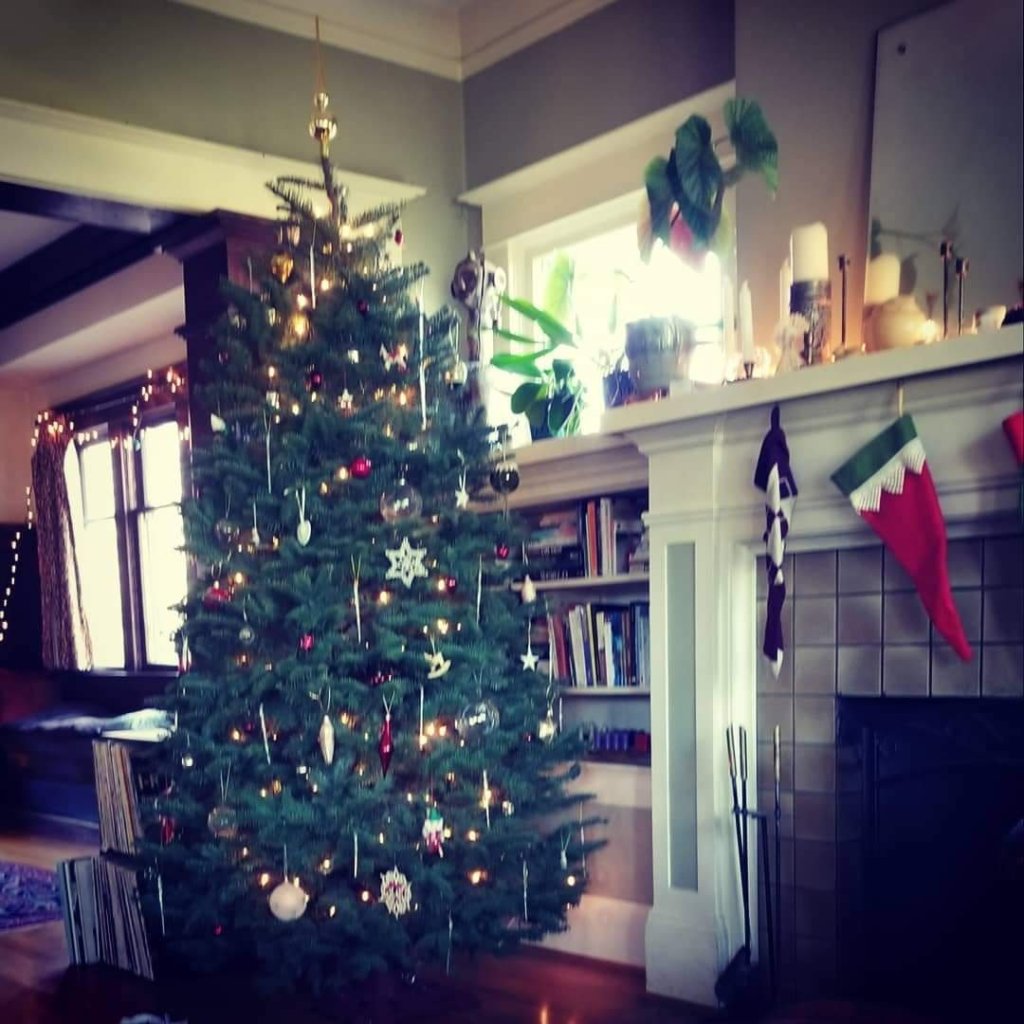
We’re grateful for a warm place to bake and for creating special foods. We invite family and friends to sit at our table and around the cozy fire. We read books and share stories and warming drinks.
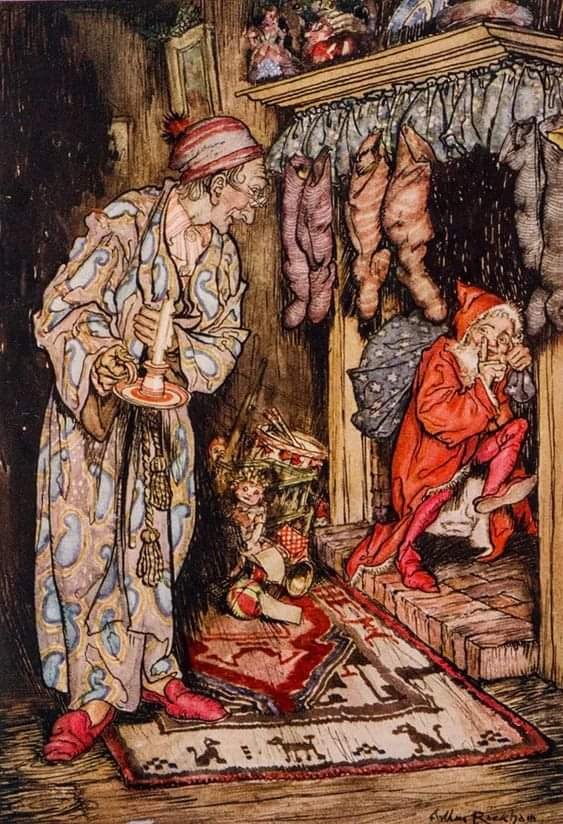
During the season we gather evergreen boughs and leaves and branches with berries from parks to make wreaths and garlands to decorate the house and to give away. We hide small gifts and candy to fill the stockings for Jul morning and pretend the elves have visited through the night.
We’ve spent hours creating our special gifts, hiding them behind our backs if someone passes by unexpectedly. We don’t even share who’s name we’ve drawn… so there’s an air of anticipation… if John drew my name, I might get a painting or something sculpted of wood. If it’s Ivan, I might get a bonsai, if it’s Laura, maybe a knitted scarf or small bottles of homemade bitters. If it’s Joannah, there’s a million possibilities, and from Jerald, handmade candles or a handbraided dog leash or something of leather. From me, someone will get something knitted or a hand-made book.
We use hand decorated brown paper for wrappings and jute ribbons or recycled papers and ribbons from last year and hand cut paper snowflakes. Cards are made from John’s lino-cut designs, or made from recycled cards I recieved last year, repurposed for this year. This year I bought some from UNICEF.
I’m an anti-theist, if a label is required. God doesn’t play into the season, for me. I love the magic of stringing lights and singing and bringing a tree in the house… a tradition that pre-dates what we now call Christmas, Xmas, etc.
I dont care what other people do. If they want to celebrate as they’re told by media advertisements and to go into debt and to get stressed during October, November and December, they can go ahead. I don’t care. We’ll be over here creating and welcoming the darker, colder days with good cheer. This is how we welcome the ending of this year and the beginning of the new with family and friends.
I understand the bah humbug spirit pervasive in society. There’s good reason, of course, but for me it’s deeper and richer and full of meaning. There is the harvest, then the darker and colder season that engulfs us all as we turn away from the sun for some months.
I would be remiss if I didn’t mention that I also know that there are the less fortunate who don’t have the ability to create such warmth and good cheer, and for that I lament. We’ll do what we can.









 eyeamdust