The very first thing that I can remember losing was my Grandma’s diamond wedding ring. I was only 14 years old. What in the world was she doing gifting a precious diamond wedding ring to her 14 year old granddaughter, anyway?
This was not the first time that this wedding ring had been lost. Grandma was an avid and master gardener. Her yard was filled with fragrant and beautiful blossoms and a lawn that she hand picked the weeds from on her hands and knees. The garden was filled with bird song. She loved those birds as though they were her own children.
One time she lost the ring herself. She didn’t know where but lamented it’s loss deeply. On one lucky day, Grandpa was helping her pull up the spent plants, while they prepared the garden for winter, and pulled up the ring clinging to the roots of one of the petunias. You can see why that ring was even more precious to her than just a wedding ring.
It hurt so bad having to confess that I’d lost it. Grandma and I were as thick as thieves. She was the keeper of my secrets that she took to her grave. I could have moved myself into her tiny house, hook line and sinker, and never looked back. I had to content myself with spending weekends with her. Though she only lived around the block from us I could never get enough of her sweet presence.
I first confessed to Mom that while swinging in the park the ring had come off and I couldn’t find it anywhere. Mom was not one who would soften the blow by telling Grandma about my foolishness. I had to face up to it on my own. “What in the world was I doing wearing that ring anyway”, she chided me.
I think it was too hard for me to hold my Grandma’s reaction in my memories. My Grandma was not one to ever be mad or to express her anger, if she ever was, I can’t remember.
To know that I had hurt and disappointed Grandma was enough punishment for me. I still cry over that ring. I wonder who might have found that it. I wish it had been me.
The Rug
Chief Joseph of the Nez Perce
The next thing I remember losing is a hand woven chief’s rug that was given to us by Jack’s Aunt Helen. She was married to his Uncle Hank. Aunt Helen (nee Phinney) was a Nez Perce, a descendant of Chief Joseph. It was evident at the Pow Wows we attended with her, that she was highly regarded among the tribes of the Northwest Territory.
This rug was passed down to her through her family and then she gifted it to Jack, my husband, who she dearly loved. Aunt Helen was fierce. She was diminutive yet strong. One did not cross her in deed or in word.
Aunt Helen’s face was round and flat and colored a soft brown. She always wore a dress and had steel grey hair cut short, and she walked the earth as though she had a specific purpose in mind to her walking. And no doubt she did.
I kind of feared yet respected Aunt Helen, and yet you could feel her love. Her love felt a bit like ownership, possessiveness. Her home on Johnson Creek road was a treasure trove of Indian artifacts. Her yard was a secret garden if there ever was one. It didn’t surprise me at all that she entrusted Jack with this precious rug. He was family though only by marriage. She had a family of her own which I’m sure she gave many gifts.
One year we were moving out to the Columbia River Gorge, the land of the Indians. Now, the Gorge is home to the Confederate Tribes of the Warm Springs, the Yakima Nation, the Nez Perce Tribe and the Cofederated Tribes of the Umatilla Indian Reservation.
We obviously, not so carefully, stashed the rug in the bed of the pickup. Somewhere along the Washington side of the river, the rug blew out of the truck. Did we realize when we were unpacking that the rug was missing or did it take us some time before we realized that the rug was no longer with us. I can’t remember.
I wonder all the time who might have found that rug. One thing I know for sure is that unless they did some research they have no idea what a treasure they have in their possession.
I think of that rug quite often and mourn our carelessness. The only thing that would make me happy is if a member of one of the tribes had found the rug and perhaps had found its rightful owners. Maybe they might have celebrated that the spirit/s had returned that rug.
The Tapestry
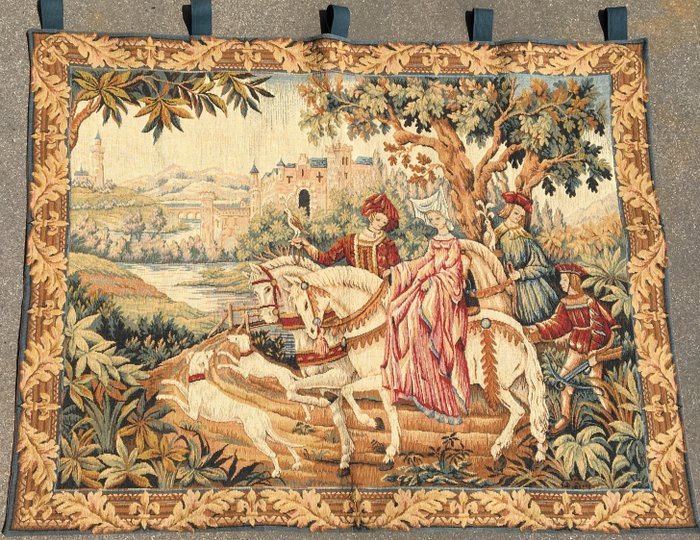
The next thing I lost was a Franklin Mint Tapestry that my mom bought me at no small cost. This is a Tapestry titled, The Royal Hunt, designed by Marc Waymel for Franklin Mint.
The Royal Hunt
According to some on Google, the tapestry can be seen in a scene from the series, Outlander.
The tapestry can now be purchased online from several different websites for around $200 to $300. For years now I’ve been wanting to buy one online. Maybe this is the year.
In the year 2000, I moved to Los Angeles to get my master’s degree in History focusing on folklore and mythology. I packed up everything I owned and put it in a storage unit. That was my first mistake.
I rolled up my tapestry with the hanging rod and slid it down into a CD rack. It fit perfectly. My second mistake is that I didn’t think carefully about the construction of the unit. One could climb on top of the storage areas and the only covering/roof was chicken wire. This storage unit was inside of one of those really large buildings that have multiple floors with multiple units on every floor. I thought everything was safe.
When I returned 2 years later to unpack my unit and bring everything in to my new house, I realized the tapestry was missing. Coincidentally, I was moving Mom in with me. There was no way I could hide the absence of the tapestry. I didn’t wait until she asked and I confessed. That was a really sad day for me. Mom didn’t have much money as a retired administrative nurse and this was a huge loss to us both.
I’ve now lived without the tapestry for more than 20 years, 23 years as a matter of fact. I’ve never quit missing this tapestry and think of it all the time. I wish I knew which tapestry out there was mine.
Some that are for sale say “some light fading or some wear and tear” but mine was perfect when I put it into my storage unit. Should I risk buying one knowing that perhaps I’m getting one that won’t s assuage my sadness over losing the tapestry? Or should I just let it go and enjoy the fact that Mom bought this for me and it’s in my memory now forever?
Who has my tapestry that my mom gave me out of love? I don’t like that you have it. It still makes me a bit angry that you climbed up on top of other people’s storage units and looked down on our personal belongings and thought that you had the right to steal things that perhaps have great value to us. I hope that every time you look at my tapestry you feel guilty. I suppose you sold it immediately thinking you’d get a small fortune. I hope that the memory of your theivery haunts you to this day.
The Photos
And then there was The Polio Poster photos. I wish Mom was still alive for me to ask some questions about these photos.
In the photos I am in an arm brace and wearing a beautiful, cotton, purple and yellow dress with purple pearl buttons. My blonde hair was in soft, long curls. I was just 5 years old and I was a victim of the virus.
There was also featured in the glossy photos, a famous actress, a chimpanzee and a huge television camera. If memory serves me right, I think on the side of the camera were the letters for KOIN TV in Portland, Oregon… or was it KPTV, another TV station.
I know the photos were being taken to feature in polio posters and I was to be a poster child. This was probably in 1953 or ’54. I had contracted polio before the polio vaccine was distributed. The March of Dimes, in particular, raised a campaign against the epidemic.
My photographs were not chosen for the campaign. I think I wasn’t “crippled” enough. Looking at the posters from that era, they featured mainly children who were in leg braces and crutches. The posters were created to generate sympathy and therefore donations for children who were victims of infantile paralysis and to promote the vaccine.
However, we received the original photographs from that time and I should be happy that I wasn’t “crippled enough”.
For all my life I looked at those photographs but at some point they disappeared. I have all of the old family photographs except for these. Being a researcher, I have looked at all of the obvious places that might have them archived. No such luck.
Postscript
Dr. L James Lewis, an employee of Dr. Jonas Salk, injects a rhesus monkey with the inert vaccine, weeks before its release.
Postscipt: The claim is that research to find a vaccine for poliomyelitis was never used on chimpanzees.
This letter was written to me in 1953 by Dad’s only sibling, Aunt Wilma, Wilma Jean to be exact. I was in the hospital suffering from infantile paralysis or poliomyelitis. I was only five years old and just starting kindergarten when I succumbed at the tail end of a serious epidemic and just a year before the Jonas Salk vaccine was distributed throughout the US public school system.
The letter is written on paper from a small tablet, maybe 3″x5″. This was the cheap kind of tablet that you might write a grocery list on. It was, at one time, a multi-colored paper that has faded to a dull orangish-yellowish brown. I rolled it at some point, tying it with what once was a pretty blue satin ribbon but over the years, it faded to a nearly colorless grey. For some reason, I have saved it for over 64 years. Mostly, it has been safely tucked away in my blue trunk. Now, I find it very curious and have a question about its intention… about her intention. About the seemingly mysterious guilt hidden there.
More about Aunt Wilma later.
Christmas 1951 – One year before I contracted polio. Mom, me, in the rocking chair, and Kristi and Steve
Mom woke us up each morning for school, singing:
“School days, school days,
Good old golden rule days.
Reading and writing and ‘rithmatic.
Played to the tune of a hickory stick…
She left every night at 10:00 for St. Vincent Hospital where she worked for over 40 years. We never thought of her as a working mom. She left the house after we were tucked soundly into bed and arrived back home mornings in time to get us ready for school. This day was no different, except for one big thing.
Kristi had already climbed out of our bed and left the bedroom, even though she wasn’t yet in school. I could hear the sounds of Mom cooking and everyone talking. Steve was already in 2nd grade and he always had lots of stories to tell. In spite of all of the morning’s activities, I could hear Mom calling me to get up and come to the table, or “you’ll be late”, she said.
I was just too tired and heavy feeling to move. I knew I needed to get out of my flannel nightie, put on my school clothes, wash up, brush my teeth and hair and get out to the kitchen nook where breakfast was already on the table. But, I didn’t think I could. Somehow, I don’t know how, I made it out to the kitchen, sat in my chair, but I couldn’t pick up my spoon. I sat there drooping, still in my nightie and I said, “Mama, I can’t pick up my spoon.” Mom turned to look at me and according to Mom, she knew at once that it was polio.
Polio was at epidemic proportions in the US by the 1950s. By 1952, thousands of children had died and tens of thousands were paralyzed. In the fall of 1953, polio season, as late summer and fall became known, I came down with the symptoms.
Mom immediately called Dr. Peasley, our family physician, who came over to confirm that I had contracted polio, one of the most feared childhood diseases. Since polio is a highly communicable disease and we did not yet have the vaccine, arrangements were made to take me to Isolation Hospital. This is where Mom took her tiny 5-year-old and dropped her off to be cared for by doctors and nurses. I don’t remember this, but Mom told the story so often, I feel that I can remember it: As I was being led away, I turned one last time and said, “Mommy, go home and put your uniform on.” Leaving me there was one of the hardest things she had ever done, she later told me.
I remember much of my experiences with polio. I can still see the young man, lying in a bed close to mine, who breathed, using a pneumothorax apparatus. I didn’t know what it was then, of course, but I remember that he blew bubbles. I don’t remember how long I was in Isolation Hospital, but I was next moved to Providence Hospital, where I spent 3 long months.
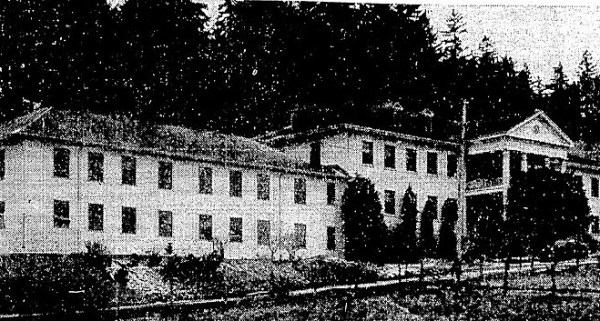
“The City of Portland opened a sixty-bed, municipal Isolation Hospital at Kelly Butte in September 1920 to house patients with contagious diseases. This hospital closed in 1960.” https://www.southeastexaminer.com/2013/05/kelly-butte/ Nick Blackbourn, 2013/
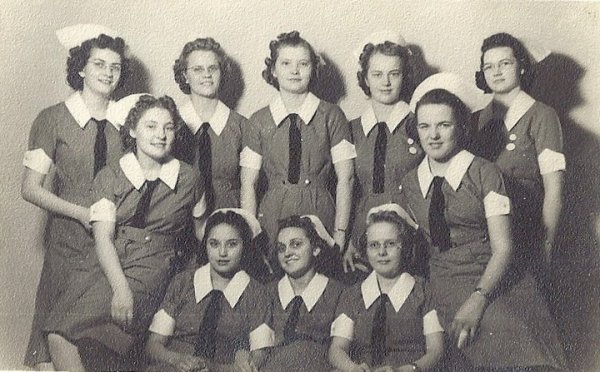
Mom as a nursing student -1942 University of Minnesota
Mom was a nurse, trained at the University of Minnesota and fortunately, she had the opportunity to train with Sister Elizabeth Kenny. Sister Kenny had developed a controversial but what proved to be an effective treatment for polio patients, utilizing exercise of affected muscles and not immobilization; in other words, physiotherapy and hot packs.
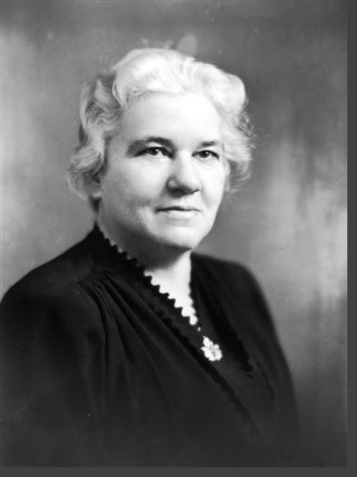
Sister Elizabeth Kenny 1880-1952
So, Mom knew what we were up against. It was possible that I might die or only fate knew how much paralysis I would suffer and how much might be permanent. Mom and Dad had two other children to be concerned with. They both were working and hospital care would not come cheap. What would they be facing financially and how could they manage a little girl of 3 years old, not yet in school, and a son who was just 7 years old and me, who needed full hospitalization?
Of course, at the time, I was not aware of any of this. I was too young to know and too sick to care. I only came to understand as an adult, just how much Kristi and Steve had to accommodate Mom and Dad’s schedules. Mom told me that Kristi and Steve couldn’t visit me so they sat countless hours in the waiting rooms while both Mom and Dad were sitting with me. Fortunately, there were Grandma and Grandpa living right around the block from us. How much did they have to sacrifice to care for Steve and Kristi and still find time to come to the hospital to visit me and keep on working. Then there was Aunt Wilma and Uncle Bob and any number of Mom’s brothers and sisters who came to see me.
My worst nightmare happened the night the iron lung was rolled into my room. If you don’t believe that a 5-year-old child can have vivid memories at that age, you are sorely mistaken. I don’t remember my symptoms other than complete fatigue. I must have had the accompanying chills, fever, vomiting, paralysis but finally, there was complete paralysis from the neck down. I remember being placed inside the machine with just my head sticking out onto a shelf with a mirror above my head. A rubber collar, attached to the machine, securely encircled my neck. My world was what I could see in the mirror. I was terrified.
As an adult, I was baffled how my parents could have made the decision to place their little child into one of these monstrosities. How could one decide that this would be better than death? To me, it is a kind of death. I would never choose to live inside of a metal apparatus with caregivers changing my diapers or having a complete colostomy and catheter. Opening the iron lung to physically care for the patient, meant that the moments when the machine was not working were moments of sheer terror. Dying of suffocation is desperately terrifying.
I don’t know how it happened but I suddenly started to recover some of the use of my body and my ability to breathe on my own and out I came. I was saved, by I don’t know what, from a life in the iron lung. Eventually, new ways were developed to help people with paralysis breathe. But, I may have, could have, spent many years in there. It is unthinkable to contemplate a life where I would be unable to play outside, feed myself, to play with toys, or read on my own or write… unable to run, climb, to make love, to have children, to drive or ride in a car, to travel or anything else you might think of.
Though I was released from a life of incarceration, I spent, from what I remember Mom telling me, three months getting well in Providence Hospital. I spent Thanksgiving in the hospital and Christmas too. I became a bit of a hellion from what I understand. I could hear and see some of the other children, who were not as sick as me, tearing down the hallways in their wheelchairs. I wanted to do that too and as soon as I wasn’t so tired, I was doing my share of racing. I remember Thanksgiving dinner. No one came to eat with me and the hospital food was not to my liking. I hated the peas and the gravy. I began to spin my tray on the table until my plate flew off sending my dinner flying. Though I was sick, the nurses were none too pleased with me.
At Christmas, Dr. Marxer, who I grew to love, let me go home for a few hours. I remember Mom and Dad coming to get me. They made a bed in the backseat of the car with blankets and pillows and all kinds of stuffed animals. When we got home, they carried me into the house and I laid on the couch with Gypsy our dog lying on my feet the whole time. I got to be a part of the celebrations with aunts and uncles, Grandma and Grandpa and Steve and Kristi doing all sorts of things to make me happy. It was terrible when Mom and Dad had to take me back. I couldn’t have been more distraught. All I wanted was to be with my family but I was tired… too tired to even eat.
The days went by slowly in the hospital but I had lots of visitors and regular time in the therapy pool. Eventually, all of my muscular strength returned and the only effect was that the right deltoid completely atrophied. When I was ready to leave the hospital, Mom kept up the physical therapy with me lying on the kitchen table and there were regular visits to the therapy pool and visits to the doctor. I do not remember how long I had to wear a brace that held my arm up and out in front of my chest, but it was too long, as far as I was concerned. I can still see it, abandoned in the basement hanging from a post. I hated it. It made me different from the other kids and I felt awkward. But I had to wear it until the surrounding muscles supported my arm and held it in place and kept it from popping out of the shoulder joint.
The only photograph that I have of me with my brace. I’m in the plaid dress and glasses; 1954
Mom and Dad refused to treat me special. I was expected to participate in family chores and there were no excuses that were accepted. Many nights I cried at the dinner table because they would force me to eat with my right hand. They also made me brush my hair and teeth with my right hand.
I had begun tap-dance lessons when I was 2 years old and soon after returning home, they commenced once again. Then, there were 12 years of ballet. I played soccer and softball. I rode bikes and scooters and I skated all around the neighborhood. I played the clarinet and bass clarinet in the school band and orchestra, playing at games and marching each year in the Rose Parade. I ran around just like any other child. I remember kindergarten, so I must have been able to return to school before the end of the school year.
I used to have photographs of me as the March of Dimes poster child. I was wearing a purple and yellow dress with pearl buttons. I was posed with a famous actress and two monkeys in front of TV cameras. Those posters were never published. Most March of Dimes posters showed children in leg braces. Maybe with only an arm brace, I was not pitiful enough to draw the sympathy of the public.
By the time I was 13 years old, my muscles could no longer hold my arm in the joint and I was repeatedly running into the house in excruciating pain for Mom to put it back in the joint. The doctor finally said that there would have to be surgery because it would continue to get worse. But this is a subject for another story.
So, back to Aunt Wilma and the letter.
Aunt Wilma, by all rights, was a wild child. I want to honor her memory so I won’t go into great detail about her personal life, but what I will share with you is common knowledge to the world and to me. She drove a black chrome-encrusted Ford Fairlane. The back floor was covered in candy wrappers and coke bottles. She’d rather eat Chinese food than anything else and she worked at the bowling alley by my grade school as a soda jerk and later tended bar.
Aunt Wilma could jitterbug like no one’s business, skirt flying up around her head as her partner swung her over his head. She had trophies for swimming, bowling, softball, and I can’t remember what else. She could hunt and fish and swam with the sea lions with Dad and Grandpa out in the ocean. She loved to camp and she loved the family. Sometimes on the weekends, she’d take us kids to her bowling tournaments and it felt like we were traveling across the country. When we asked her where we were going, she’d say Timbuktu. We knew we’d get candy, hamburgers, milkshakes… sometimes all but sometimes just one or the other.
I thought Aunt Wilma was the best thing that ever happened to me, except for Grandma. She was so athletic, so well dressed, so gregarious, so much fun. There was always a bit of a feeling that we were being naughty but Aunt Wilma made it O.K., gave us permission to be a little naughty. I didn’t learn until much later that Aunt Wilma was naughty. At 5 years old, I didn’t even know then all the fun that she could be.
When we went to her house, she put us to work folding clean laundry, dusting and doing dishes. She was too busy having fun for these mundane chores. One time, Kristi, who was probably 4 or 5 years old, was standing on a chair at the sink, scrubbing a double sink full of dishes. As Auntie Wilma walked by, Kristi said, “You work me to the bone”. Aunt Wilma swooped her up and took her straight out to the car without a word and drove her home and didn’t have her over for weeks. Kristi was shocked not really knowing the extent of the truth she had spoken.
So, Aunt Wilma lived dangerously. She was an expert flirt and as she aged into her 30’s and 40’s she wanted to wear our clothes and embarrassed us no end with our boyfriends. Having male attention was an important aspect of her life. I think I have said enough to illustrate why I have questions about this letter.
Her lifestyle does not preclude her religious beliefs. I don’t doubt that she believed in God. I am sure that she was sure that she might be dead or worse except for his intervention, and if I were a believer in a god that intervened in our day-to-day activities, I would say it was so.
So now we come to the letter. Just exactly what does this suppose to mean? “Grandpa and me were so happy and having such a good time and never thought anything could happen, so God thought we needed to be taught a lesson. He didn’t want to hurt you, so he just made you sick.”
God punished me because Aunt Wilma and Grandpa were so happy? Doesn’t it sound like she felt guilty about something? Doesn’t it?
I have transcribed the entire letter except page 13. That page is missing and I am sure it will never be recovered. This makes me sad but the letter is old, it has traveled with me and has been stored precariously for nearly 7 decades. Could I be the only one to think that at least that one statement on page 14 is curious?
Read on and tell me what you think.
1/ Hello Karen, I hope that you are not mad at me for not coming over to see you, but I have had a cold and I don’t think the doctors and nurses would like me to bring that to you. All the other little girls and boys in the hospital
2/ with you might get more sick. I want you to get well fast so I don’t want you to catch a cold from me. Santa Claus said to get well fast so you could see him when you come home. He’ll probably wait till you
3/ get there to come to bring presents. If he does have to go back to his home so Kristi and Stevie won’t break them and your momma can keep them for you. Maybe he’ll bring them to the hospital.
4/ I don’t know, I think you will be home by then though. Gee, I sure hope so. You do everything the doctors and nurses tell you to and maybe you will be. My house is so dirty. I can’t get it as clean
5/ as you do when you help me. You’re such a big help and can do so much I can’t hardly get along without your help. But we’ll make up for lost time later. Your momma keeps telling me how
6/ you are and what you do and say and about the things people send you. I think that’s real nice and you are right when you say that all hospitals are nice. Because if it weren’t for them, you might never get well.
7/ We both know that God is in there with you just to watch and make sure you and the rest of the boys and girls like you will get well and get what they need to make them well.
8/ I tell him every night what a good girl you are and all the good things you’ve done and to help you all he can. And if anyone can make you well faster, it’s him, so you talk to him too, ’cause He’ll hear you
9/ and help you more than any of us can. He talks to the doctors and nurses and tells them what to do for you, so you talk to him all you want. When you get lonesome, don’t cry, just
10/ pretend he is right where you can see him and talk to him, then you won’t be lonesome ’cause you know He’s with you and that is the best company in the whole wide world. That’s what I do when I’m
11/ lonely, so I know God is always with you, honey, but you can’t see him. He hears everything you say and sees everything you do Even when you sleep, He’s awake to watch
12/ and see that you are all right. Sometimes you will wonder why you should be sick if God is supposed to take care of you. Well, He didn’t do it because you were naughty or because he was mad at
13/
14/ Grandpa and me were so happy and having such a good time and never thought anything could happen, so God thought we needed to be taught a lesson. He didn’t want to hurt you, so he just made you sick. That
15/ is how wonderful He is. So you talk to Him and tell Him anything you want to. People don’t talk to Him just at night before they go to bed. Anytime you want to talk, He listens. Even if you want to tell him a secret, and you want to whisper it, he’ll still hear you. Isn’t that going to be a lot of fun to know that you aren’t ever going to be lonesome and will always have someone to talk to? You try it and see. It sure helps.






 eyeamdust