The Mountain Hare Hat: what a challenge.

What am I working on now, you might ask. Well, I’m working on my frustration and trying for patience and acceptance. Let me tell you why.

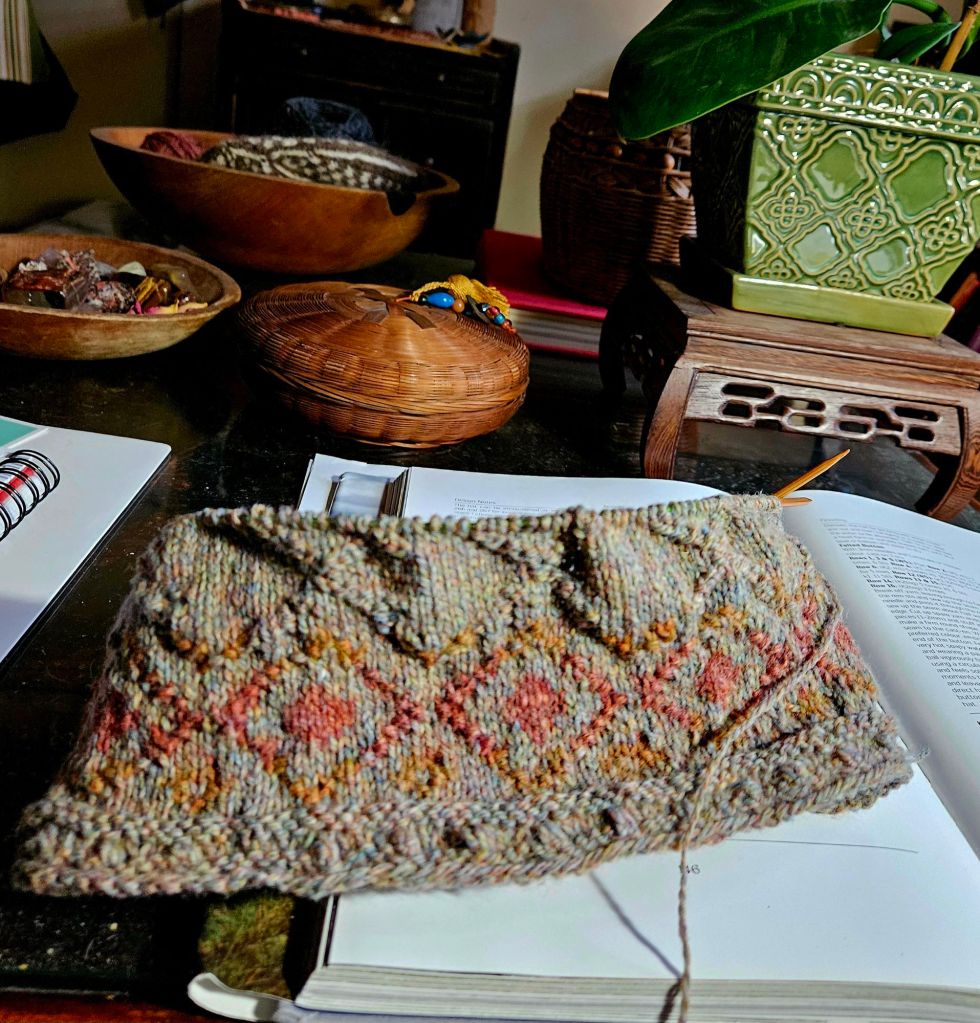
This is Alice Starmore’s, Mountain Hare Hat featured in the publication, “Glamourie”, by same said author. It’s quite a substantial hardcover publication with 278 pages, containing 11 knitting patterns and 7 costumes and stories illustrated to go along with the patterns.

I’ve had my heart set on making this hat since I saw it online years ago. I purchased the kit and borrowed the book from the library. But that wasn’t good enough. I had to buy the book even though I knew I wouldn’t be making any of the other patterns contained within.. But it’s just a glorious book and worth having in one’s own library. The photographs and the stories are enough in themselves to justify the price. The price is substantial but like I said before, worth having.

I knew when I bought the kit, and contemplated, making the hat that it was not a beginers level pattern. But I was just over the line of a beginner and had been knitting sweaters and mittens and hats and shawls and scarves and socks, etc. There were always expected challenges in everything that I knit., but this pattern is kicking my ass.

The kit came with the yarn only and no pattern attached, which is unusual, but I bit the bullet because I was so in love with the hat. The yarn is Alice Starmore’s Hebridean, 2 ply. The colors are well named pebble beach, corncrake, driftwood and sundew. It was the colors that drew me in and the one of a kind design. The yarn is rustic and the hand dyed colors are taken from nature.

So what could go wrong? Everything, it seems, from cast-on to working with the chart. I started and ripped out at least 4 times before I put the pattern, the book and the dreaded object aside. I was worried that knitting, and then ripping it out too many times would ruin the yarn. For some reason, I left it sitting out on my baskets of yarn and it bothered me, it bothered me bad that I couldn’t get it done. It wasn’t the pattern’s fault, nor was it the yarn’s fault… there is only one other thing to blame and it is me.

So, after I finished christmas knitting and the new year celebrations had come and gone, I decided to start on the Mountain Hare Hat once again. I tore out what I had already started and left abandoned and wound the yarn into balls. Then I made my first mistake.

I started my cast-on with the larger needle size and it was supposed to be the smaller needle size indicated in the pattern. But by the time I realized it, I was through with the brim. The next mistake was that I thought that it would be alright. Well, as you can see, it’s not alright. As I began on the body of the hat, the brim gave kind of a flare. Dammit, I’m not going to tear it out again. I’m going to just keep going.

In the brim are a row of french knots. I was supposed to make them with a contrasting color but after the first few knots, I said to myself, f*** it. I was following the instructions, but somehow the knots were ending up on the inside of the brim. So not only are they not the right color but they’re on the inside of the cap. But I quickly convinced myself that I can push them through. They’re not happy about it, but I think I can do a little fixing to make them stay on the right side.

So, “soldier on”, said I to myself. I’m not ripping this out again. At this point I decided that, make all of the mistakes that you will, but I will not rip back. Sure, I will “tink” back if I’ve made a knit stitch where I should have made a purl stitch, but I’m not ripping back for anything. I will finish this hat and wear this hat, be it a big fat mess or at least acceptable.

So, as you can see from the image, it’s not a big fat mess, but it’s barely acceptable. I’ve tried it on and it fits great. In spite of all of these problems that I’m having with this pattern, I’m having fun. I am what they call a process knitter and not necessarily a product  knitter. Maybe when I’ve finished, and I’ve blocked it, some of the mistakes will be buried by this beautiful yarn.

I still have a long way to go. I’m only on row 27 and there’s upwards of 60 some rows, then there’s all the french knots to make throughout and the finishing touch of a felted button at the very top.

I’m determined to go on no matter how many mistakes I make. When I finish, I will post a photo of it.

My moniker isn’t “abundant imperfections” for nothing.
This Quilt Deserves Better

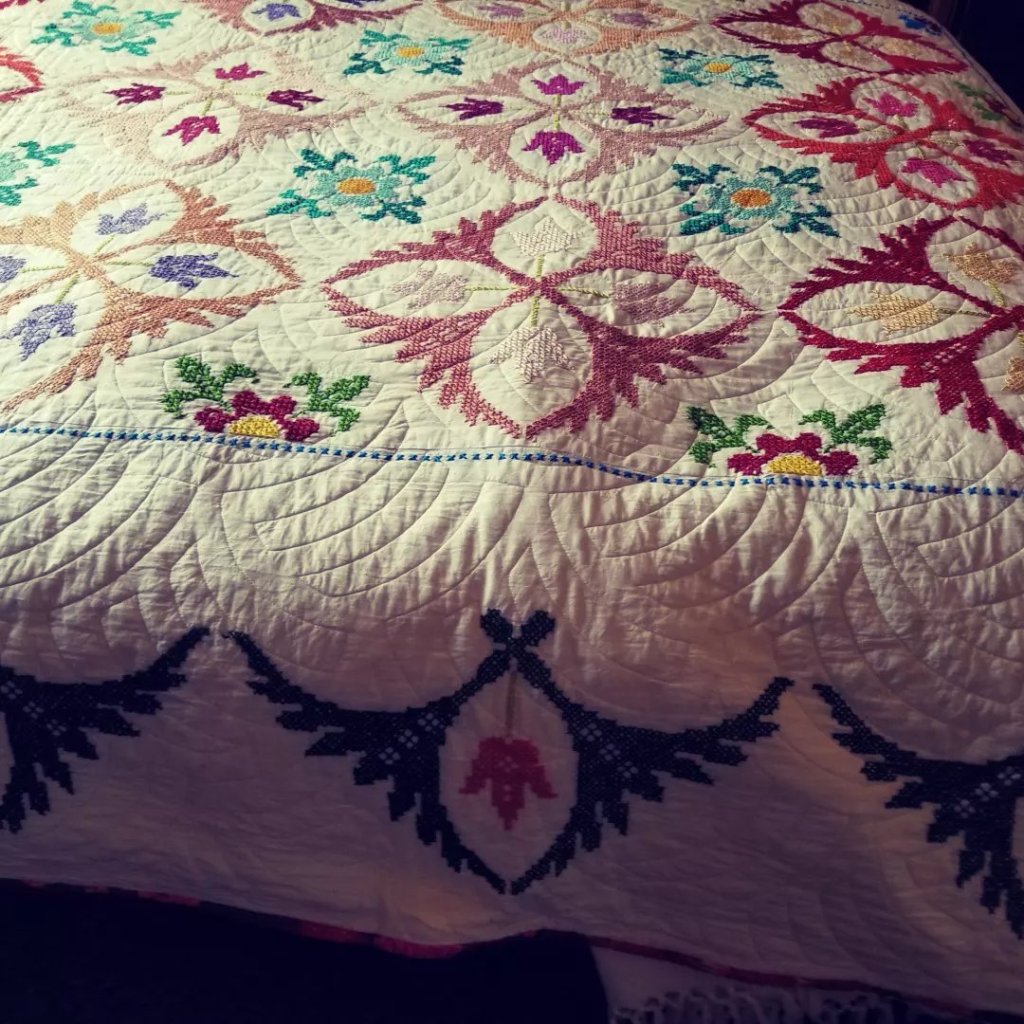
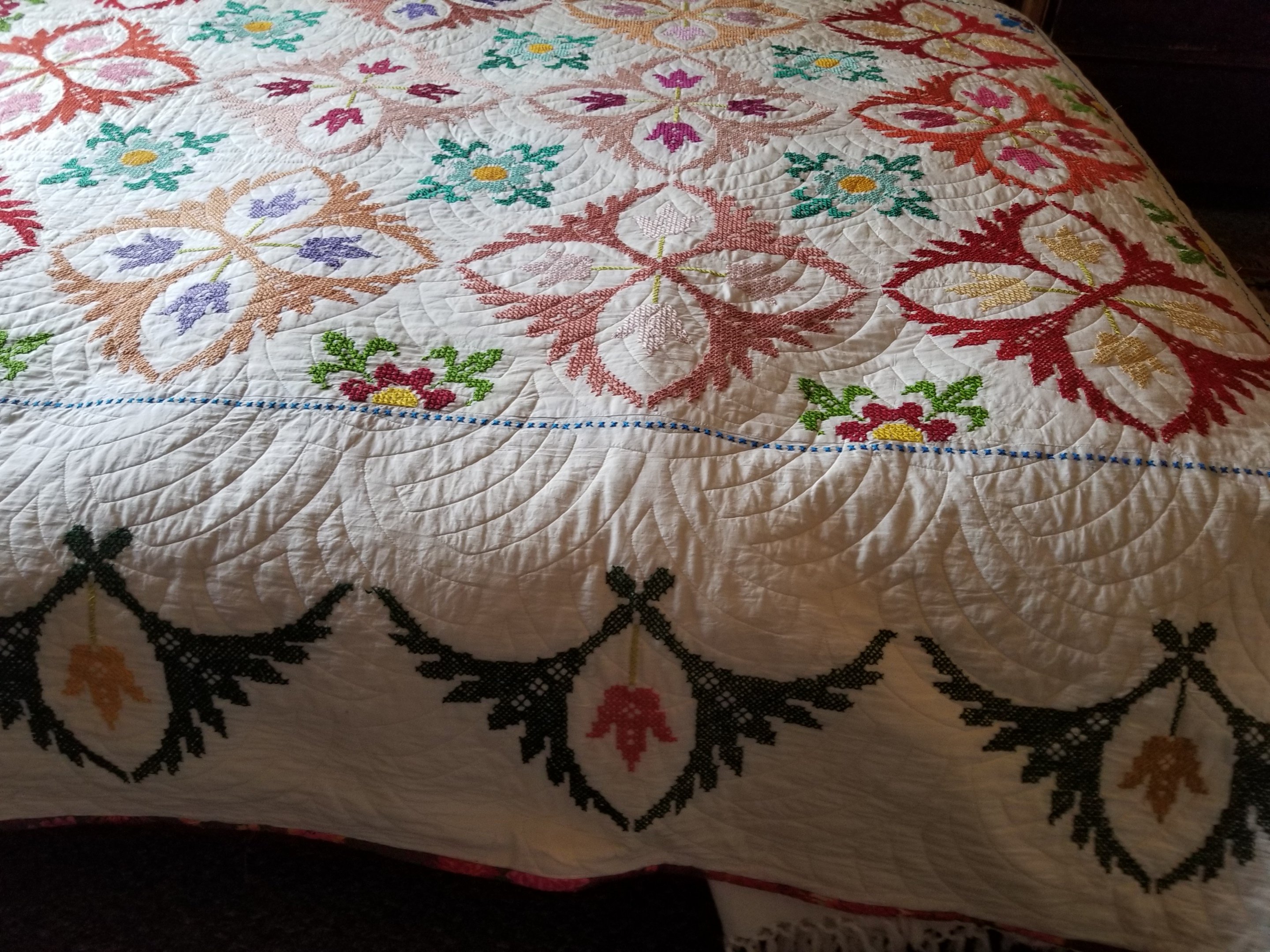
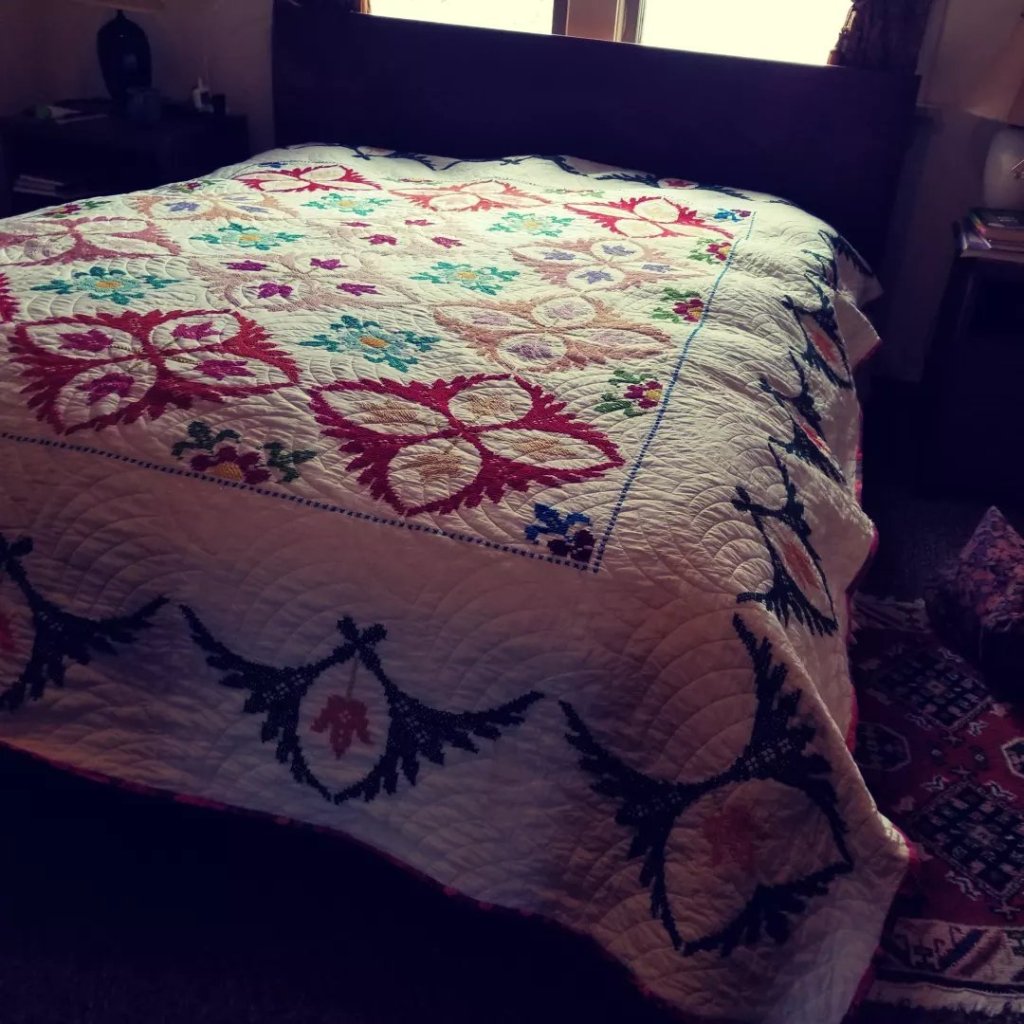
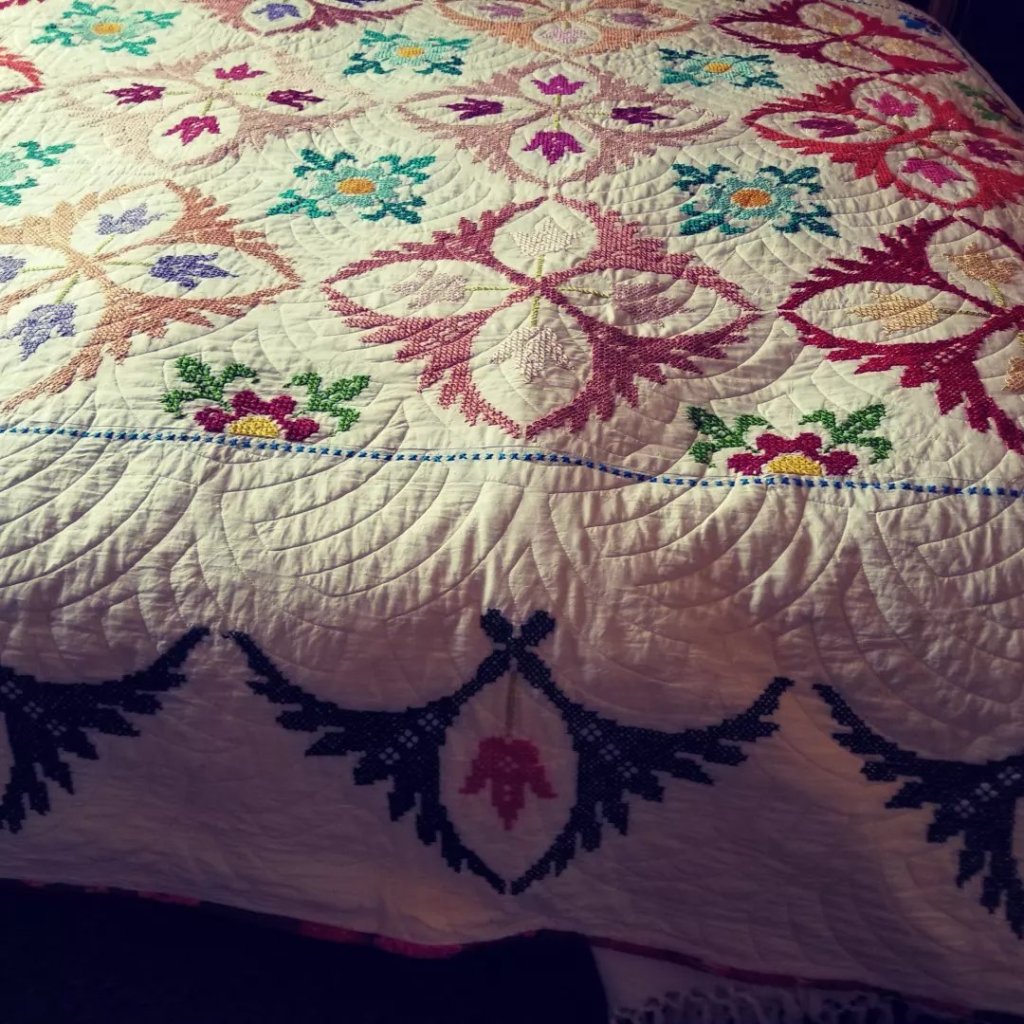
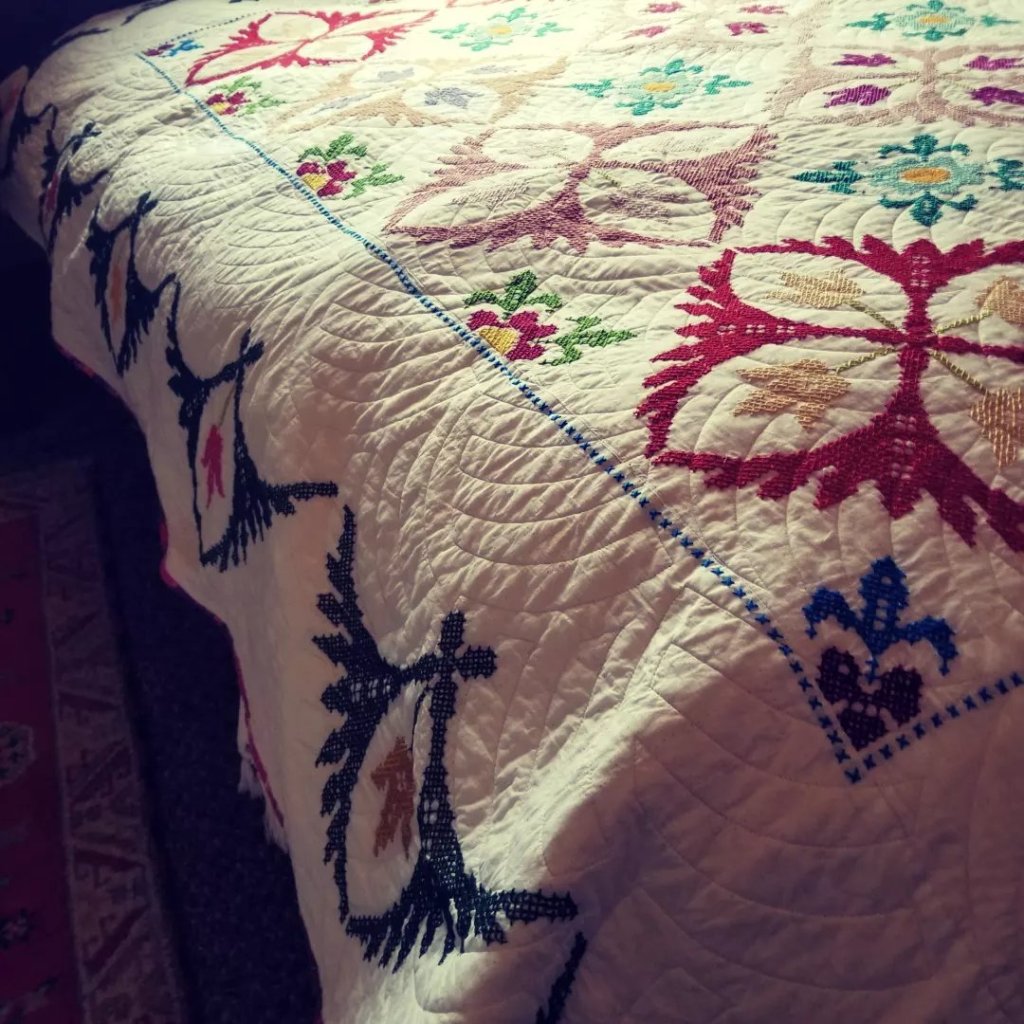
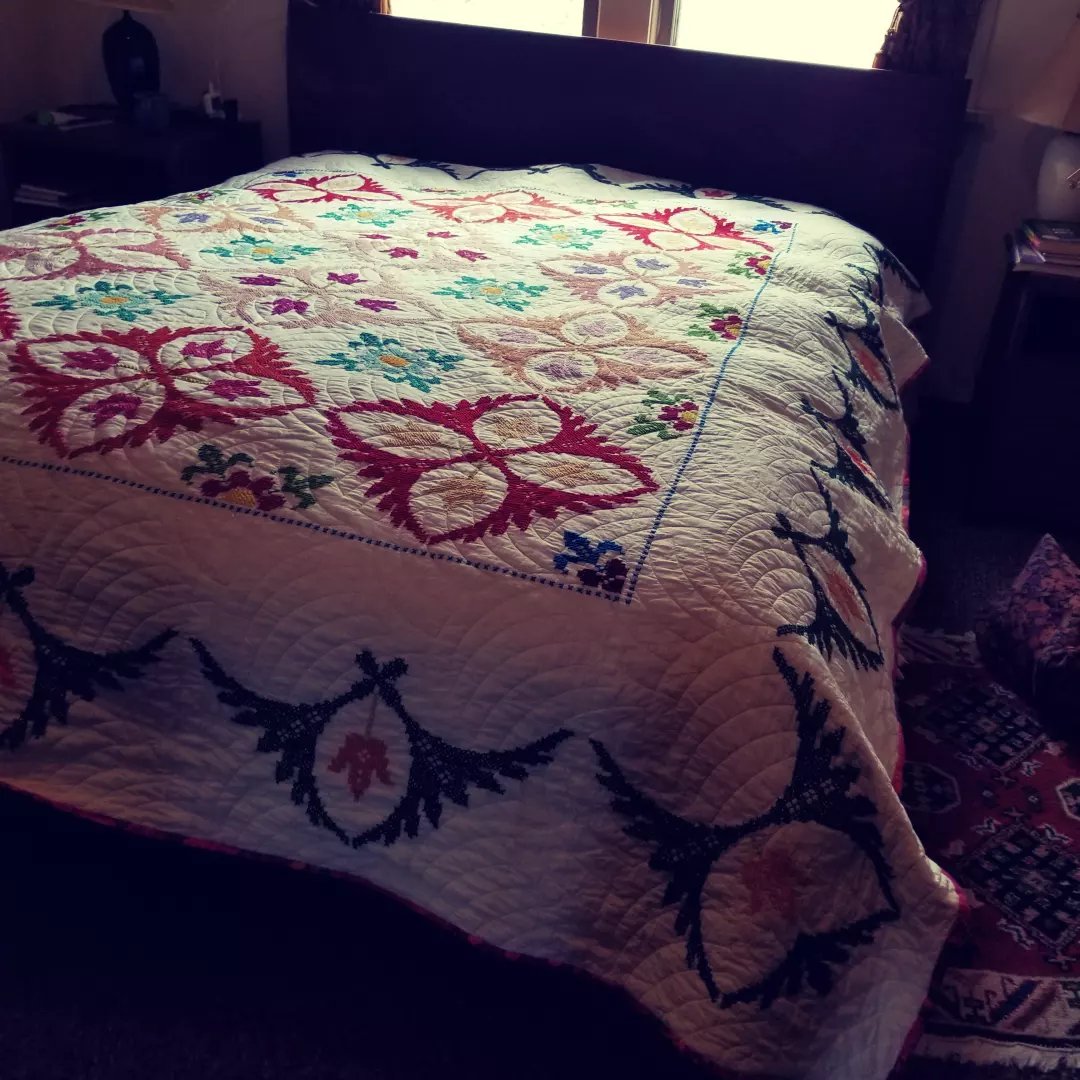
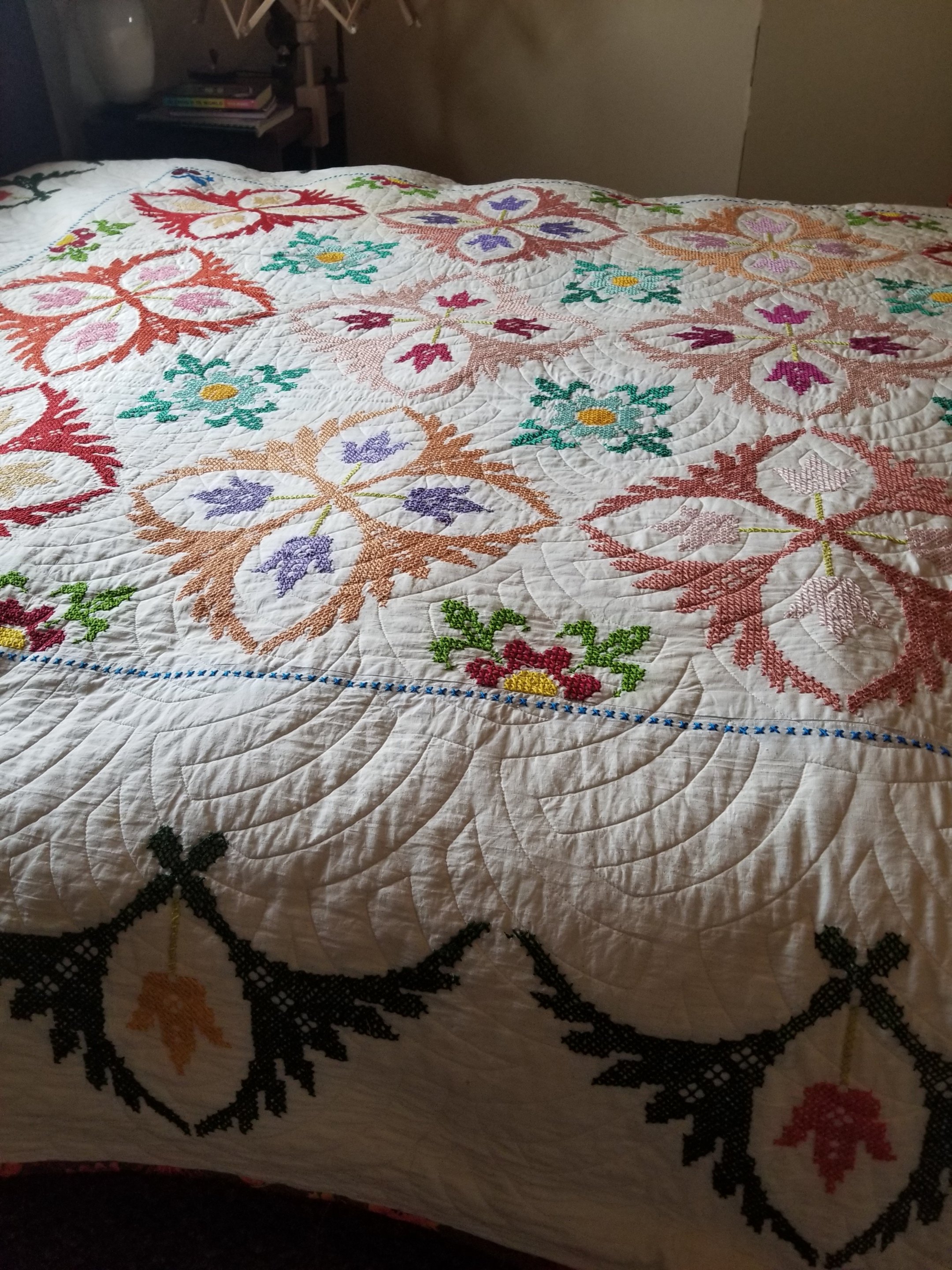
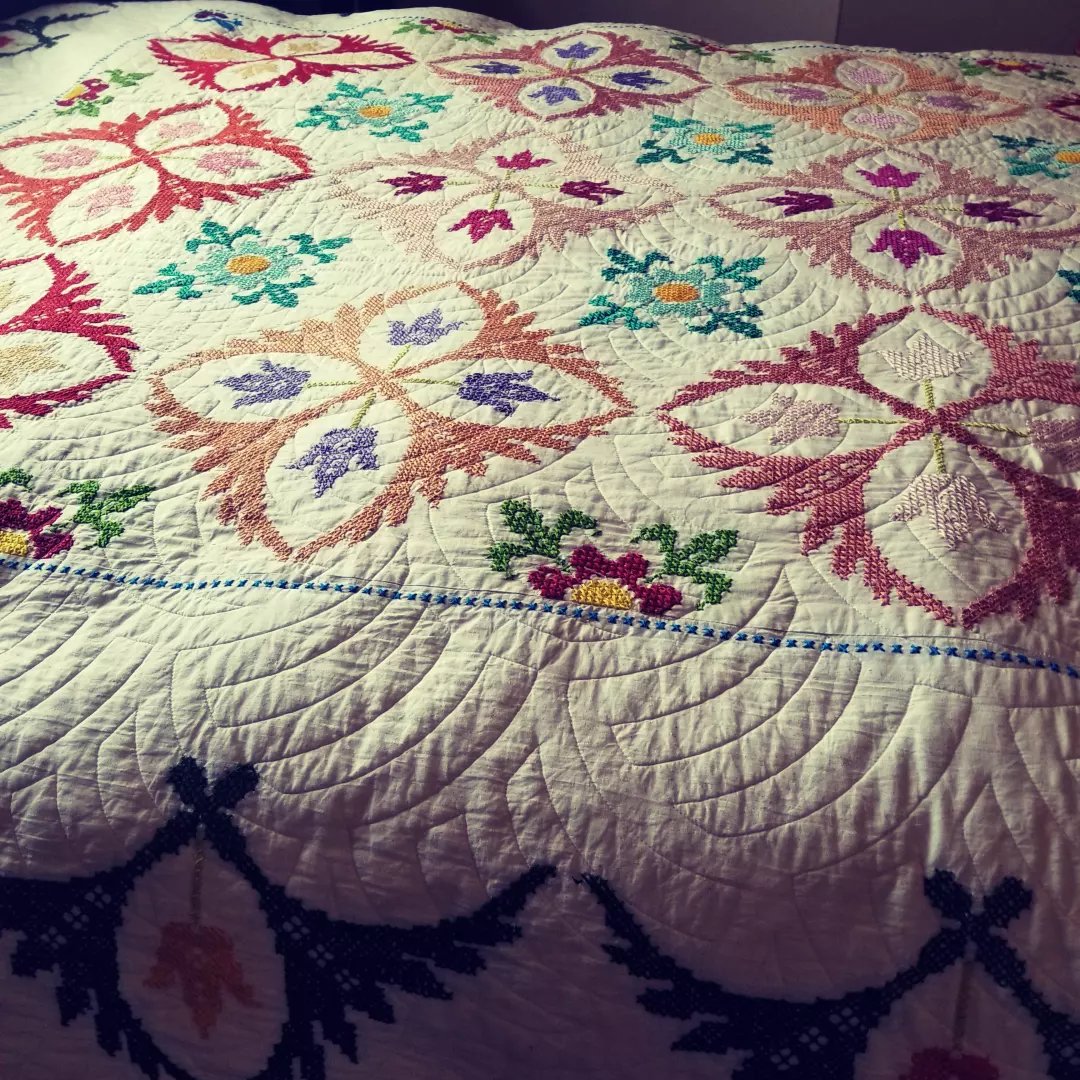
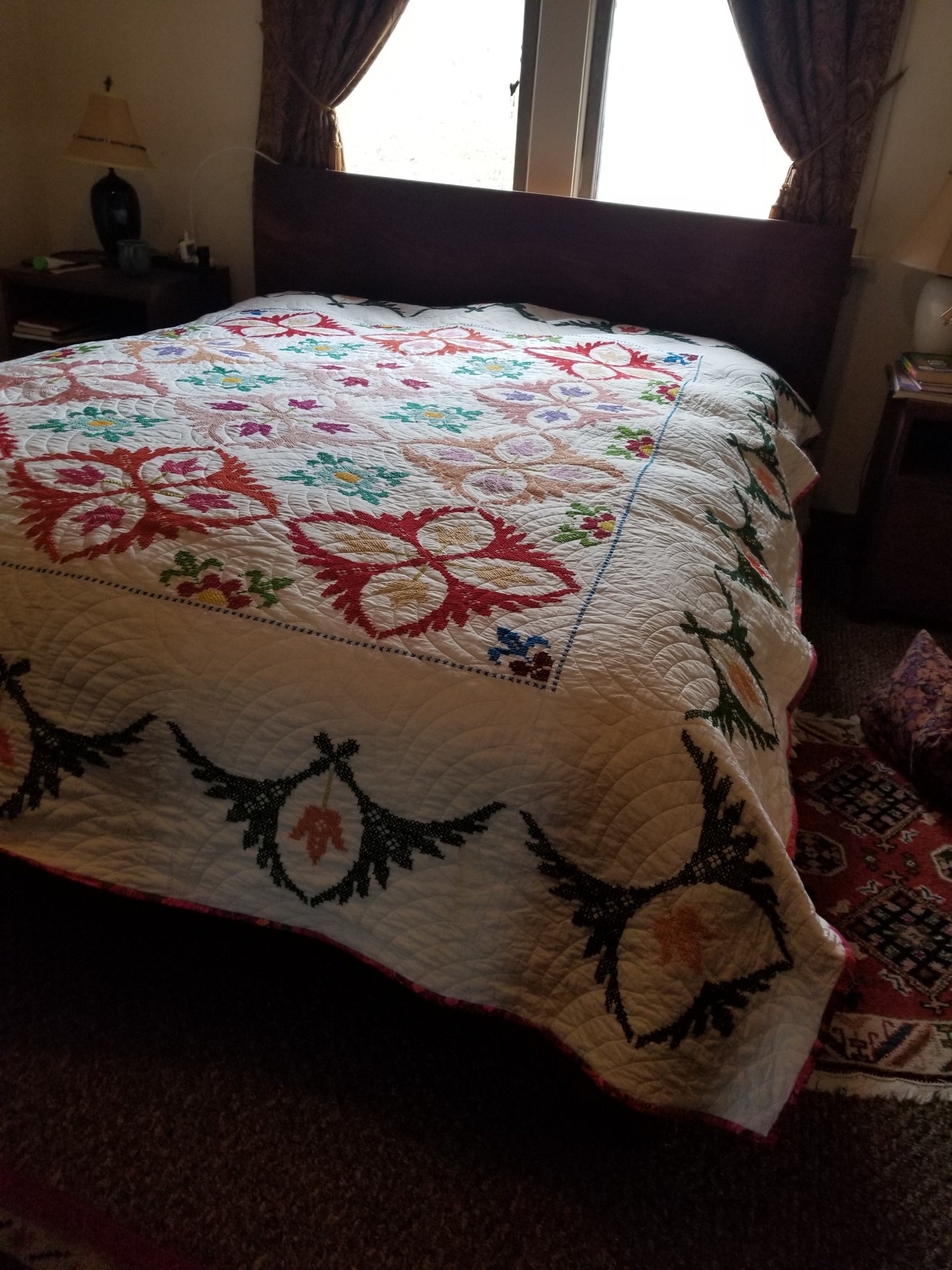
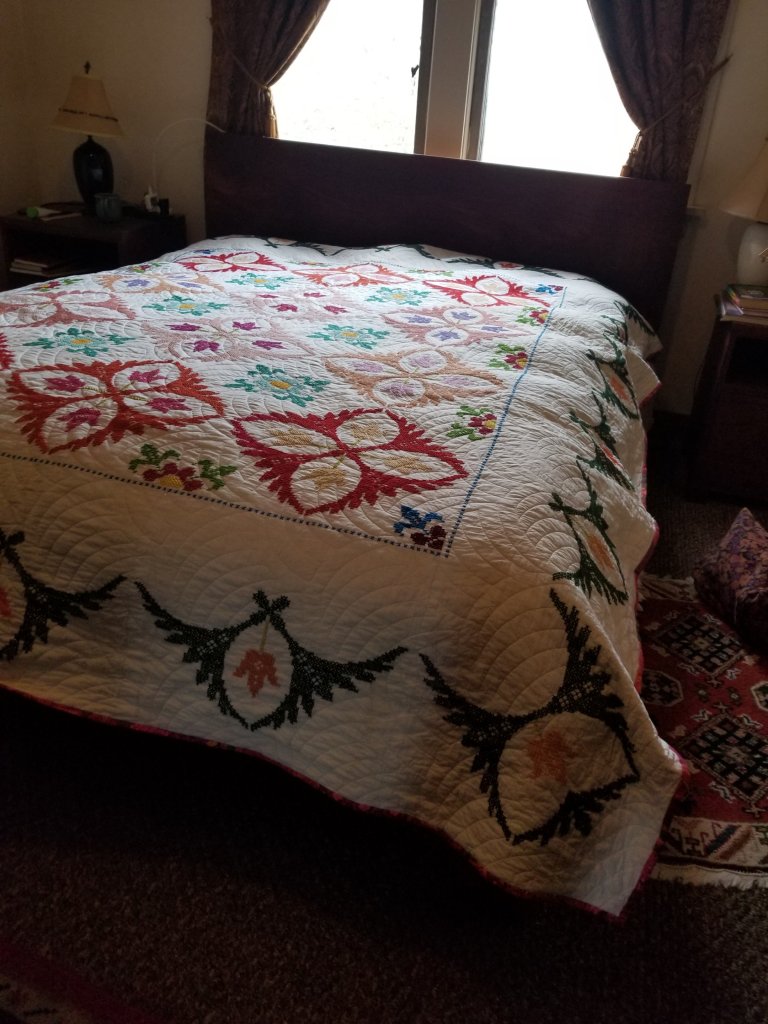
You know, this crosstitch quilt took 40 years and more hours to create than you could ever imagine. I loved every minute of those hours.

There were years when it languished in a closet, partially completed, while my life was filled with family, going to school, traveling, and other obligations. But it was always there, waiting for me to come back to it.

Now that I’m older, crafting is what I do. It’s all that I do. I do it for joy, peace, and the satisfaction of creating something beautiful. While stitching, be it crossstitch, crochet, crewel work, knitting, bookbinding, or tapestry, I forget about the troubles that face me, that face us in this incredible yet troubling world that we live in. Podcasts, audio books, documentaries, travel vlogs, and the like fill my days while I craft.

Beyond the stitching, however, there was the cost of taking the quilt to the “long arm quilter.” By the time I finished the cross stitching, I was not inclined to hand stitch a queen sized quilt. Three hundred dollars was a small price to pay.

For those of you who don’t quilt, you may not know what that is. A long arm quilter is a person who owns a very large, almost room sized machine in which they can feed a quilt of almost any size. That machine is connected to a computer on which many patterns are programmed. A pattern is chosen, and off it goes with the expertise of the long armed quilter. For those of us who quilt, it is a marvel.

At that point is when the long arm quilter saved it from more time sleeping in the trunk or closet. I had started to quilt it by hand, but after months of working on it, I realized that the task was too daunting. I just wanted it to be done. When I got the quilt back a week later, I then hand stitched the binding. It was finally ready to use.

But, by this time, this quilt is so precious that I can’t use it on my bed… Only because I have two cats and a dog that often share my bed. Claws, hair, and dirt would most likely destroy it.

So for now, it’s folded and safely sits on my ottoman with a pillow on top where Fran Ham, the cat, loves to sleep. I can only enjoy the parts of it that peek out from underneath.

Beautiful quilt. You deserve better.

The Quilt

This cross stitch quilt is spectacular and it only took five decades to complete.

The quilt is made by making millions of tiny cross stitchings that I started sometime in my 20s and continued into my 30s. All the while there was home, children, work and gardening, weaving and spinning, macrame, sewing and crochet. There were births, helping with school projects and homework and driving to soccer and baseball games, picnics and family reunions. And then there was moving… from Portland, to Estacada, to Lacey, to Whibey Island, to Washogal and Home Valley, then back into Portland.

But all along, the quilt stayed with me, patiently waiting. The children grew and moved away. Finally, in my 40s and 50s, I started the hand quilting but then I started to knit, as well. Then there was the divorce and new relationships. There was years of University and moving to Florida and California. And the beginning of my career. Once again, the quilt was all but forgotten. But I kept it, and it lay dormant, waiting.

Once, I accidentally tipped a cup of tea off the table into the basket sitting beside my chair, soaking into parts of the quilt. That’s when I almost gave up on it. I thought it was forever ruined. I couldn’t wash it because the pattern was not indelible. The ink would wash out leaving me without a guide. But I couldn’t destroy it or even give it away. So, I put it away while getting my BA and my MA and even started and finished my career.

Finally, in my late 60s, I picked up some quilting hoops and worked on the quilting some more. I set up the hoop stand in the living room where I looked at it every day. The quilting thread and needles beside it and I spent some brief hours working on it. But I somehow knew that sewing tiny running stitches to cover the entire queen sized quilt would never be done. It was discouraging. It was so beautiful, I just couldn’t give up on it.

I was now in my my 70s. I had worked on it and carried it everywhere with me for five decades and I was in danger of never finishing it. It didn’t help that I was developing arthritis in my hands. In the end, would it remain unfinished? The thought saddened me.

Luck was with me, however. Crafting podcasts and vlogs became a thing. I watched them constantly while I knitted. I had my favorites but once, by the recommendation of other crafters, I came across a woman who lived on the English border with Scotland. Her blog, Kate of the Last Homely House, a reference to Tolkien’s, “The Hobbit”, became a favorite of mine. Anyone who loves Tolkien is a friend of mine.

After her mom passed away, Kate was left with boxes of unfinished patchwork quilts that only needed the quilting to be done. It was then that she mentioned Kat, a long arm quilter, who lives in Scotland, who she would employ to quilt her mother’s quilts. What is this, she says? Could I find someone near me to finish mine? I had no idea. I had no clue as to what a long arm quilter was.

It took only a simple Google search to find a few long arm quilters in my area. I called one of them and made an appointment for the very next day. I packed up my tea stained quilt (the stain had faded over the years) and entered the world of long arm quilting. The machine is huge and nearly filled the entire workshop. It’s connected to a computer whose software programs a multitude of designs to choose from. I showed my soon to be savior my “art piece”, chose a design and I said, “f***k it”, when I accepted the $300 quote with ease. In two weeks, voila!, I had my beautiful finished quilt in hand.

But wait! It still wasn’t finished. A quilt consists of three layers. The top, the batting, or the fill, and the backing. The four raw edges of these layers need to be bound. Would the quilt now languish once again? No. Not this time. I was inspired by already having paid for the quilting and its beauty.

Some months ago, I bought the fabric for the binding, I made the binding, machine stitched the binding to the front, then, I finished it by handsewing the binding to the back.

I washed it in the clawfoot bathtub, hung it to dry and here it is in all it’s glory. The stain is still visible if you really look for it but that doesn’t bother me at all. As an archivist, I see every part of this quilt as evidence of its journey to the present. I wouldn’t change a thing.

The only problem is, now that it’s finished, what shall I do with it? I can’t leave it on the bed because the dog sleeps with me and she’s got dagger claws. It wouldn’t take long for it to be ruined.

Shall I just fold it up and display it on the end of the bed or should I figure out which wall I could hang it on?

Besides that dilemma, I am really over the moon, and all the stars, that it’s finished. For now, it hangs out on my foot stool where I can enjoy it all day long, every day. It’s already almost an heirloom.

The Magical Life of the Quilt

This cross stitch quilt is spectacular. It only took four decades to complete.

I finished the cross stitching in my 20s and 30s, all the while there was home, children, work and weaving and spinning. In my 40s and 50s I started the hand quilting and started to knit, as well. I put it away while getting my masters degree and started and finished my career.

In my late 60s, I picked up some quilting hoops and worked on it some more.

In my 70s I said, “f***k it” and took it to a local long arm quilting shop and… voila!

A couple of months ago I bought the fabric for the binding, I made the binding, machine stitched the binding to the front, then just two days ago, I finished it by handsewing the binding to the back. I washed it in the clawfoot bathtub, hung it to dry and here it is in all it’s glory.

The only problem is, what shall I do with it? I can’t leave it on the bed because the dog sleeps with me and she’s got dagger claws. It wouldn’t take long for it to be ruined.

Shall I just fold it up and display it on the end of the bed or should I figure out which wall I could hang it on?

Besides that dilemma, I am really over the moon and all the stars that it’s finished.