
Dad grew up loved in a two bedroom house with Grandpa, Grandma and a beloved but wild, younger sister, Wilma. They lived happily in working man’s St. Johns, the northern most part of Portland, heating the cozy house with coal and surrounded by Grandma’s carefully tended gardens. They were a part of a big, sweet, close-knit family that spread out from Portland to Rainier.
Grandma’s nine sisters and brothers and her mom and dad, Ida Belle and Egbert Womack, came out to Oregon from Kentucky before the turn of the century, traveling the long distance by train. Great-grandma was the grand-daughter of one of Kentucky’s infamous plantation owners. They said of him that he was as kind to his slaves as he was to his race horses.
Great-great grandpa’s enormous house slave was a favored character in Grandma’s stories of her childhood. The stories of her past were my favorites; I could see the people and places in my mind’s eye as if I’d been there. My memory has faded and I lament that I can’t remember her marvelous name, but I remember that she had twelve children. Grandma and her siblings would dance around her, pulling at her skirt and the ties of her apron as she washed their laundry, begging her to recite all of their names, names that were strange to their ears. Ethelile is the only one I remember. When she tired of their foolish game, she’d holler, “Get out of here or I’ll grease you with this bar of soap and swallow you whole.” Even though they loved her, they believed she would swallow them whole. They’d scatter out of her reach only to return later to madden again like a bunch of yellow jackets on a picnic ham. Tobacco had made her grandpa’s fortune.
Grandma said all the kids cried all the way to Oregon, heart-broken to leave their grandma and grandpa and their favorite nanny. But after a long journey, they arrived at their destination, Rainier, Oregon, located on the mighty Columbia river. There they set up home on some acres in the barely settled territory.
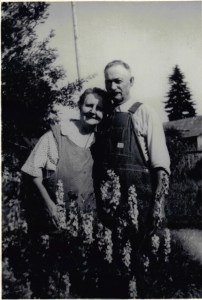
Logging and saw mills were a way of life then in the verdant Pacific Northwest. Young men worked, felling virgin forests with gigantic handsaws and using big chains to pull trees by horse and oxen to the river for transport. Grandma’s young brother, Gilbert, lost his life dancing on a log jam on the wild Columbia.

After finishing school, Grandma became a phone operator and eventually met Grandpa, a cooper. When I knew Grandpa, he died of a stroke when I was still young, he was missing parts and whole fingers on both hands. The huge saw blades in the wooden barrel mill took many fingers, hands and arms of the men that manned them and sometimes would take a man’s life.
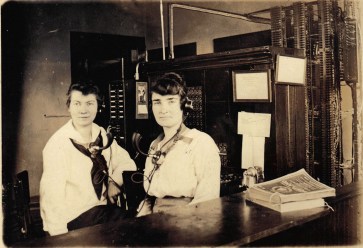
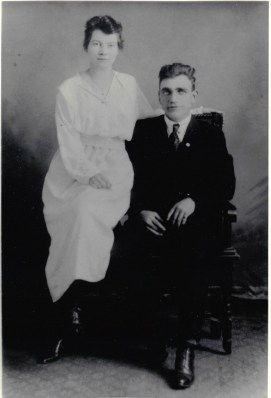 The two of them, Edward and Jessie, moved to St. Johns many years even before the beautiful bridge was built. After Dad was born, they lived on Leonard St. until dad was four or five.
Dad watched Theodore Roosevelt high school being built. His black lab followed him in his wooden wagon around the block to watch the men at work. 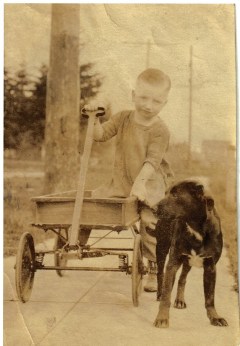
Dad passed through James John grade school and graduated from Roosevelt, that lovely school building he witnessed appear from the ground up. He was a letterman, a dancer, a joker, he loved the girls and he was a good son.
They moved from Leonard to Jersey St., just a few blocks away, where Dad and Aunt Wilma grew up in their tiny house with the lovely garden. Grandpa converted the garage into a small house that we all called the “little house”. Just about everyone lived there at one time or another. We spent many happy days in this garden.

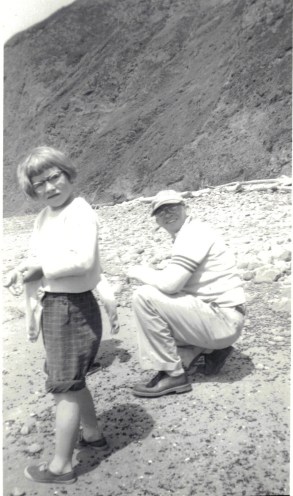
Grandpa taught Dad to hunt and fish, so a passionate hunter and fisherman he was until his dying day. As kids, we’d go fishing with Dad on slippery, muddy slopes, crawling over large, wet boulders to get to a spot on a roaring, fall swollen river for Steel-head or for spring Chinook. Or we’d be out in a boat on a lake or in the Willamette and Columbia rivers or over the bar for any salt water catch or on the beach at the coast where Dad cast his line from his largest poles. We’d wake before dawn to dig for clams at low tide. We grew up dirty, sandy, sunburned or sopping wet and freezing cold and happy. We camped in a canvas army tent, in canvas and flannel sleeping bags. We suffered mosquitoes and bee stings. We dug for night-crawlers with flashlights out in the cool night air, our shoes getting soaked as the dew settled on the grass, just so we could go fishing.
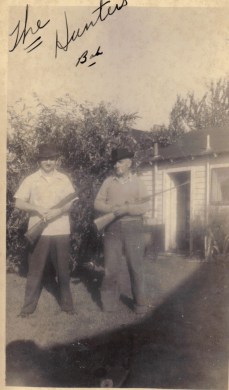


I can still smell the banana oil he used to clean his hunting guns in our living room. It probably wasn’t banana oil but it smelled like it to me. Dad was an excellent shot and bagged deer, pheasant, geese and duck. He grew up alongside his dad and his black labs.
Mom never questioned that Dad readied for fishing and hunting in the living room, though we had a full basement. Guns and fishing poles were spread out, resting against the fireplace and tables; and tackle boxes filled with lures and bobbers and line and weights and bullets and shot gun shells were common sights in our house.
After high school, Dad went to work for the Union Pacific Railroad. And then the Army called him up and sent him to fight in the Phillipines, just barely 18 years old. 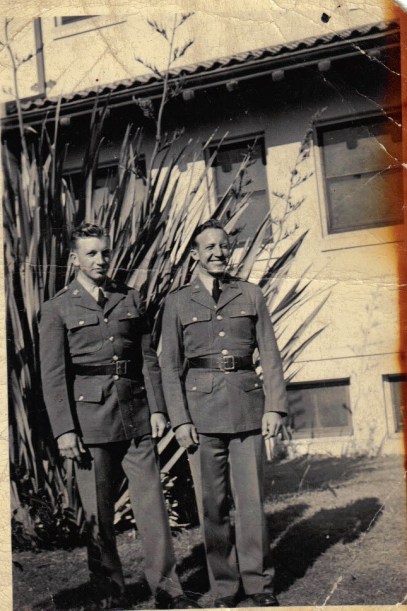
He had only one story to tell us kids and I don’t think he meant to tell us. Maybe I overheard him as he talked to some of his friends. Or maybe I asked him about the Japanese sword in the dark corner of the closet in his bedroom and the Japanese flag that was folded in his handkerchief drawer and the US military ribbons and medals in his jewelry box on his dresser. Or maybe it was the old, small book in German, covered in black leather with a hole driven clear through as by a nail that piqued my curiosity. Or was it the red bound Mien Kampf on the book shelf that caused me discomfort. I don’t know… but the uncomfortable, distressing story goes that out in the jungle, Dad came up on one side of a log just as a young Japanese soldier rose on the opposite side. With one look into each others eyes, they realized that one of them must die. The Japanese boy lost his life there. Dad brought home his flag and sword. 
After the war, Mom and Dad met, standing in line at a liquor store and were soon married and after came three children, Steven Larry, Karen Lea and Kristi Louise. You could say that we lived happily ever after until Dad was killed in a car accident at 52 years of age. Happy yes, but life is more complicated than that.
Dad loved to bowl, play golf and as you know, hunt and fish. He and Mom went out dancing. We had family vacations and loving large families on both Mom and Dad’s side. Mom was one of ten, so we had family galore with reunions and holidays spent together.
But…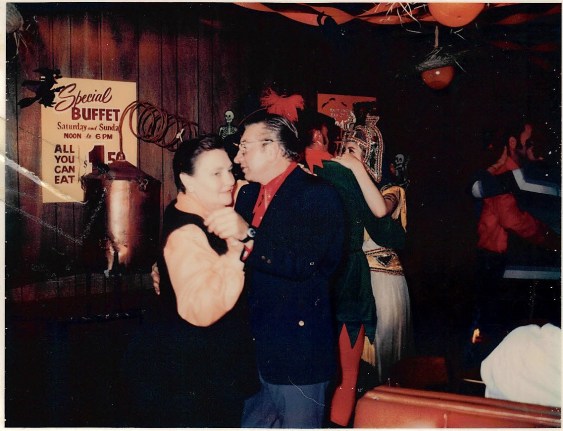
After the war, Dad went back to work again on the railroad, but not for long. He tried sales, he tried being a longshoreman, he tried a stint in the office of Acme Fast Freight, but it was pretty obvious that Dad was dissatisfied with work. We had a house, a boat, seemingly everything a family could need or want. There were some hushed disagreements. Some not so hushed arguments. Dad liked his beer and his scotch maybe a little too much. But our family stuck together like glue. Nothing was more important to Dad than family.
My memories of Dad are good. He was fun, sometimes dangerously so. He was a strict parent. He was loving. He was always there. All of these traits were good for bringing up a family. It was only after I grew out of childhood that I saw Dad as a man, separate from us, Mom and us kids, and that man was not simple, but complicated. There was something wrong. Was it the war that disturbed his peace? Was it the general absurdity of life? Was it unfulfilled hopes and dreams?
Since Dad is gone, since he left us so young, we will never know. But one thing I know for sure is that he loved us, he met our needs and we all had a short, relative post-war carefree childhood bubble… at the expense of our father’s well-being.
Though I have left out many, many stories about my life with Dad, I have written this short and insufficient tale to say you gave us everything you had to give, Dad. I love you.


 eyeamdust
Great Story, Karen. Made me think about telling my stories, but they would never be so interesting. Thanks for sharing your
dad with us.
LikeLike
Very cool
LikeLike